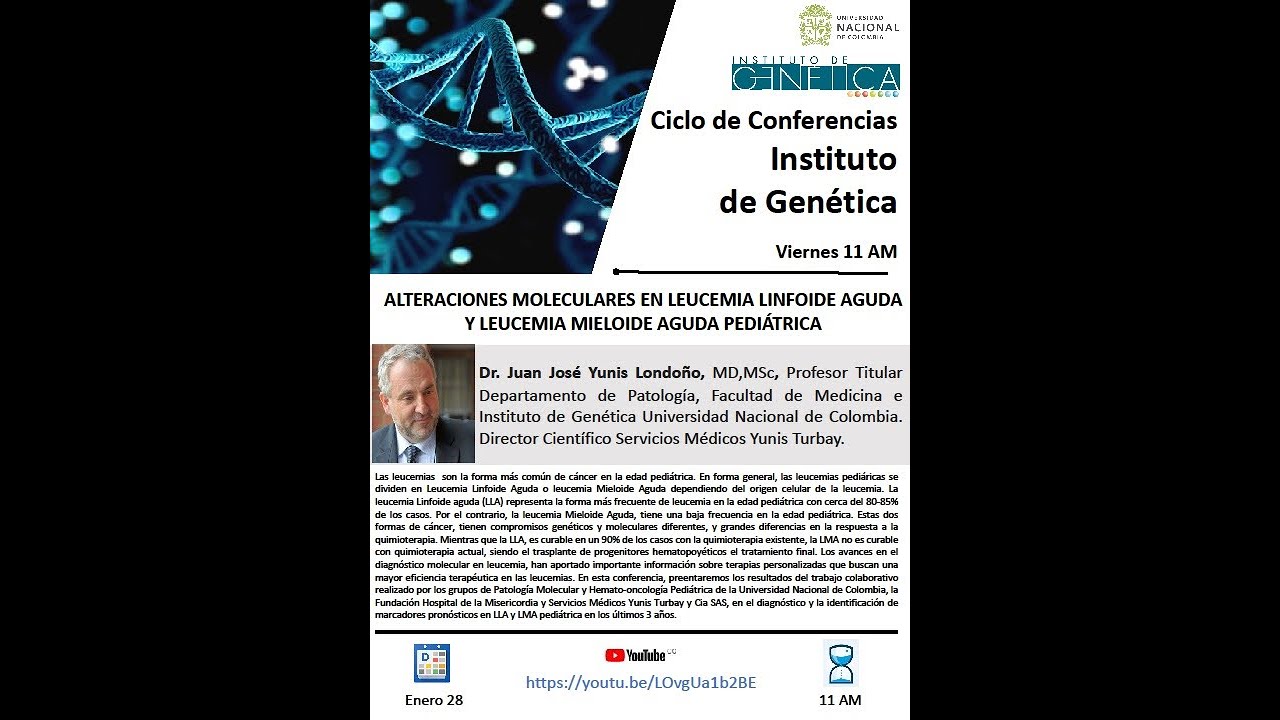
Alteraciones Moleculares en Leucemia Linfoide Aguda y Leucemia Mieloide Aguda Pediátrica.
Keywords
Summary
187 words
Critical Evaluation
Value of the Information & Strength of the Argument
The presentation provides valuable insights into the molecular landscape of pediatric leukemias, particularly in a Colombian population, which is underrepresented in genomic studies. The argumentation is solid, based on original data from funded research projects. The speaker effectively contrasts pediatric and adult AML, highlighting differences in mutation frequencies. The discussion of FLT3 testing and its clinical implications is well-supported by references to landmark studies and clinical trials. The presentation also underscores the importance of pharmacogenetics in predicting toxicity, adding practical value. However, the talk is dense and assumes a certain level of background knowledge, which may limit accessibility for a general audience.
Scientific Rigor, Source Quality, Title Accuracy
The presentation demonstrates scientific rigor through the use of established classification systems (WHO, European LeukemiaNet) and references to key publications, such as the Cancer Genome Atlas study and the work by Papaemmanuil et al. The speaker cites specific studies and clinical trials, including the RATIFY trial for FLT3 inhibitors. The title accurately reflects the content, focusing on molecular alterations in pediatric ALL and AML. The talk is well-structured, with clear objectives and results. However, as a conference presentation, it lacks the formal peer-review process, and some data are presented without full statistical details. The inclusion of pharmacogenetic and ancestry studies adds depth, but these are mentioned briefly due to time constraints.
228 words
Title / Content Match
The title accurately reflects the content, which focuses on molecular alterations in pediatric acute lymphoblastic leukemia and acute myeloid leukemia.
Quality & Reliability
8/10
The presentation is based on original research projects funded by Colciencias, with detailed methodology and data. The speaker is a professor and director of molecular pathology, with postdoctoral training at Harvard. The content is consistent with established scientific knowledge, though it is a conference presentation and not peer-reviewed.
Key Moments
Markers derived by PSI from the transcript: the creator did not define chapters.
- Introduction and welcome by Professor Cadavid, introducing Professor Juan José Yunis.
- Professor Yunis begins his presentation, apologizing for his voice, and introduces the collaborative research projects.
- Discussion of the frequency of pediatric leukemias and the importance of molecular markers.
- Overview of AML classification and the role of cytogenetics and molecular alterations.
- Presentation of the 2013 Cancer Genome Atlas study on adult AML, highlighting recurrent mutations in FLT3, NPM1, and DNMT3A.
- Discussion of FLT3 mutations, their prognostic significance, and the importance of rapid testing.
- Results from the Colombian pediatric AML cohort, showing FLT3 as the most frequent mutation, contrasting with adult AML.
- Introduction to the Philadelphia-like profile in pediatric ALL, its poor prognosis, and the research project.
- Conclusion summarizing the key findings and implications for personalized therapy.
Cited Sources
- Genomic and Epigenomic Landscapes of Adult De Novo Acute Myeloid Leukemia — Referenced as the 2013 Cancer Genome Atlas study on adult AML.
- Genomic Classification and Prognosis in Acute Myeloid Leukemia — Referenced as the 2016 study by Papaemmanuil et al. proposing a new molecular classification of AML.
- Midostaurin plus Chemotherapy for Acute Myeloid Leukemia with a FLT3 Mutation — Referenced as the clinical trial (RATIFY) demonstrating the efficacy of midostaurin in FLT3-mutated AML.
Concurring Sources
- Genomic Classification and Prognosis in Acute Myeloid Leukemia — The study by Papaemmanuil et al. supports the molecular heterogeneity of AML and the importance of mutations like FLT3 and NPM1.
- Midostaurin plus Chemotherapy for Acute Myeloid Leukemia with a FLT3 Mutation — The RATIFY trial confirms the clinical benefit of FLT3 inhibitors in AML, aligning with the presentation's emphasis on FLT3 testing.
Dissenting Sources
- Genomic and Epigenomic Landscapes of Adult De Novo Acute Myeloid Leukemia — The Cancer Genome Atlas study focuses on adult AML, and the mutation frequencies differ from the pediatric cohort presented, highlighting age-related differences.
Contribution & Novelties
This presentation provides original data on the molecular profile of pediatric AML and ALL in a Colombian population, which is underrepresented in genomic studies. It highlights differences in mutation frequencies compared to adult AML and other populations, such as the higher prevalence of FLT3 mutations in their cohort. The research also includes pharmacogenetic analyses to predict treatment toxicity, which is a novel contribution. The presentation emphasizes the clinical utility of rapid molecular testing and the potential for personalized therapy.
Pour aller plus loin :
- FLT3 gene - Genetics Home Reference — Overview of the FLT3 gene and its role in leukemia.
- Philadelphia chromosome - Wikipedia — Background on the Philadelphia chromosome and its significance in leukemia.
- Acute lymphoblastic leukemia - National Cancer Institute — Comprehensive information on pediatric ALL treatment and research.
132 words
Radar Profile
The radar profile shows high scores across all dimensions, indicating a well-rounded presentation with substantial information, strong scientific quality, and technical depth. The balance between quantity and quality suggests a comprehensive and reliable source.
💬 No comments were provided for analysis.