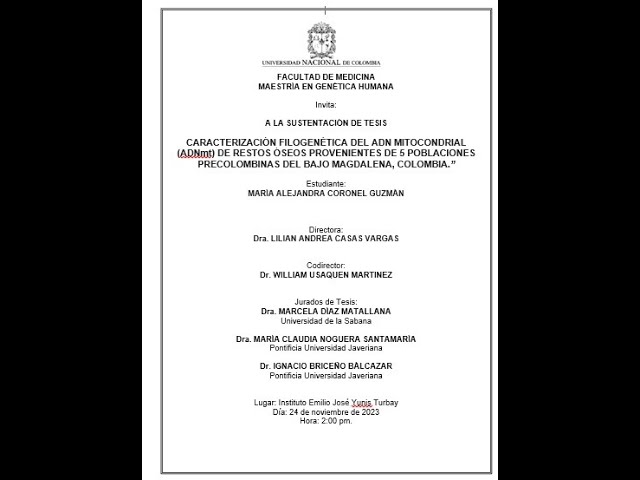
SUSTENTACIÓN DE TESIS - MARÍA ALEJANDRA CORONEL GUZMÁN
Keywords
Summary
141 words
Critical Evaluation
Value of the Information & Strength of the Argument
The value of the information lies in the presentation of original genetic data from ancient populations in a region that has been understudied genetically. The argumentation is solid, as the student systematically describes the methodology, results, and their interpretation, comparing with published data. The use of multiple analytical methods (Fst, PCA, networks, phylogenetic trees) strengthens the conclusions. However, the small sample size and the preliminary nature of the results limit the generalizability. The student also acknowledges the challenges of ancient DNA work, which adds credibility.
Scientific Rigor, Source Quality, Title Accuracy
The scientific rigor is evident in the careful laboratory protocols to avoid contamination, the use of appropriate software, and the comparison with published datasets. The sources cited include the Cambridge Reference Sequence, PhyloTree, and various studies (e.g., by Llamas, Perego, and others) for haplogroup assignments and coalescence times. The title accurately reflects the content, and the presentation is well-structured. The defense includes a question period where the student answers queries, demonstrating her understanding. The video is a formal academic presentation, and the quality of sources is appropriate for a thesis defense.
191 words
Title / Content Match
The title accurately reflects the content: a thesis defense on the phylogenetic characterization of mitochondrial DNA from pre-Columbian remains in the Lower Magdalena region.
Quality & Reliability
7/10
The thesis defense presents original research with a clear methodology, but the video is a recording of a presentation, not a peer-reviewed publication. The results are preliminary and the sample size is small. The speaker is a master's student, and the work is supervised by experts. The presentation is coherent and follows scientific standards, but the lack of detailed data and the informal setting limit the score.
Key Moments
Markers derived by PSI from the transcript: the creator did not define chapters.
- Introduction and reading of the act of defense
- Introduction to the study: Magdalena River basin and migration routes
- Explanation of mitochondrial DNA as a genetic marker and its use in human evolution
- Objectives and sample collection: 42 dental samples from five archaeological sites
- Methodology: DNA extraction, PCR amplification, and sequencing
- Results: haplogroup assignment and genetic diversity indices
- Interpopulation analysis: Fst distances and PCA
- Phylogenetic networks for each haplogroup and comparison with other populations
- Discussion: implications for migration routes and genetic diversity
- Conclusions and future directions: complete mitogenome analysis
Cited Sources
- PhyloTree — Used for haplogroup assignment
- Cambridge Reference Sequence — Reference for mtDNA comparison
- Study by Llamas et al. (2016) — Cited for coalescence times and haplogroup distributions
- Study by Perego et al. (2010) — Cited for haplogroup A2 and B2 distributions
- Thesis by Adriana Pérez — Provided comparative ancient DNA data from Colombia
Concurring Sources
- Llamas et al. (2016) — Their study on ancient mitochondrial DNA diversity in the Americas supports the high diversity and migration patterns observed.
- Perego et al. (2010) — Their work on haplogroup distributions in the Americas is consistent with the findings.
Dissenting Sources
- Some studies on modern populations — The high diversity in ancient populations contrasts with lower diversity in some modern populations, but this is expected due to genetic drift and admixture.
Contribution & Novelties
The original contribution is the genetic characterization of ancient populations from the Lower Magdalena region, which had not been studied at the mitochondrial level. The study provides new haplotype data and supports the role of the Magdalena River as a migration corridor. The use of complete mitogenomes for some samples adds resolution. The findings also highlight the high genetic diversity in pre-Columbian populations compared to modern ones.
Pour aller plus loin :
- Ancient DNA and human evolution — Provides background on ancient DNA research.
- Mitochondrial DNA — Explains the structure and use of mtDNA in population genetics.
- Haplogroup A2 (mtDNA) — Details on the A2 haplogroup, common in Native Americans.
- Peopling of the Americas — Overview of migration routes and genetic evidence.
122 words
Radar Profile
The radar profile shows high scores in quantity of information and technical level, reflecting the detailed presentation of methods and results. The quality of information and global reliability are slightly lower due to the preliminary nature of the research and the small sample size.
💬 No comments were provided for analysis.