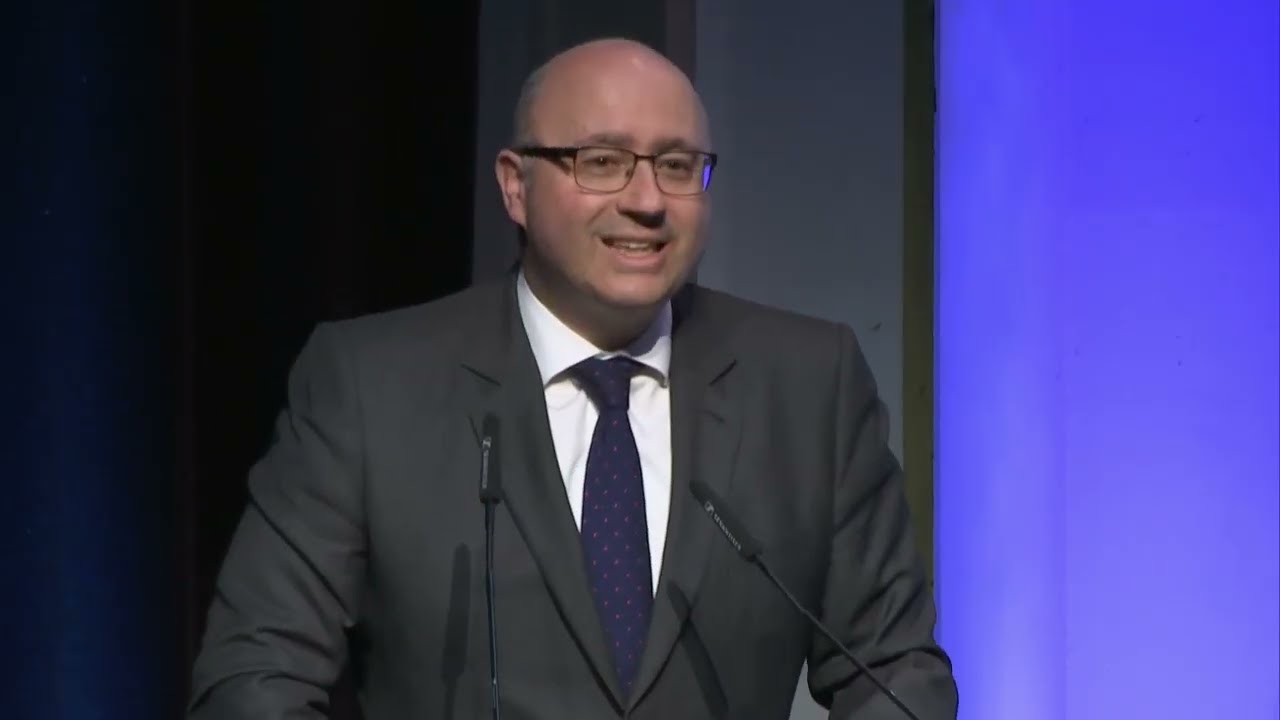
Keynote #2 (Joanna Drake) : Official Side Event of the NES
Keywords
Summary
166 words
Critical Evaluation
Value of the Information & Strength of the Argument
The speech provides valuable insights into the European Commission’s policy direction for nuclear energy, detailing specific funding programs and legislative measures. The argumentation is coherent, structured around five clear initiatives, and grounded in the Commission’s strategic priorities. However, it is largely a policy announcement rather than a critical analysis, and the speaker does not address potential challenges or counterarguments.
Scientific Rigor, Source Quality, Title Accuracy
The speech is a primary source from an EU official, lending it high authority. However, it does not cite external sources or provide evidence for claims such as the doubling of electricity demand or the need for 200,000 jobs. The title accurately reflects the content, and the speech is part of a broader event, which adds context. No comments were provided for analysis.
137 words
Title / Content Match
The title accurately reflects the content: a keynote speech at a side event of the Nuclear Energy Summit, delivered on behalf of Joanna Drake.
Quality & Reliability
7/10
The speech is delivered by a representative of the European Commission, providing authoritative information on EU policy initiatives. However, it is a political/strategic communication rather than a peer-reviewed scientific presentation, and the content is forward-looking with some uncertainty.
Key Moments
Markers derived by PSI from the transcript: the creator did not define chapters.
- Introduction and apologies from Joanna Drake, delivered by Domenico Rossetti.
- Mention of the upcoming Integrated Nuclear Programme (PIN) and SMR strategy.
- First initiative: Euratom research and training program, calls 2026-2027.
- Details on Euratom priorities: LTO, SMR safety, skills, isotopes, and access to research facilities.
- Support for the Jules Horowitz reactor and Marie Curie fellowships.
- Second initiative: Industrial Accelerator Act (IAA) and its 'Made in EU' preferences.
- Third initiative: State aid frameworks IPCEI and CISAF.
- Fourth initiative: EU startup and scale-up strategy, including Scaleup Europe fund.
- Fifth initiative: Skills for nuclear, including the European Nuclear Skills Academy.
- Conclusion: doubling nuclear research budget in next MFF and closing remarks.
Cited Sources
- Euratom Research and Training Programme — Mentioned as the first initiative supporting nuclear research.
- Industrial Accelerator Act — Proposed legislation to boost demand for low-carbon technologies.
- IPCEI on Innovative Nuclear Technologies — Mentioned as a state aid framework under discussion.
- EU Startup and Scaleup Strategy — Strategy to support startups and scaleups, including nuclear.
- European Nuclear Skills Academy — Initiative to develop nuclear skills in Europe.
Concurring Sources
- IAEA Nuclear Energy Series — General IAEA publications on nuclear energy, aligning with the speech's themes.
Dissenting Sources
- Nuclear power: A dangerous distraction — Environmental NGOs often argue against nuclear expansion, contrasting with the speech's advocacy.
Contribution & Novelties
The speech provides an up-to-date overview of EU policy initiatives supporting nuclear energy, particularly the upcoming Euratom work program and the Industrial Accelerator Act. It highlights the Commission’s commitment to doubling nuclear research funding in the next MFF.
Pour aller plus loin :
- Euratom Research and Training Programme — Official page for the Euratom program.
- Small Modular Reactors — IAEA overview of SMRs.
- European Industrial Accelerator Act — Official page for the IAA.
- IPCEI on Nuclear — Information on IPCEI.
- Nuclear Skills — European Nuclear Skills Network.
87 words
Radar Profile
The radar profile shows moderate to high scores across all dimensions, with a slight dip in technical level, reflecting the policy-oriented nature of the speech. The high reliability score is due to the authoritative source, while the lower technical score indicates limited depth on scientific details.