Keynote#3 (Véronique Rouyer) – Official Side Event of the NES
Keywords
Summary
166 words
Critical Evaluation
Value of the Information & Strength of the Argument
The presentation provides valuable insights into the current state and future needs of nuclear safety research from an authoritative institutional perspective. The argumentation is coherent and well-structured, building a case for increased international cooperation and strategic planning. The speaker effectively uses examples of NEA initiatives and documents to support her points, though some arguments rely on general statements rather than detailed evidence. The emphasis on the declining capacity of research infrastructure and the need for early investment is compelling and well-argued.
Scientific Rigor, Source Quality, Title Accuracy
The presentation demonstrates scientific rigor by referencing official NEA documents and reports, such as the strategic roadmap and the technical opinion paper on SMRs. The speaker is a recognized expert, and the content aligns with the institutional position of the OECD-NEA. The title accurately reflects the content, and the presentation is consistent with the context of the Nuclear Energy Summit side event. No public comments were provided, so no analysis of audience reception is possible.
171 words
Title / Content Match
The title accurately reflects the content: a keynote presentation by Véronique Rouyer at an official side event of the Nuclear Energy Summit.
Quality & Reliability
8/10
The speaker is a high-level expert from the OECD-NEA, and the content is based on official NEA documents and collaborative research. However, the presentation is an opinion/expert talk with limited detailed data, and some statements are general.
Key Moments
Markers derived by PSI from the transcript: the creator did not define chapters.
- Introduction of Véronique Rouyer and her role at OECD-NEA.
- Overview of NEA's mission and collaborative research activities.
- Discussion on the expected expansion of nuclear power and safety challenges.
- Introduction of the CSNI and its working groups.
- Mention of recent CSNI reports on long-term operation and SMR safety.
- Discussion on key topics: long-term operation, SMRs, safety assessment approaches.
- Emphasis on the need for research excellence and leveraging legacy activities.
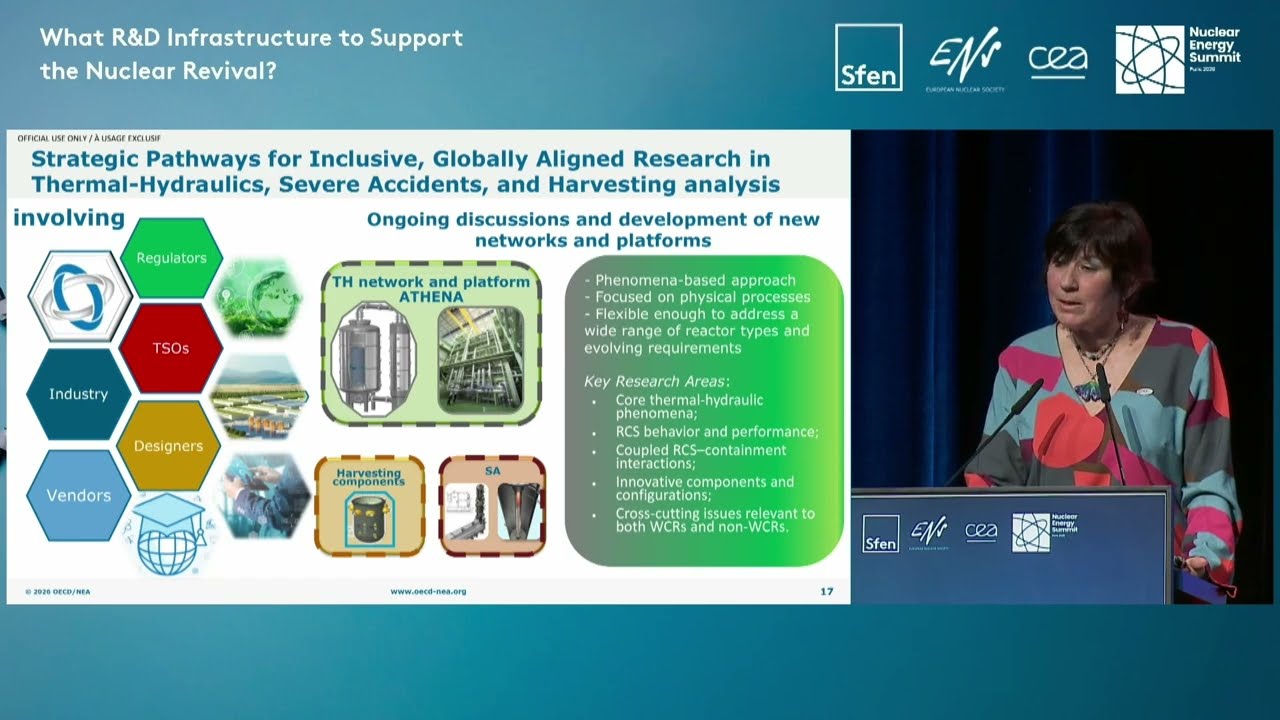
- Introduction of the strategic roadmap for nuclear reactor safety research.
- Details on the roadmap's focus areas and crosscutting priorities.
- Discussion on thermal-hydraulics and the ATENA platform.
- Conclusion and call for stakeholder collaboration.
Cited Sources
- NEA Strategic Roadmap for Nuclear Reactor Safety Research — Referenced as a key document outlining urgent safety research needs.
- NEA Brochure for Decision Makers — Referenced as a call for action for stakeholders.
- CSNI Technical Opinion Paper on SMR Safety — Referenced as a recent report on SMR safety research recommendations.
- NEA Joint Projects — Referenced as a proven model for collaborative experimental research.
Concurring Sources
- IAEA Nuclear Safety and Security — International perspective on nuclear safety, consistent with the need for collaboration.
- World Nuclear Association Safety of Nuclear Reactors — Industry perspective on safety, aligning with the emphasis on research and regulation.
Contribution & Novelties
The presentation provides an authoritative overview of the OECD-NEA’s current initiatives and strategic direction for nuclear safety research, highlighting the urgent need for international collaboration and infrastructure investment. It offers a unique perspective on the challenges and opportunities in the field, particularly for SMRs and long-term operation.
Pour aller plus loin :
- OECD-NEA Nuclear Safety Research — Official page for NEA safety research activities.
- IAEA Safety Standards — International safety standards relevant to nuclear regulation.
- Nuclear Energy Agency (NEA) — Official NEA website with publications and data.
87 words
Radar Profile
The radar profile shows high scores in information quality and reliability, reflecting the authoritative source and institutional backing. The moderate scores in quantity and technical level indicate a focused but not overly detailed presentation, suitable for a high-level audience.