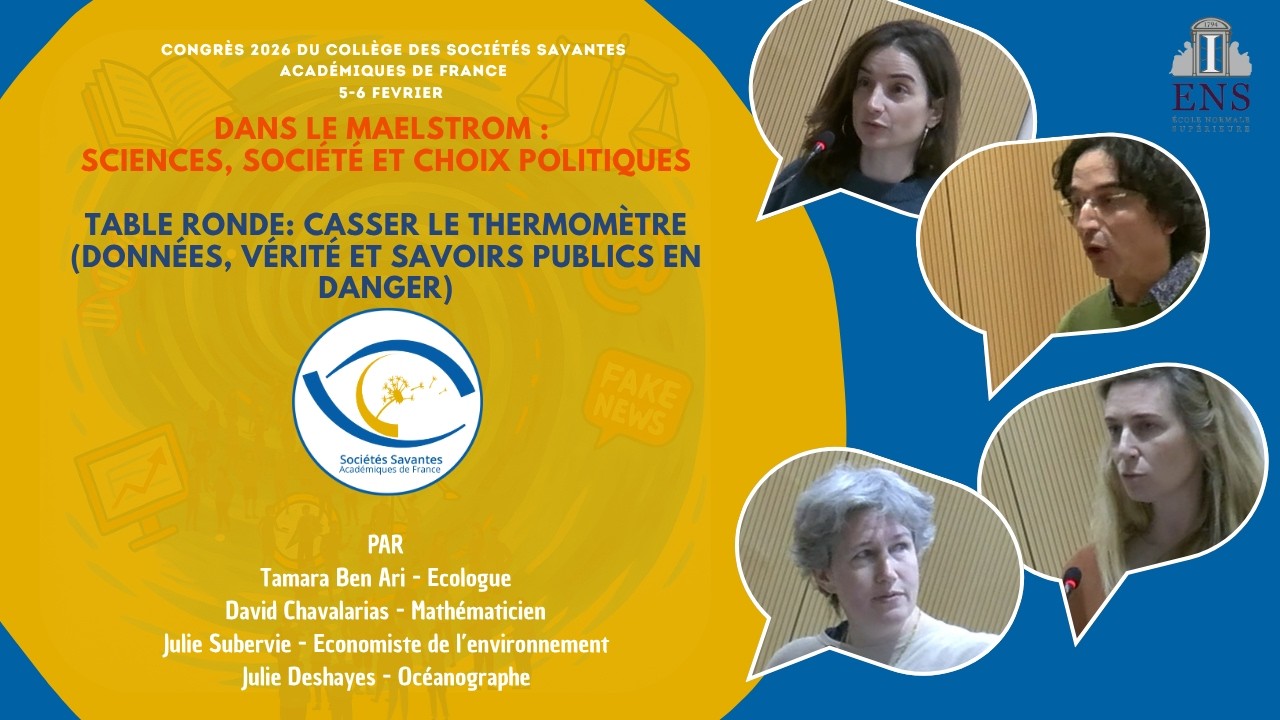
Table ronde 1 - Discussion avec la salle
Keywords
Summary
127 words
Critical Evaluation
Value of the Information & Strength of the Argument
The discussion provides valuable insights into the current challenges facing scientific research, particularly regarding funding and data access. The panelists argue convincingly that project-based funding undermines long-term observations and exploratory research, and they highlight the need for institutional support to protect scientists from attacks. The argumentation is solid, grounded in the panelists’ expertise and real-world examples, though it is primarily opinion-based rather than data-driven. The debate on cost-benefit analysis is nuanced, acknowledging both its potential utility and its ethical pitfalls.
Scientific Rigor, Source Quality, Title Accuracy
The discussion is scientifically rigorous, with panelists referencing specific research programs and institutional experiences. However, no formal sources are cited within the video, and the links provided in the description are to Copernicus and GEO websites, which are relevant but not directly cited. The title accurately reflects the content, which is a roundtable discussion with audience participation. The panelists’ expertise lends credibility, but the lack of formal citations limits the verifiability of specific claims.
169 words
Title / Content Match
The title accurately reflects the content, which is a roundtable discussion with audience participation.
Quality & Reliability
8/10
The discussion features expert researchers from INRAE and CNRS, providing informed perspectives on scientific funding, data access, and academic freedom. The content is grounded in their professional experience and references to ongoing research programs. However, it is a debate format with no formal citations or peer-reviewed sources presented, and the discussion is largely opinion-based.
Key Moments
Markers derived by PSI from the transcript: the creator did not define chapters.
- Julie Deshayes discusses the role of Copernicus and GEO in AMOC measurements.
- David Chavalarias and Tamara Ben Ari discuss how to defend against attacks on science.
- Julie Deshayes explains what CNRS is doing to maintain AMOC observations.
- Julie Subervie discusses INRAE's support for cross-referencing health and phytosanitary databases.
- David Chavalarias critiques project-based funding and its impact on academic freedom.
- Discussion on the asbestos case and the pitfalls of cost-benefit analysis.
- Audience questions on defining pediatric cancer clusters, participatory science, and long-term funding.
- Julie Deshayes concludes by emphasizing the need to defend disciplines and scientific method.
- David Chavalarias concludes on the importance of popular support and leaving the ivory tower.
- Julie Subervie concludes on breaking silos and interdisciplinary work with legal experts.
Cited Sources
- Copernicus — Mentioned as a European observation program relevant to AMOC measurements.
- Group on Earth Observations (GEO) — Mentioned as a global initiative for Earth observation systems.
Concurring Sources
- Copernicus — Supports the discussion on Earth observation programs.
- Group on Earth Observations (GEO) — Supports the discussion on global observation initiatives.
External References
Contribution & Novelties
The discussion provides a unique platform for researchers to voice concerns about the sustainability of long-term observation programs and the impact of funding models on scientific freedom. It highlights the need for institutional support and interdisciplinary collaboration. The panelists’ experiences offer practical insights into defending science against political attacks.
Pour aller plus loin :
- AMOC (Atlantic Meridional Overturning Circulation) — Provides background on the ocean circulation system discussed.
- Copernicus Programme — Details the European Earth observation program.
- Cost-benefit analysis — Relevant to the debate on regulatory decision-making.
87 words
Radar Profile
The radar profile shows high scores in information quantity and quality, with moderate technical level and high reliability. This indicates a well-informed discussion with strong expert input, though the technical depth is not extreme, making it accessible to a broader audience.
💬 No comments were provided for analysis.