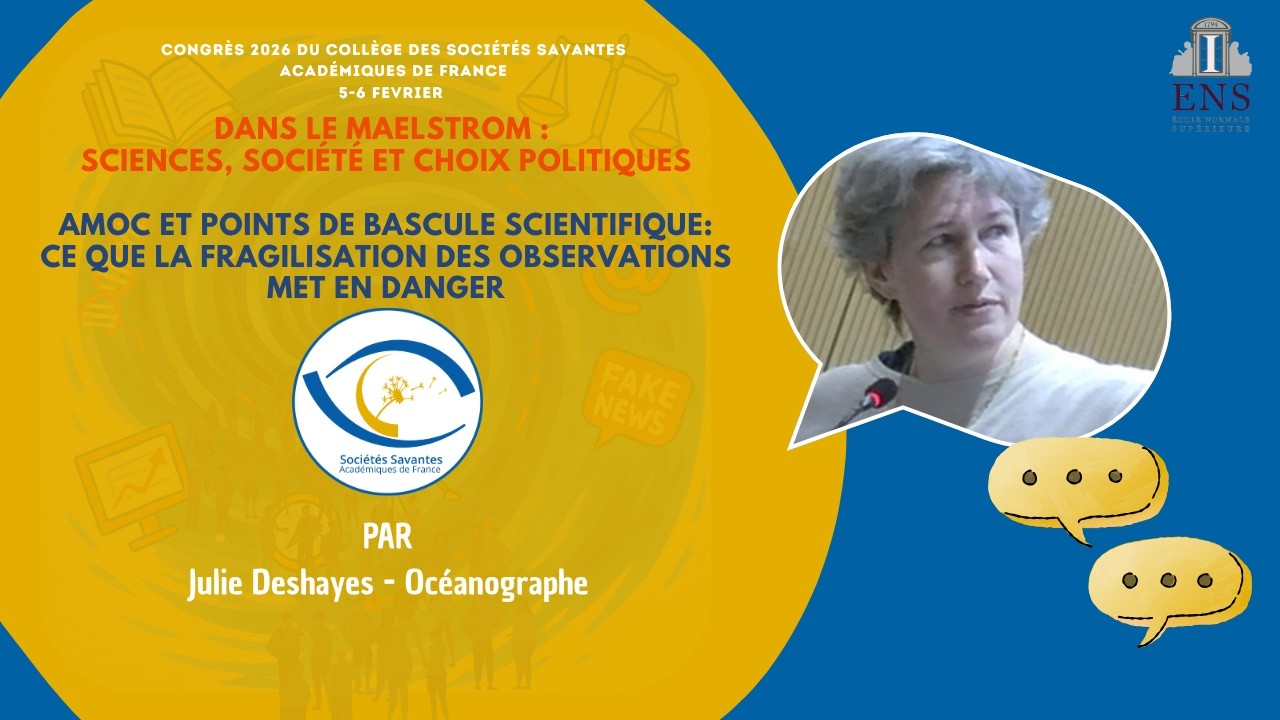
Table ronde 1 - Courants océaniques et points de bascule climatiques - Julie Deshayes, océanographe
Keywords
Summary
137 words
Critical Evaluation
Value of the Information & Strength of the Argument
The talk provides valuable insights into the scientific process behind AMOC monitoring, highlighting the importance of long-term observations and the challenges of funding. Deshayes argues convincingly that the AMOC is not collapsing based on direct measurements, while acknowledging the value of statistical models but cautioning against overinterpreting their results. She effectively distinguishes between scientific consensus and media hype, using the example of the 2004 article and the movie ‘The Day After Tomorrow’ to illustrate how misinformation can persist. Her argumentation is solid, grounded in her expertise and specific examples from the RAPID program.
Scientific Rigor, Source Quality, Title Accuracy
The talk demonstrates high scientific rigor, with clear explanations of the AMOC and its measurement. Deshayes references the RAPID program and its 400+ publications, as well as the IPCC report, providing credible sources. She also mentions a 2024 article on calibration corrections, showing attention to detail. The title accurately reflects the content, which focuses on ocean currents and climate tipping points. The talk is well-structured and informative, with no apparent discrepancies between the title and the content.
185 words
Title / Content Match
The title accurately reflects the content, which focuses on ocean currents and climate tipping points, with a specific emphasis on the AMOC.
Quality & Reliability
9/10
High reliability due to the speaker's expertise as a CNRS research director and oceanographer, clear distinction between observations and models, and explicit references to scientific literature and IPCC reports.
Key Moments
Markers derived by PSI from the transcript: the creator did not define chapters.
- Introduction: Deshayes explains her background and the AMOC as a mathematical construct.
- Explanation of the RAPID program and how the AMOC is measured at 26°N.
- Discussion of what is actually measured: weekly variability and precision limits.
- Challenges of funding long-term programs, with examples of chaotic financial arrangements.
- Importance of precise and continuous measurement of the AMOC.
- Epistemological question: what science should we do?
- Statistical models vs. observations: two opposing views of the AMOC.
- Failures in public communication and their political consequences.
- What the IPCC report says about the AMOC.
- Conclusion: the need to continue measuring.
Cited Sources
- L’évolution incertaine de la circulation océanique (2023) Julie Deshayes, Actualités IPSL — Article by Julie Deshayes on the uncertain evolution of ocean circulation, referenced in the video description.
- Full episode on YouTube — Link to the full video, provided in the description.
Concurring Sources
- IPCC AR6 WG1 — The IPCC report is cited in the video as the authoritative source on AMOC collapse probability.
Dissenting Sources
- Statistical models suggesting AMOC decline — Deshayes mentions statistical models that suggest an ongoing decline, but she argues these are not supported by direct observations.
Contribution & Novelties
The talk provides a clear, expert perspective on the AMOC, correcting common misconceptions and highlighting the importance of continuous observation. It offers a unique insider view of the challenges in funding long-term scientific programs. The speaker emphasizes the need for better communication between scientists, media, and policymakers.
Pour aller plus loin :
- AMOC on Wikipedia — Overview of the AMOC and its role in climate.
- RAPID program — Official site of the RAPID array, providing data and information.
- IPCC AR6 WG1 — The latest IPCC report, which includes assessments of the AMOC.
- The Day After Tomorrow (film) — The movie that popularized the AMOC collapse scenario.
106 words
Radar Profile
The radar profile shows high scores in quality and reliability, reflecting the expert and well-sourced nature of the talk. The quantity of information is also high, but the technical level is moderate, making it accessible to a general audience. The overall balance indicates a highly informative and trustworthy presentation.
💬 No comments were provided for analysis.