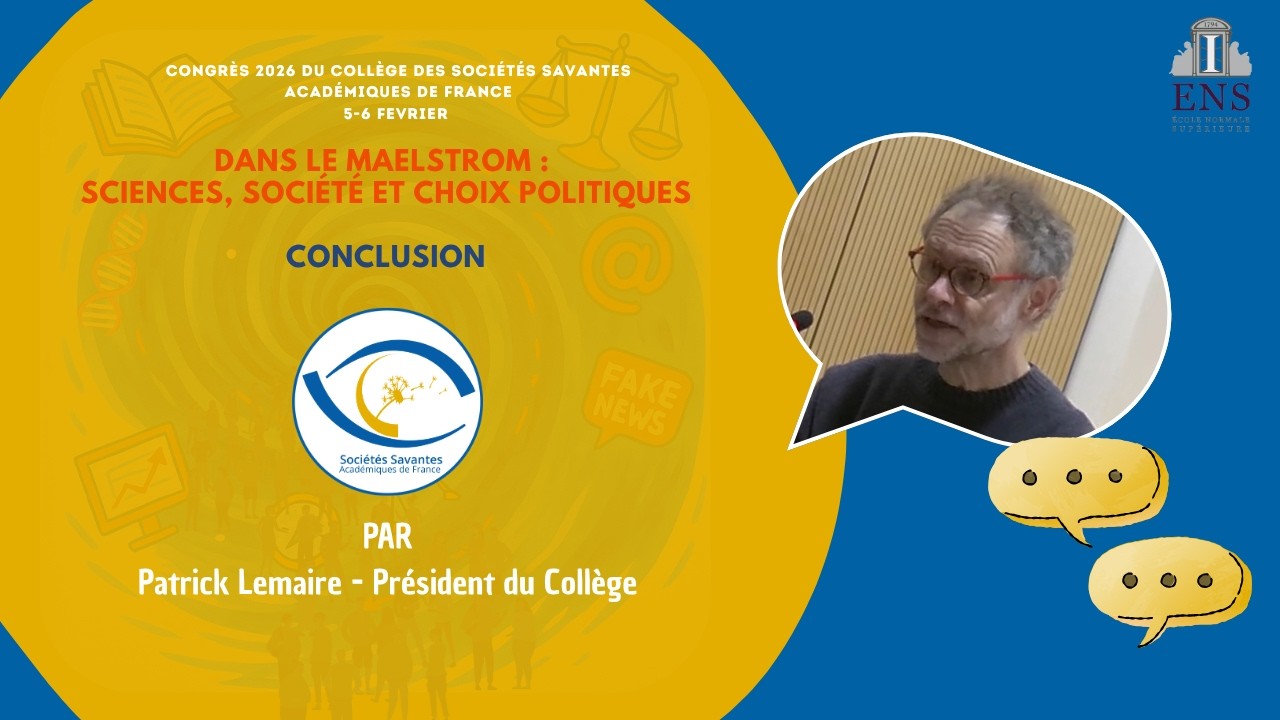
Conclusions Congrès 2026 du Collège de sociétés savantes - Patrick Lemaire
Keywords
Summary
178 words
Critical Evaluation
Value of the Information & Strength of the Argument
The video provides valuable insights into the current challenges facing the French research community, particularly regarding academic freedom, funding, and governance. Lemaire’s arguments are well-structured and based on the collective discussions of the congress, lending them credibility. He presents a balanced view, acknowledging both the strengths and weaknesses of the current system. The call for interdisciplinary collaboration and the integration of jurists is particularly compelling. However, the arguments are largely opinion-based and lack specific data or case studies to support them.
Scientific Rigor, Source Quality, Title Accuracy
The scientific rigor is moderate; the speaker is an expert in his field, but the content is a synthesis of discussions rather than a presentation of original research. The sources cited are not explicitly mentioned, but the video is part of a congress with publicly available materials. The title accurately reflects the content, as it is indeed the concluding remarks of the congress. The video includes a brief mention of the previous congress and the upcoming one, but no external sources are referenced.
179 words
Title / Content Match
The title accurately reflects the content, as the video presents the concluding remarks of the congress by Patrick Lemaire.
Quality & Reliability
7/10
The speaker is the president of the Collège des sociétés savantes académiques de France, providing an expert synthesis of the congress discussions. The content is opinion-based and reflects the collective views of the congress, but lacks detailed citations or verifiable data.
Chapters
- Introduction et remerciements
- Message 1 – L'importance du collectif
- Interdisciplinarité et limites des silos disciplinaires
- Manque de formation à la philosophie et l'histoire des sciences
- Le rôle des juristes et les procédures bâillon
- Tour d'ivoire, neutralité et engagement
- Attirer les jeunes chercheurs : la quête de sens
- Libertés académiques et libertés fondamentales
- Accès aux données et importance des infrastructures
- Rapport ambigu aux institutions de recherche
- Gouvernance scientifique : signaux préoccupants (INCa, DGRI)
- Le financement de la recherche en question
- Europe et grandes fondations philanthropiques comme alternatives
- Former les chercheurs à la communication publique
- Conclusion et annonce du prochain congrès (février 2027)
Cited Sources
- Full episode on YouTube — The video itself, which contains the full congress conclusions.
Concurring Sources
- Academic freedom — The video discusses threats to academic freedom, which is a well-documented issue.
Contribution & Novelties
The video offers a unique synthesis of the congress’s key messages, providing a cohesive overview of the concerns and proposals of the French academic community. It highlights the importance of collective action and interdisciplinary collaboration, and raises critical questions about research funding and governance.
Pour aller plus loin :
- Academic freedom — Provides background on the concept and its global context.
- SLAPP suit — Explains the legal tactic mentioned in the video.
- Wellcome Trust — An example of a philanthropic foundation funding research, as referenced in the video.
88 words
Radar Profile
The radar profile shows balanced scores across information quantity, quality, and reliability, with a slightly lower technical level, reflecting the video's focus on policy and societal issues rather than technical details.