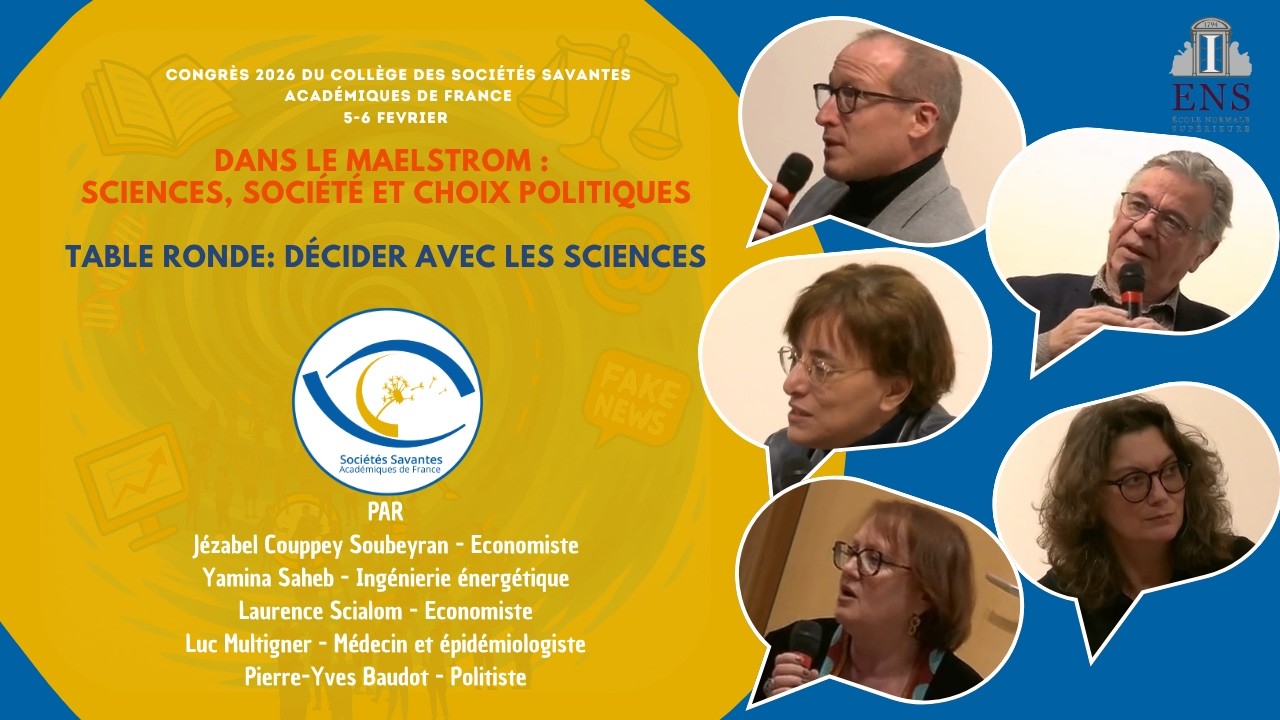
Table ronde 2 - Décider avec les sciences
Keywords
Summary
181 words
Critical Evaluation
Value of the Information & Strength of the Argument
The value of the information is high, as it provides first-hand accounts from scientists directly involved in high-stakes science-policy interactions. Yamina Saheb’s detailed description of the IPCC process, including the nomination of leadership and the battle over the word ‘sobriety’, offers rare insider insights. Luc Multigner’s testimony on the chlordecone affair illustrates the real-world consequences of political interference in science. Laurence Scialom’s analysis of banking lobby tactics is well-documented and compelling. The argumentation is solid, with each speaker grounding their claims in concrete examples and published work. The debate format allows for nuanced discussion, and the speakers acknowledge the complexity of the issues, avoiding simplistic conclusions.
Scientific Rigor, Source Quality, Title Accuracy
The scientific rigor is generally high, as the speakers are established researchers with relevant expertise. They reference their own publications and well-known reports (e.g., IPCC reports, Scialom’s book ‘La fascination de l’ogre’). However, as a roundtable, the evidence is largely anecdotal and relies on personal experience rather than systematic citation. The title ‘Décider avec les sciences’ accurately captures the central theme, and the content aligns well with it. The discussion is well-structured into three parts, each addressing a distinct aspect of the science-policy relationship. The speakers maintain a critical perspective, and the moderation ensures a balanced exchange.
218 words
Title / Content Match
The title accurately reflects the content: the roundtable discusses how scientific knowledge influences political decisions, with concrete examples and critical analysis.
Quality & Reliability
8/10
The roundtable features four established researchers from different disciplines (energy engineering, political science, epidemiology, economics) sharing their direct experience with science-policy interfaces. Their accounts are grounded in documented cases (IPCC process, COVID-19 policies, chlordecone crisis, banking lobby). The discussion is nuanced and self-critical, acknowledging the political dimensions of science. However, as a debate, it relies on personal testimony and argumentation rather than systematic evidence review.
Chapters
- Introduction
- Présentation de la session par Jézabel Couppey-Soubeyran
- Présentation des intervenants
- VOLET 1 – Science et politiques publiques
- Yamina Saheb — La fabrique du rapport du GIEC
- Pierre-Yves Baudot— Décider avec quelle science ? L'exemple du Covid
- Luc Multigner — Vingt ans de recherche sur le chlordécone
- VOLET 2 – Science et fabrication du doute
- Luc Multigner — Quand l'État sème le doute sur ses propres scientifiques
- Laurence Scialom — Lobbys bancaires et capture intellectuelle
- VOLET 3 – Science et engagement
- Laurence Sialom — Parcours d'une économiste engagée
- Pierre-Yves Baudot— Chercheur militant malgré lui
- Yamina Saheb — L'engagement ou la trahison de la science ?
- Questions du public et échanges
- Conclusion
Cited Sources
- Full episode on YouTube — The complete roundtable discussion is available on YouTube.
Concurring Sources
- IPCC — The IPCC's official website provides reports and information on its processes, supporting Yamina Saheb's account.
Contribution & Novelties
The roundtable provides a unique multi-disciplinary perspective on the science-policy interface, combining insights from energy engineering, political science, epidemiology, and economics. It highlights the often-overlooked political dimensions of scientific processes, such as the IPCC’s internal negotiations and the selective use of science during the COVID-19 crisis. The discussion on scientific engagement offers a nuanced view, distinguishing between partisan militancy and commitment to the collective interest.
Pour aller plus loin :
- IPCC — Official IPCC website for reports and processes.
- Chlordécone — Overview of the chlordecone pesticide and its environmental impact.
- La fascination de l’ogre — Laurence Scialom’s book on banking lobby capture.
102 words
Radar Profile
The radar profile shows high scores in information quantity, quality, and reliability, with a slightly lower technical level, reflecting the accessible yet expert nature of the discussion. The balance across dimensions indicates a well-rounded and informative roundtable.