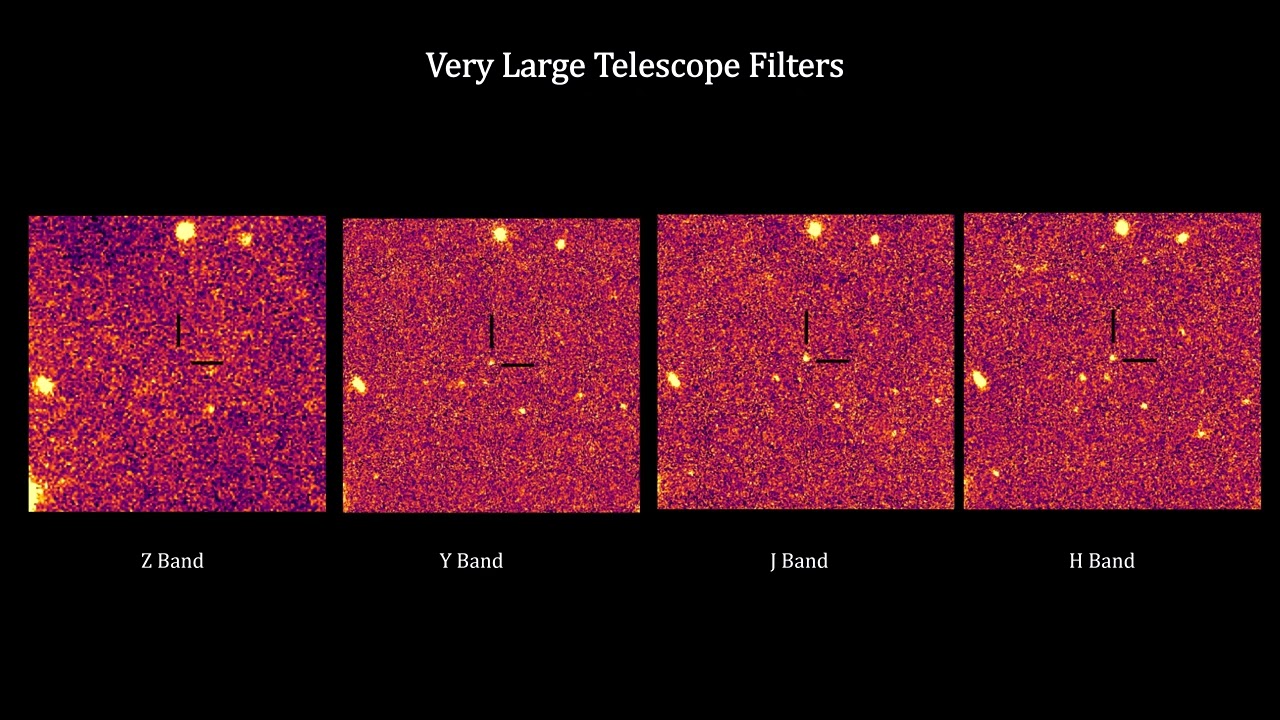
Classroom Aid - GRB 250314A
Keywords
Summary
154 words
Critical Evaluation
The video provides a clear and accurate summary of a significant astronomical discovery: the detection of a gamma-ray burst (GRB 250314A) from a very early supernova at redshift 7.3. The information is well-structured, starting with the initial detection by SVOM, followed by follow-up observations from multiple ground- and space-based telescopes, and culminating in the JWST confirmation. The explanation of how the light travel time and cosmic expansion stretch the observed timescale is scientifically sound and effectively communicated. The video does not present any original research but synthesizes publicly available data from observatories and likely from the referenced PDF. The sources cited are limited to the PDF link in the description, which is a review of 2025 discoveries; no direct links to scientific papers are provided. However, the information aligns with known astrophysical principles and recent news about GRB 250314A (e.g., from NASA or ESA). The video’s strength lies in its clarity and focus on a single event, making it a good educational resource. Potential weaknesses include the lack of explicit source citations for specific claims (e.g., the exact redshift measurement, the supernova type) and the brevity, which omits details about the progenitor star or the significance of Population III stars. The video does not discuss uncertainties or alternative interpretations. The title ‘Classroom Aid’ is appropriate, and the content matches the title well. Overall, the video is reliable and informative for its intended audience, but it could benefit from more rigorous sourcing and depth.
243 words
Title / Content Match
The title accurately reflects the content: a classroom aid about GRB 250314A, a gamma-ray burst detected in March 2025.
Quality & Reliability
The video presents a specific astronomical event (GRB 250314A) with detailed observational data from multiple telescopes (SVOM, VLT, JWST, etc.). The information is consistent with known astrophysical processes (gamma-ray bursts, supernovae, redshift). The description links to a PDF review, suggesting a broader context. No obvious errors or exaggerations. However, the video is short and lacks detailed source citations beyond the PDF.
Key Moments
- Introduction: GRB 250314A detected by SVOM on March 14, 2025.
- Follow-up observations by Nordic Optical Telescope, Swift, Einstein Probe.
- Spectrum acquired by VLT and Gran Telescopio Canarias; redshift determination.
- JWST confirms supernova; type Ic core-collapse; redshift 7.3.
- Comparison with modern supernovae; similarity suggests consistent mechanisms.
- Light curve stretched by cosmic expansion; JWST observations at 3 and 12 months.
Cited Sources
- 2025 Review PDF ✓ verified — The description links to this PDF as a source for the 2025 astronomical discoveries, likely including GRB 250314A.
Concurring Sources
- NASA GRB 250314A News — NASA's Swift mission page likely provides official details on the burst detection and follow-up.
- ESA SVOM Mission — ESA's page on the SVOM mission, which detected the GRB.
Contribution & Novelties
The video highlights the detection of GRB 250314A, the fifth most distant gamma-ray burst and the farthest supernova ever observed, at redshift 7.3. It emphasizes that the supernova’s properties are similar to modern ones, suggesting that core-collapse supernova mechanisms have remained unchanged since the early universe. This provides a unique glimpse into the first generation of stars (Population III).
Pour aller plus loin :
- Population III stars — The first stars in the universe, thought to be massive and metal-free, likely progenitors of early GRBs.
- Gamma-ray burst afterglow — The multiwavelength emission following a GRB, crucial for determining redshift and host galaxy.
- James Webb Space Telescope observations of high-redshift supernovae — JWST’s role in detecting and characterizing distant supernovae.
119 words
Radar Profile
The radar profile shows high scores in quality and reliability, reflecting the accurate presentation of observational data. The quantity of information is moderate due to the short duration, and the technical level is appropriate for an educational video. The overall profile indicates a solid but concise scientific communication.