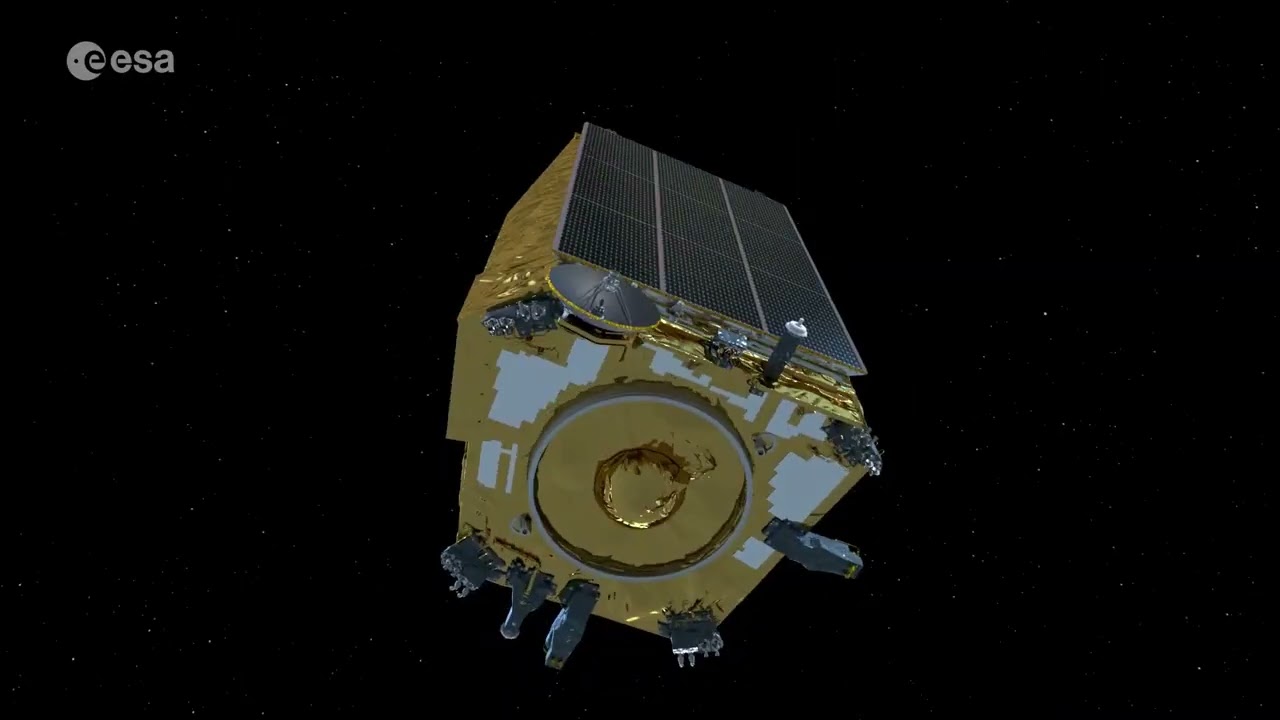
Euclid Space Telescope Introduction
Keywords
Summary
147 words
Critical Evaluation
The video provides a basic but accurate overview of the Euclid space telescope. The information presented is consistent with publicly available mission descriptions from ESA. The narrator correctly identifies Euclid’s orbit at L2 and its scientific objectives: studying dark energy and dark matter through weak lensing and galaxy clustering. The mention of the two instruments (VIS and NISP) is precise. However, the video is very short (2:30) and lacks depth; it does not delve into the technical challenges, data analysis methods, or expected scientific impact. The reliance on a single PDF resource limits the breadth of sources. The video does not cite any peer-reviewed papers or official ESA documents directly, though the linked PDF may contain such references. The production quality is adequate, with clear narration and appropriate visuals. The video’s strength lies in its accessibility, making complex concepts understandable to a lay audience. Weaknesses include the lack of critical discussion about potential limitations or controversies in dark energy research. The video does not address alternative theories or the current state of evidence. Overall, it serves as a useful introductory resource but should be supplemented with more detailed materials for a comprehensive understanding. The absence of any advertising or sponsorship is noted. The title accurately reflects the content, and the video fulfills its stated purpose.
215 words
Title / Content Match
The title accurately reflects the content: a brief introduction to the Euclid space telescope.
Quality & Reliability
The video provides a clear introduction to the Euclid space telescope, referencing a detailed PDF resource. However, the short duration limits depth, and no peer-reviewed sources are directly cited in the video itself.
Key Moments
Cited Sources
- Euclid Space Telescope PDF ✓ verified — The video references this PDF as a source for further information.
Concurring Sources
- ESA Euclid Mission — Official mission page confirming the telescope's objectives and instruments.
Contribution & Novelties
The video provides a succinct introduction to the Euclid mission, suitable for newcomers. It clearly states the telescope’s orbit, instruments, and scientific goals.
Pour aller plus loin :
- ESA Euclid Mission Overview — Official ESA page with detailed mission information.
- Weak Gravitational Lensing — A key technique used by Euclid to map dark matter.
- Baryon Acoustic Oscillations — A standard ruler for measuring cosmic distances and dark energy.
68 words
Radar Profile
The radar profile shows moderate scores across all dimensions, reflecting a balanced but shallow introductory video. The highest score is in fiabilite_globale due to alignment with known facts, while quantite_information is limited by the short duration.