Immigration, Partnership Dynamics and Welfare Persistence
Keywords
Summary
167 words
Critical Evaluation
Value of the Information & Strength of the Argument
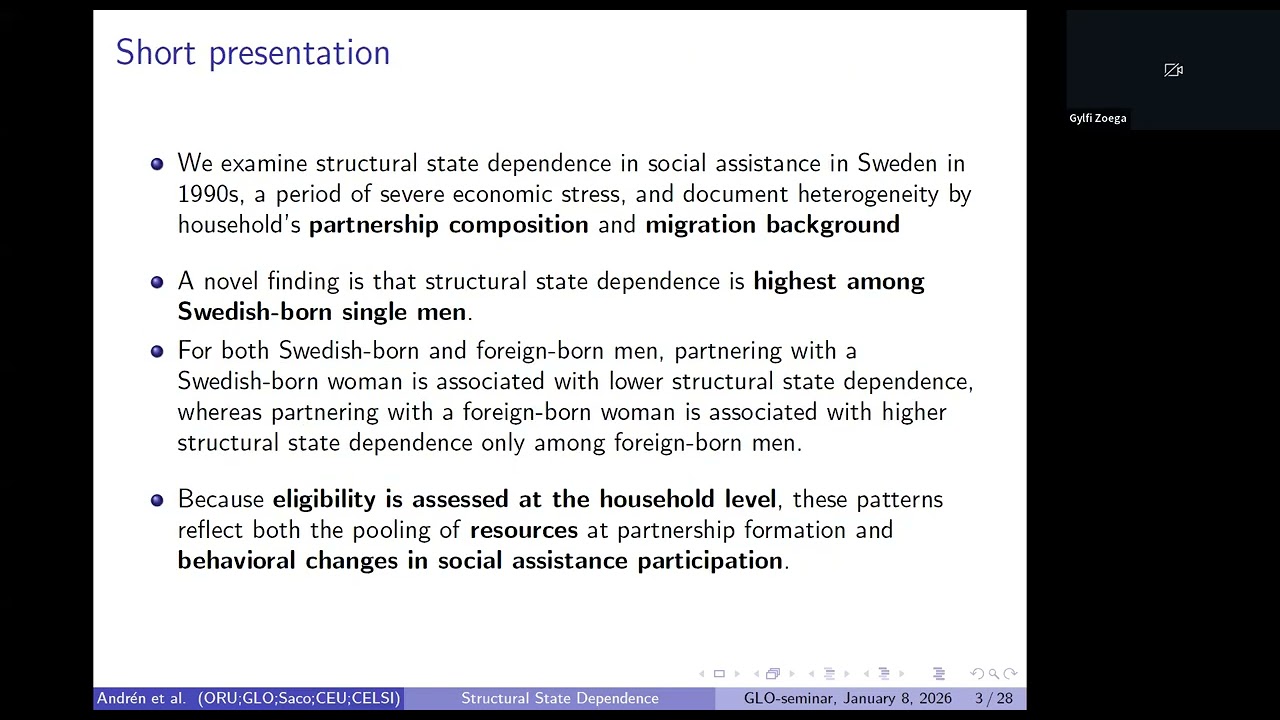
The presentation provides valuable insights into welfare persistence, challenging common assumptions about immigrant welfare dependence. The argumentation is solid, grounded in economic theory and rigorous econometric methods. The speaker clearly explains the distinction between spurious and structural state dependence, using intuitive examples. The results are presented with appropriate caveats, and the discussion acknowledges potential endogeneity and institutional complexities. The value lies in the novel focus on household-level analysis and the finding that single native men, though few, are most trapped, which has policy implications.
Scientific Rigor, Source Quality, Title Accuracy
The research is based on Swedish register data and builds on previous studies, including the speaker’s own 2013 work. The methodology is rigorous, using structural econometric models as introduced by Heckman. The title accurately reflects the content. The presentation is part of a seminar series, and the speaker is a recognized expert. The sources cited are the two GLO discussion papers and the data from Statistics Sweden. The adéquation between title and content is strong, with no misleading elements.
178 words
Title / Content Match
The title accurately reflects the content, which focuses on immigration, partnership dynamics, and welfare persistence in Sweden.
Quality & Reliability
8/10
The presentation is based on two GLO discussion papers, uses Swedish register data, and employs structural econometric methods. The speaker is a professor at Örebro University and a GLO fellow, with co-authors including Martin Kahanec. The methodology is rigorous, and the results are placed in the context of previous studies. However, the presentation is a seminar talk, not a peer-reviewed publication, and some details are simplified for the audience.
Key Moments
Markers derived by PSI from the transcript: the creator did not define chapters.
- Introduction and overview of the presentation
- Discussion of the Swedish social assistance system and eligibility rules
- Explanation of structural state dependence and its distinction from spurious persistence
- Presentation of data and sample: cohort from 1990, household-level analysis
- Key results: single native men have highest structural state dependence
- Impact of partnership: immigrants marrying natives reduce welfare persistence
- Discussion of endogeneity in partnership formation and econometric approach
- Policy implications and comparison with previous studies
- Q&A session: clarifications on welfare system and unemployment context
Cited Sources
- GLO Discussion Paper (first paper) — The presentation is based on two GLO discussion papers by Andrén, Andrén, and Kahanec.
- GLO Discussion Paper (second paper) — The presentation combines results from two GLO discussion papers.
Concurring Sources
- Previous study by Andrén and Andrén (2013) — The speaker mentions a 2013 study with similar focus, providing a baseline for comparison.
Contribution & Novelties
The main contribution is the shift from individual-level to household-level analysis of welfare persistence, aligning with institutional rules. The finding that single native men, though few, have the highest structural state dependence challenges common narratives. The study also addresses endogeneity in partnership formation.
Pour aller plus loin :
- Heckman’s work on state dependence — Foundational econometric models for state dependence.
- Swedish social assistance system — Overview of the institutional setting.
- Welfare trap concept — Related concept of welfare dependency.
79 words
Radar Profile
The radar profile shows high scores in information quantity, quality, and reliability, with a slightly lower technical level, indicating a presentation that is both rigorous and accessible. The balance suggests a strong scientific contribution with clear communication.
💬 No comments were provided for analysis.