Virtual Seminar with Stephen Drinkwater (University of Roehampton & GLO)
Keywords
Summary
167 words
Critical Evaluation
Value of the Information & Strength of the Argument
The value of the information lies in its use of a unique cross-national dataset to address a timely and under-researched topic. The authors provide descriptive statistics that reveal substantial heterogeneity across host countries, which is valuable for policymakers. The argumentation is structured around a clear research question and theoretical framework, drawing on human capital theory and related literature. However, the analysis is preliminary and largely descriptive; the authors do not yet present regression results or rigorous causal identification. The discussion of mechanisms, such as return intentions and language barriers, is plausible but not empirically tested in the presented slides. The authors are transparent about data limitations, including the cross-sectional nature and potential measurement issues, which strengthens the credibility of their claims.
Scientific Rigor, Source Quality, Title Accuracy
The seminar demonstrates scientific rigor through the use of a recognized UNHCR dataset and careful description of sampling and variable construction. The authors acknowledge limitations and engage with audience questions about data quality and interpretation. The sources cited include UNHCR data and academic literature on education and migration, though specific references are not listed in the description. The title accurately reflects the content, and the presentation adheres to academic norms. However, the lack of peer review and the preliminary nature of the findings temper the overall reliability. The audience questions indicate engagement and scrutiny, but no systematic analysis of comments is possible as none were provided.
242 words
Title / Content Match
The title accurately describes the content: a virtual seminar by Stephen Drinkwater on Ukrainian refugee children's schooling.
Quality & Reliability
7/10
The seminar presents original research based on a recognized UNHCR dataset, with transparent methodology and discussion of limitations. However, the presentation is preliminary and lacks peer review, and some claims are not fully substantiated.
Key Moments
Markers derived by PSI from the transcript: the creator did not define chapters.
- Introduction and acknowledgments
- Background on Ukrainian refugee movements
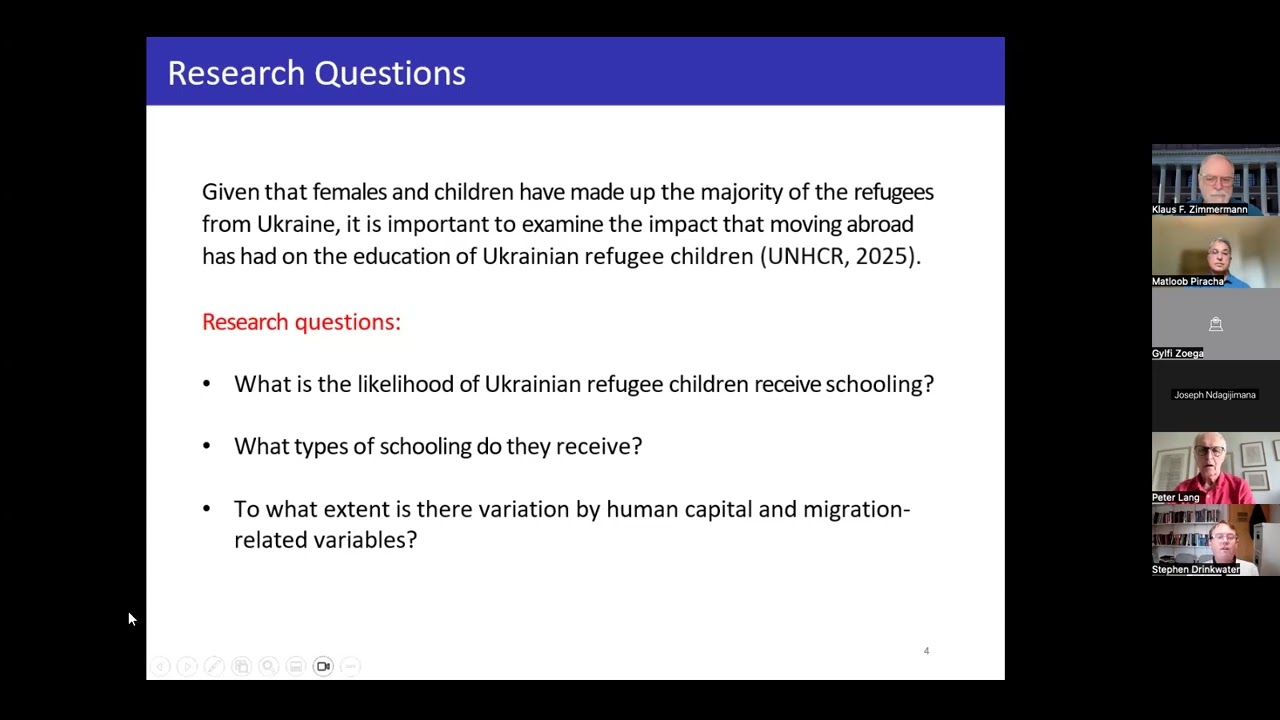
- Research questions and importance of schooling
- Discussion of online vs in-person schooling
- Theoretical framework: human capital and migration
- Data description: UNHCR intentions survey
- Descriptive statistics on schooling attendance
- Descriptive statistics on modes of instruction
- Discussion of country variations and potential explanations
- Conclusion and next steps
Cited Sources
- UNHCR Intentions and Perspectives of Refugees from Ukraine — Main dataset used for the study
Concurring Sources
- UNHCR Ukraine Emergency — Provides official data on refugee numbers and intentions, consistent with the study's dataset.
Contribution & Novelties
This study provides a cross-national analysis of schooling choices among Ukrainian refugee children, using a unique UNHCR dataset. It contributes to the emerging literature on Ukrainian refugee education by examining both attendance and mode of instruction across multiple host countries, offering insights into how human capital and migration-related factors shape these decisions. The findings highlight significant country-level variation, suggesting that policy responses and integration contexts matter.
Pour aller plus loin :
- UNHCR Ukraine Emergency — Official data and reports on Ukrainian refugees.
- Human Capital Theory — Theoretical foundation for investment in education.
- Refugee Education: Integration and Challenges — UNHCR’s perspective on refugee education.
103 words
Radar Profile
The radar profile shows high scores in quantity and quality of information, reflecting the rich dataset and clear presentation. The technical level is moderate, suitable for an academic audience but not overly complex. Overall reliability is good, though the preliminary nature of the research prevents a higher score.