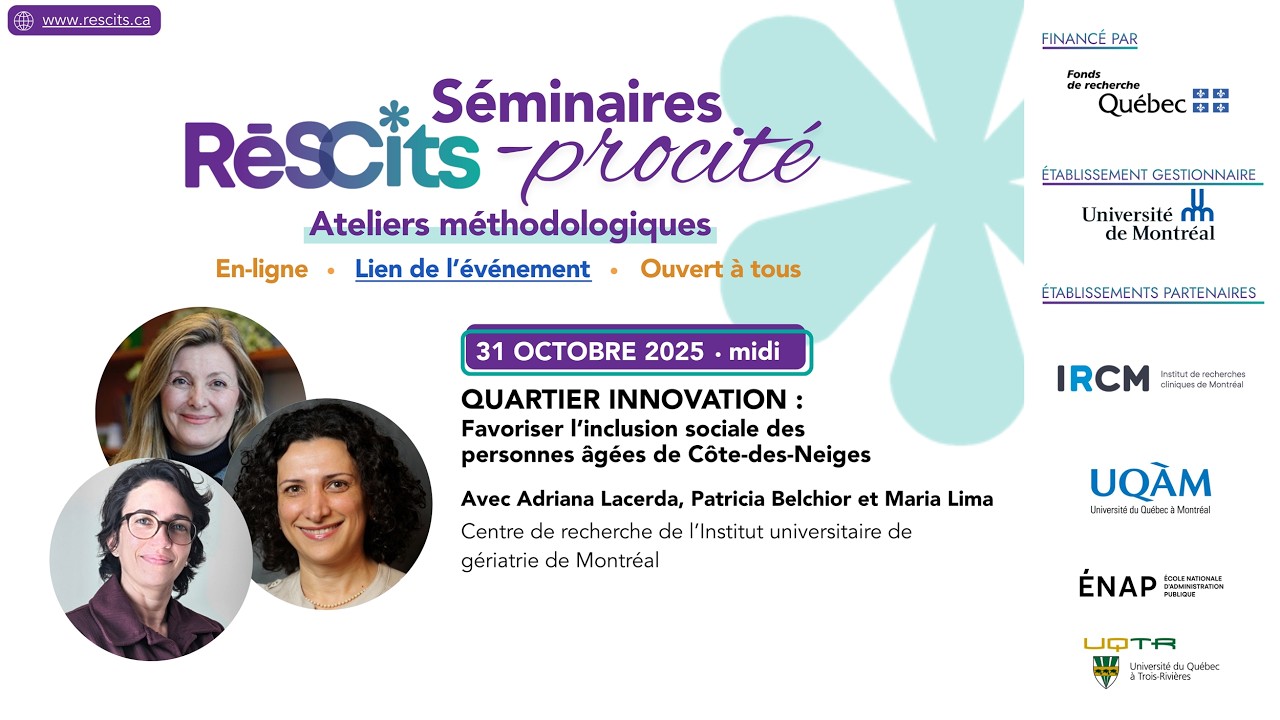
Séminaire RéSCits procité 31 octobre 2025
Keywords
Summary
168 words
Critical Evaluation
Value of the Information & Strength of the Argument
The seminar provides valuable insights into the practical implementation of a living lab approach for social inclusion of older adults. The argumentation is solid, grounded in a clear theoretical framework (European Network of Living Labs) and a structured methodology (embedded case studies, research-action design). The presenters effectively demonstrate the value of co-creation and stakeholder engagement, providing concrete examples of initiatives and their development. The discussion of challenges and lessons learned adds depth to the presentation, though the argumentation could be strengthened by more explicit evidence of outcomes and impacts.
Scientific Rigor, Source Quality, Title Accuracy
The scientific rigor is evident in the systematic approach to establishing the living lab, including needs assessment, stakeholder consultation, and iterative design. The sources cited are primarily internal project documents and references to the European Network of Living Labs, but specific academic references are not explicitly mentioned in the transcript. The title accurately reflects the content, and the presentation is well-structured and coherent. The lack of detailed citations may limit the ability to verify claims, but the project’s alignment with established methodologies lends credibility.
188 words
Title / Content Match
The title accurately reflects the content: a seminar on the Quartier Innovant living lab project, presented by the researchers involved.
Quality & Reliability
7/10
The seminar presents a well-structured research project (living lab) with clear methodology, stakeholder engagement, and concrete outcomes. However, it is a presentation rather than a peer-reviewed publication, and the evidence is primarily descriptive.
Key Moments
Markers derived by PSI from the transcript: the creator did not define chapters.
- Introduction of the speakers and the seminar series.
- Background of the project: origins at CRIUGM and the goal to create an age-friendly neighborhood.
- Consultation with community stakeholders and identification of key needs.
- Definition of living lab and its application in the project.
- Description of the three main themes: cognition, communication, and mobility.
- Methodology: embedded case studies and research-action design.
- Examples of co-creation workshops and principles guiding them.
- Overview of specific initiatives and their development.
- Discussion of outcomes and lessons learned.
- Q&A session and closing remarks.
Cited Sources
- European Network of Living Labs — Definition of living lab used in the project.
Concurring Sources
- European Network of Living Labs — The project aligns with the ENoll definition of living labs.
Contribution & Novelties
The seminar contributes to the understanding of living labs as a methodology for social innovation in aging. It provides a detailed case study of a community-based living lab, highlighting the importance of co-creation and stakeholder engagement. The project’s focus on social inclusion and its multi-thematic approach (cognition, communication, mobility) offers a comprehensive model for addressing the needs of older adults in urban settings.
Pour aller plus loin :
- Living lab — Overview of the living lab concept and its applications.
- Social isolation in older adults — WHO fact sheet on social isolation and loneliness among older adults.
- Participatory action research — Explanation of the research approach used in the project.
110 words
Radar Profile
The radar profile shows high scores in quantity of information and technical level, reflecting the detailed presentation of the project's methodology and outcomes. The quality of information and global reliability are slightly lower, indicating that while the content is well-structured, it relies on descriptive rather than empirical evidence.
💬 No comments were provided for analysis.