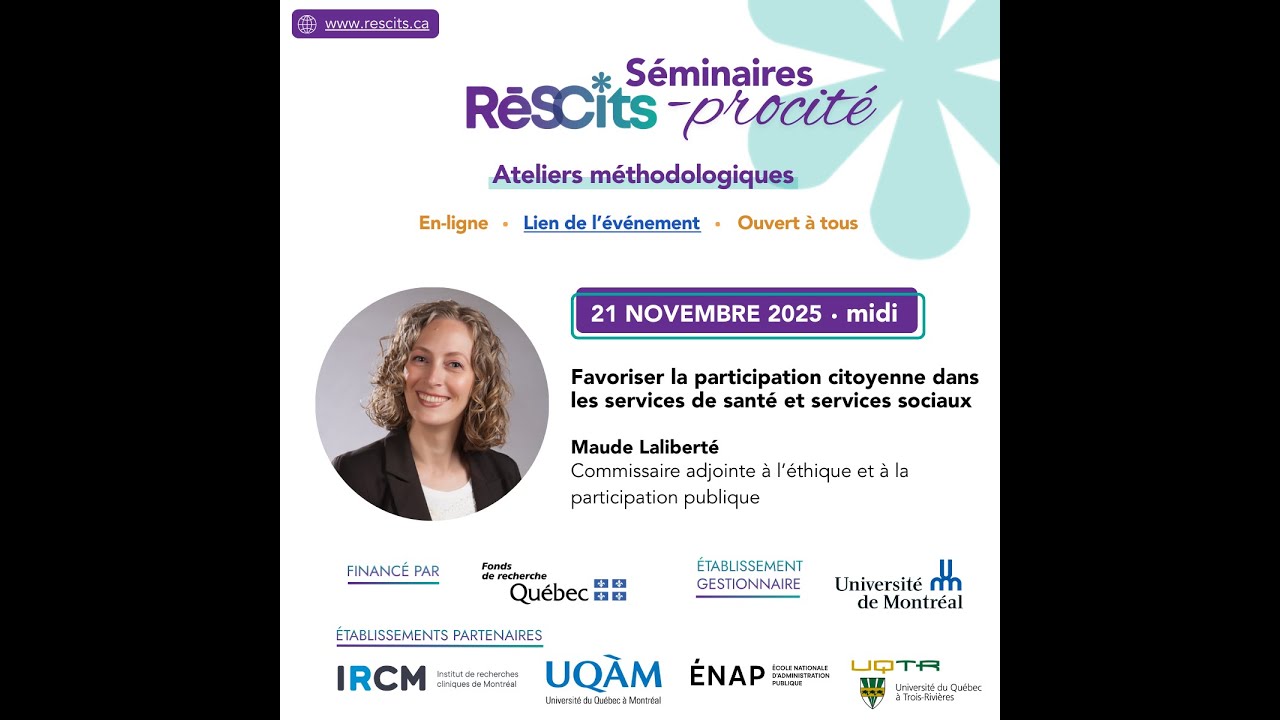
Séminaire RéSCits-procité - Participation citoyenne à la Commission sur la santé et le bien-être
Keywords
Summary
180 words
Critical Evaluation
Value of the Information & Strength of the Argument
The seminar provides valuable insights into the practical implementation of citizen participation in a public health institution. The CSBE team presents a coherent and well-argued case for integrating citizen knowledge into health system evaluation and transformation. They emphasize the importance of ethical deliberation, transparency, and accountability. The argumentation is supported by references to their legislative mandate and specific methodological tools. However, the presentation is largely descriptive and lacks critical examination of potential limitations or challenges of their approach.
87 words
Title / Content Match
The title accurately reflects the seminar's focus on citizen participation in the work of the Commission on Health and Welfare, as presented by the CSBE team.
Quality & Reliability
8/10
The seminar is presented by the Commissaire à la santé et au bien-être du Québec (CSBE), an official public body, and features experts in bioethics and public participation. The content is well-structured, referencing legal foundations and methodological frameworks. However, it is primarily a presentation of institutional practices and perspectives, with limited external verification or critical scrutiny.
Key Moments
Markers derived by PSI from the transcript: the creator did not define chapters.
- Introduction of the seminar and the CSBE team by the network director.
- Maude Laliberté presents the CSBE's mandate and values, emphasizing rigor and diversity of knowledge.
- Maryam Ben Dahmen explains the CSBE's abductive approach and the two-phase process of understanding and transforming the health system.
- René-Pierre Turmel describes the composition and functioning of the consultation forum, including ethical deliberation.
- Romane Pollett presents the narrative framework for the 2025-2026 forum, focusing on systemic obstacles and levers for change.
- Discussion of the first forum session on HIV and stigmatization, including the use of icebreakers and deliberative activities.
- Q&A session begins, addressing questions about the forum's representativeness and the integration of citizen knowledge.
Cited Sources
- Commissaire à la santé et au bien-être du Québec (CSBE) - Official website — The CSBE is the public body discussed in the seminar, and its website provides information on its mandate, reports, and public consultations.
- Légis Québec - Loi sur le commissaire à la santé et au bien-être — The law that establishes the CSBE and its consultation forum, referenced by René-Pierre Turmel.
Concurring Sources
- World Health Organization - Health systems governance — Supports the importance of governance and participation in health systems, aligning with the CSBE's approach.
Contribution & Novelties
The seminar offers a detailed look at how a public health institution operationalizes citizen participation in its governance and evaluation processes. It highlights the CSBE’s innovative use of a legislated consultation forum and a participatory platform to integrate diverse knowledge forms. The presentation of the ’narrative framework’ for the forum is a novel approach to structuring deliberations on systemic issues.
Pour aller plus loin :
- Deliberative democracy — Relevant to the forum’s deliberative methods.
- Citizen participation — Core concept of the seminar.
- Health system performance assessment — Context for the CSBE’s mandate.
92 words
Radar Profile
The radar profile shows high scores in quality of information and global reliability, reflecting the institutional credibility and structured presentation. The quantity of information is moderate, as the seminar focuses on specific institutional practices. The technical level is moderate, suitable for a general academic audience.