GG - Sex Genetics Part 4 - Problems
Keywords
Summary
135 words
Critical Evaluation
Value of the Information & Strength of the Argument
The video provides valuable practice for students learning genetics, especially those preparing for the MCAT. The instructor’s step-by-step approach helps clarify the application of different modes of inheritance. He explains the reasoning behind each step, such as why female birds are hemizygous and why sex-influenced traits require a chart. The argumentation is logical and consistent, building on previously introduced concepts. However, the presentation is informal and lacks visual aids beyond a simple whiteboard, which might limit engagement. The value lies in the practical problem-solving examples, which are directly applicable to exam scenarios.
Scientific Rigor, Source Quality, Title Accuracy
The scientific rigor is moderate: the content is accurate and aligns with standard genetics textbooks, but the video does not cite any sources or references. The instructor relies on his expertise, which is credible given the educational nature of the channel. The title accurately reflects the content, and the video is well-structured for a tutorial. No external sources are mentioned, so the quality of sources cannot be assessed. The adéquation between title and content is good, as the video indeed focuses on problems related to sex genetics.
194 words
Title / Content Match
The title accurately reflects the content, which focuses on solving problems related to sex genetics.
Quality & Reliability
7/10
The video is a tutorial by a genetics educator, likely with expertise, but no formal citations or references are provided. The content is accurate and aligns with standard genetics principles, but the lack of sources and the informal presentation limit the verifiability and depth.
Key Moments
Markers derived by PSI from the transcript: the creator did not define chapters.
- Introduction: The lecture will work through problems on sex-related modes of inheritance.
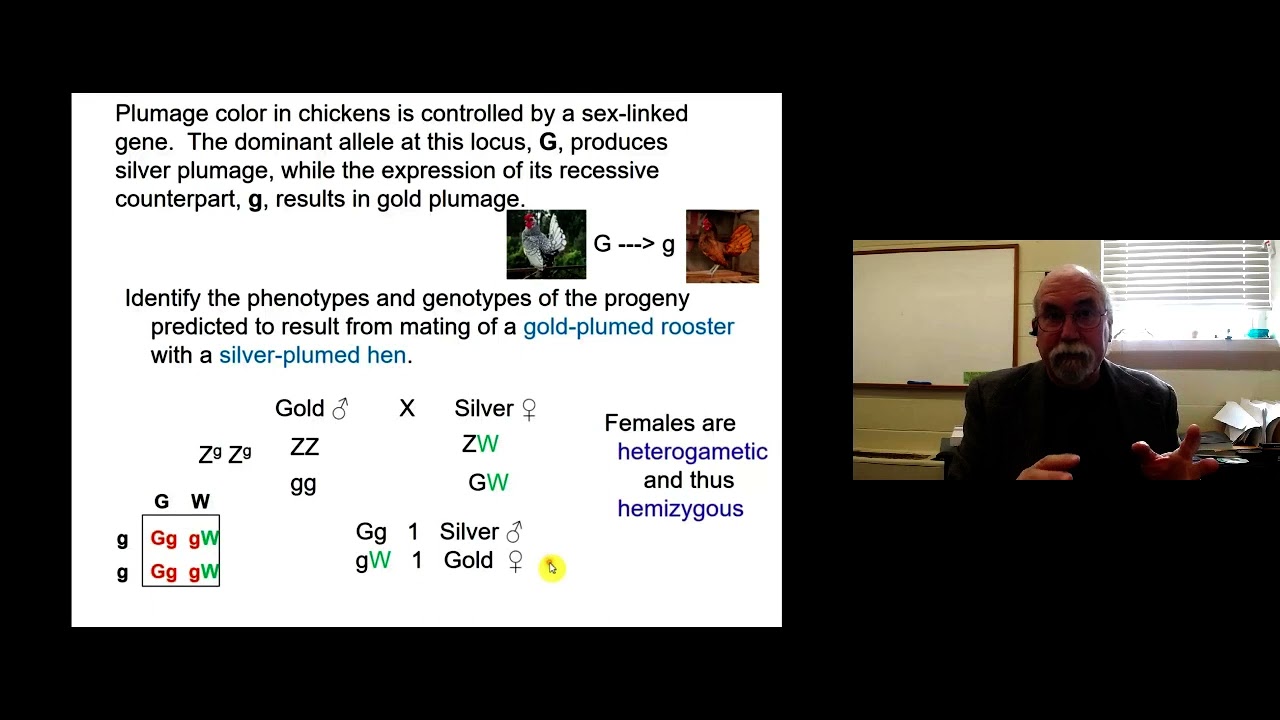
- Problem 1: Sex-linked trait in chickens (silver/gold plumage).
- Explanation of ZW sex-determination system in birds.
- Setting up the cross and Punnett square for the chicken problem.
- Solution: All male progeny are silver, all female progeny are gold (crisscross inheritance).
- Problem 2: Sex-influenced trait in sheep (horn presence).
- Explanation of sex-influenced inheritance and creation of a chart for phenotypes.
- Solution: Half of progeny are horned females, half are polled males.
- Problem 3: Holandric trait (tusk presence) in mammals.
- Solution: 50% tusked males, 50% non-tusked females.
- Summary of sex-limited, sex-influenced, and sex-linked inheritance.
Contribution & Novelties
The video offers a practical tutorial on solving genetics problems involving sex-related modes of inheritance, which is valuable for students. It clarifies common misconceptions, such as the difference between sex-linked and sex-influenced traits, and emphasizes the importance of recognizing the mode of inheritance from problem clues. The examples are well-chosen and directly applicable to exam settings.
Pour aller plus loin :
- Sex linkage — Overview of sex-linked inheritance.
- Sex-influenced traits — Explanation of traits where expression depends on sex.
- Holandric inheritance — Definition and examples of Y-linked inheritance.
- ZW sex-determination system — Details on the system in birds and other organisms.
101 words
Radar Profile
The radar profile shows a balanced performance across all dimensions, with slightly higher scores in information quantity and quality, reflecting the tutorial's focus on practical problem-solving. The technical level is moderate, suitable for intermediate students, and the overall reliability is good given the educational context.