HG Quantitative Genetics Part 2
Keywords
Summary
148 words
Critical Evaluation
Value of the Information & Strength of the Argument
The lecture provides a solid foundation in quantitative genetics, clearly explaining the decomposition of phenotypic variance and the distinction between broad and narrow sense heritability. The argumentation is logical and builds upon previous lectures, using examples to illustrate abstract concepts. The instructor effectively communicates the importance of additive genetic variance for selection and breeding. However, the lecture lacks depth in discussing the limitations and assumptions of heritability estimates, such as the assumption of fixed environments and the potential for genotype-environment interactions. The argumentation is generally sound but could benefit from more critical analysis of the methods and their interpretations.
Scientific Rigor, Source Quality, Title Accuracy
The lecture is scientifically accurate and aligns with established quantitative genetics principles. However, it does not cite specific sources or studies, which limits its scientific rigor. The title accurately reflects the content, as it is a continuation of a series on quantitative genetics. The lecture is well-structured and the instructor’s explanations are clear, but the lack of references and the informal tone may reduce its credibility for a more advanced audience. The content is appropriate for an introductory level, but it does not engage with the primary literature or recent advances in the field.
208 words
Title / Content Match
The title accurately reflects the content, which is a continuation of a series on quantitative genetics, focusing on key concepts and terminology.
Quality & Reliability
7/10
The lecture provides a clear and accurate overview of quantitative genetics concepts, including variance decomposition and heritability. The content aligns with established genetic principles, though it lacks citations to specific studies or sources. The presentation is didactic and suitable for an introductory audience, but the lack of references and the informal tone slightly reduce its scientific rigor.
Key Moments
Markers derived by PSI from the transcript: the creator did not define chapters.
- Introduction to the lecture, outlining topics: variance and heritability.
- Explanation of quantitative genetics focusing on variance and distribution of traits.
- Decomposition of phenotypic variance into genetic and environmental components.
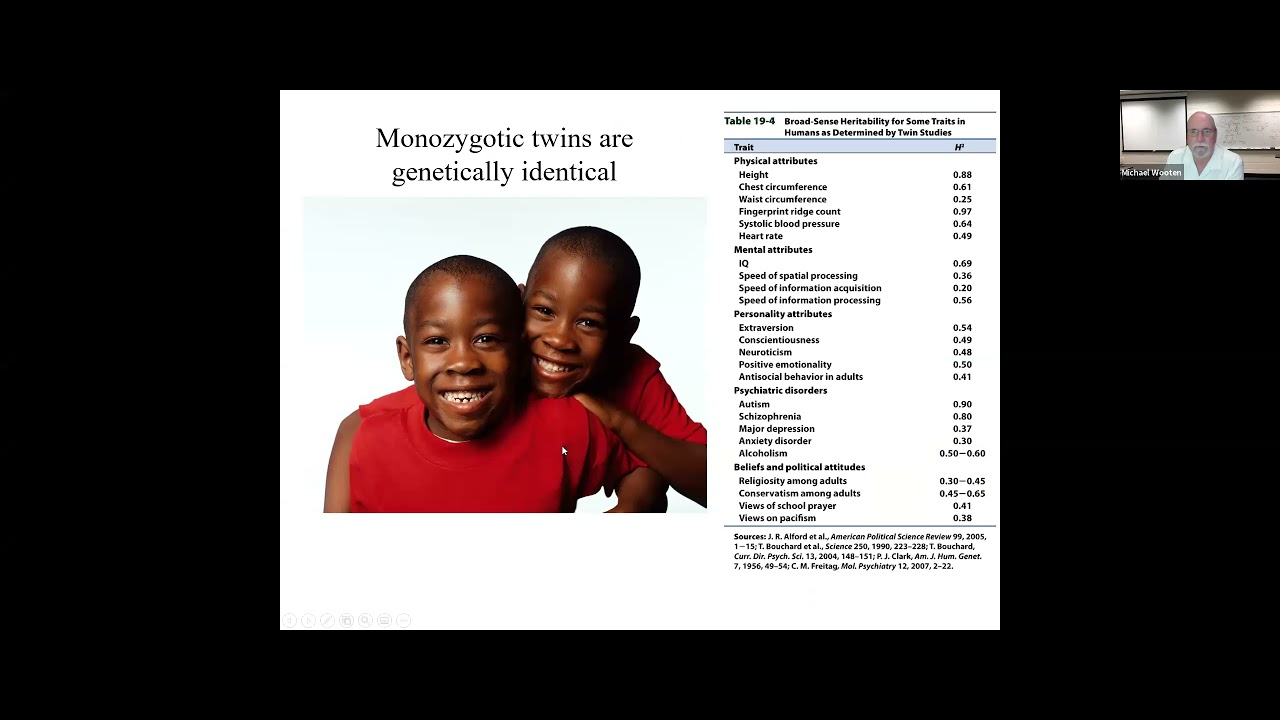
- Discussion of twin studies as a method to estimate heritability.
- Introduction to broad-sense heritability and its calculation.
- Examples of broad-sense heritability in human traits like height and weight.
- Breakdown of genetic variance into additive, dominance, and interaction components.
- Explanation of additive gene action and its importance in selection.
- Introduction to narrow-sense heritability and its use in breeding.
- Examples of narrow-sense heritability in humans and implications for selection.
Contribution & Novelties
This lecture provides a clear and accessible introduction to quantitative genetics, particularly for students new to the field. It effectively explains the decomposition of phenotypic variance and the distinction between broad and narrow sense heritability, which are foundational concepts. The use of examples from human traits helps to make the material relatable. However, the lecture does not introduce novel concepts or methods, and it lacks engagement with recent advances in quantitative genetics, such as genomic selection or GWAS.
Pour aller plus loin :
- Heritability — Provides a comprehensive overview of heritability, including its calculation and interpretation.
- Quantitative genetics — Offers a broader context for the concepts discussed in the lecture.
- Twin study — Explains the methodology and applications of twin studies in estimating heritability.
- Additive genetic effects — Details the concept of additive genetic variance and its role in selection.
140 words
Radar Profile
The radar profile shows a balanced performance across all dimensions, with slightly lower scores in technical level and reliability. This reflects the lecture's introductory nature and lack of citations, while still providing a solid foundation in quantitative genetics.