GG Cytology Part 2
Keywords
Summary
154 words
Critical Evaluation
Value of the Information & Strength of the Argument
The lecture provides valuable information on polyploidy, a key concept in genetics and agriculture. The instructor effectively explains complex topics using relatable examples like bananas, potatoes, and cotton, making the content accessible. The argumentation is solid, as he logically progresses from defining terms to discussing mechanisms and real-world applications. However, the presentation lacks depth in some areas, such as the molecular mechanisms behind polyploidy, and relies heavily on anecdotal examples rather than citing specific studies. The discussion of the Irish potato famine and the genetic vulnerability of clonal crops is particularly insightful, highlighting the practical consequences of polyploidy.
Scientific Rigor, Source Quality, Title Accuracy
The scientific rigor is moderate. The instructor demonstrates a good understanding of the subject and presents accurate information, but he does not cite specific sources or studies. The content aligns with standard genetics textbooks, but the lack of references reduces its scholarly value. The title ‘Cytology Part 2’ is appropriate, as the lecture continues the cytology series and focuses on chromosome number changes. The adéquation between title and content is good, though the title could be more descriptive. No comments were provided for analysis.
197 words
Title / Content Match
The title is concise and accurately reflects the content, which is a continuation of cytology lectures focusing on chromosome number changes.
Quality & Reliability
7/10
The content is scientifically accurate and well-structured, covering fundamental concepts of euploidy and polyploidy with relevant examples. However, the presentation is informal and lacks citations to primary literature, relying on general knowledge and textbook-style explanations.
Key Moments
Markers derived by PSI from the transcript: the creator did not define chapters.
- Introduction to cytology and overview of chromosome number changes.
- Definition of euploidy and its relevance in different organisms.
- Explanation of autopolyploidy with examples like bananas and watermelons.
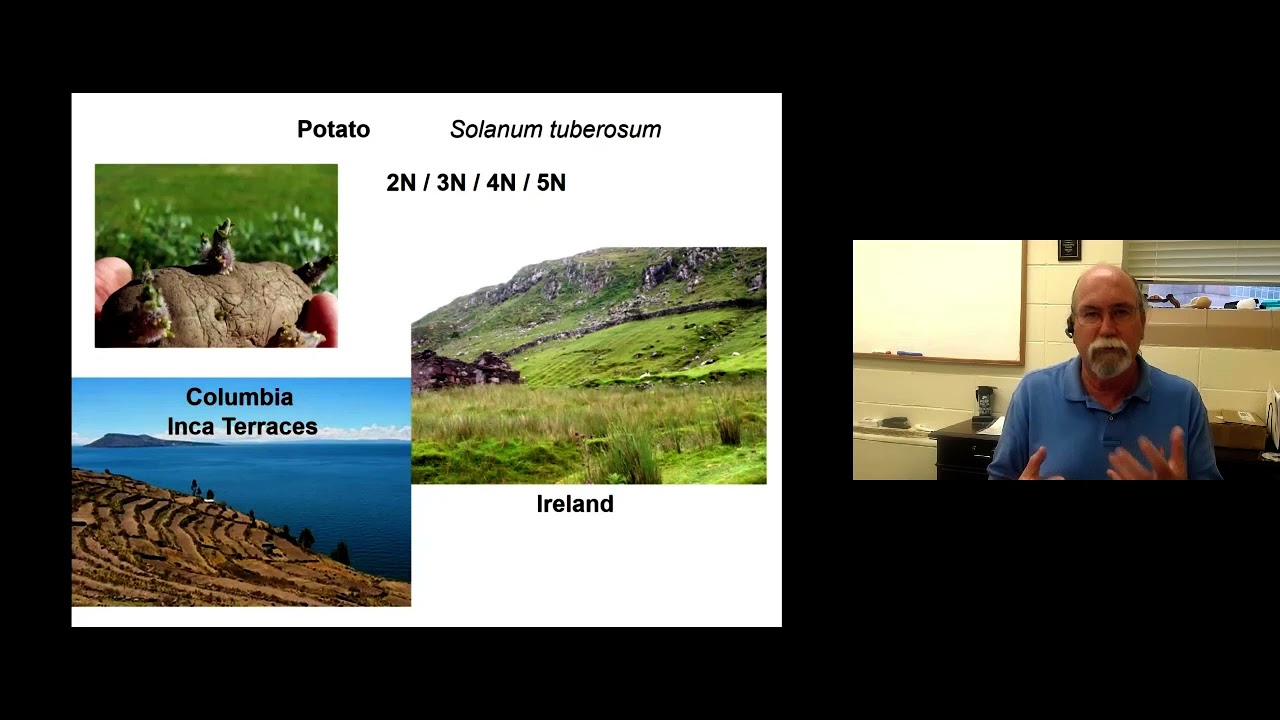
- Discussion of tetraploid potatoes and the Irish potato famine.
- Introduction to allopolyploidy and examples like cotton and wheat.
- Explanation of endopolyploidy with examples from liver cells and Drosophila.
- Conclusion and transition to aneuploidy in the next lecture.
Contribution & Novelties
The lecture provides a comprehensive overview of polyploidy, emphasizing its agricultural significance and evolutionary implications. It uniquely connects concepts like autopolyploidy and allopolyploidy to real-world examples, such as the genetic vulnerability of clonal crops leading to the Irish potato famine. The discussion of endopolyploidy in specific tissues adds depth. For further exploration, consider these resources:
Pour aller plus loin :
- Polyploidy - Wikipedia — Overview of polyploidy types and mechanisms.
- Allopolyploidy - Wikipedia — Detailed explanation of allopolyploid formation.
- Endopolyploidy - Wikipedia — Information on endopolyploidy in various organisms.
89 words
Radar Profile
The radar profile shows a balanced performance across all dimensions, with slightly higher scores in information quantity and technical level, indicating a solid educational resource. The lower score in information quality suggests room for improvement in citing sources and providing more rigorous scientific backing.