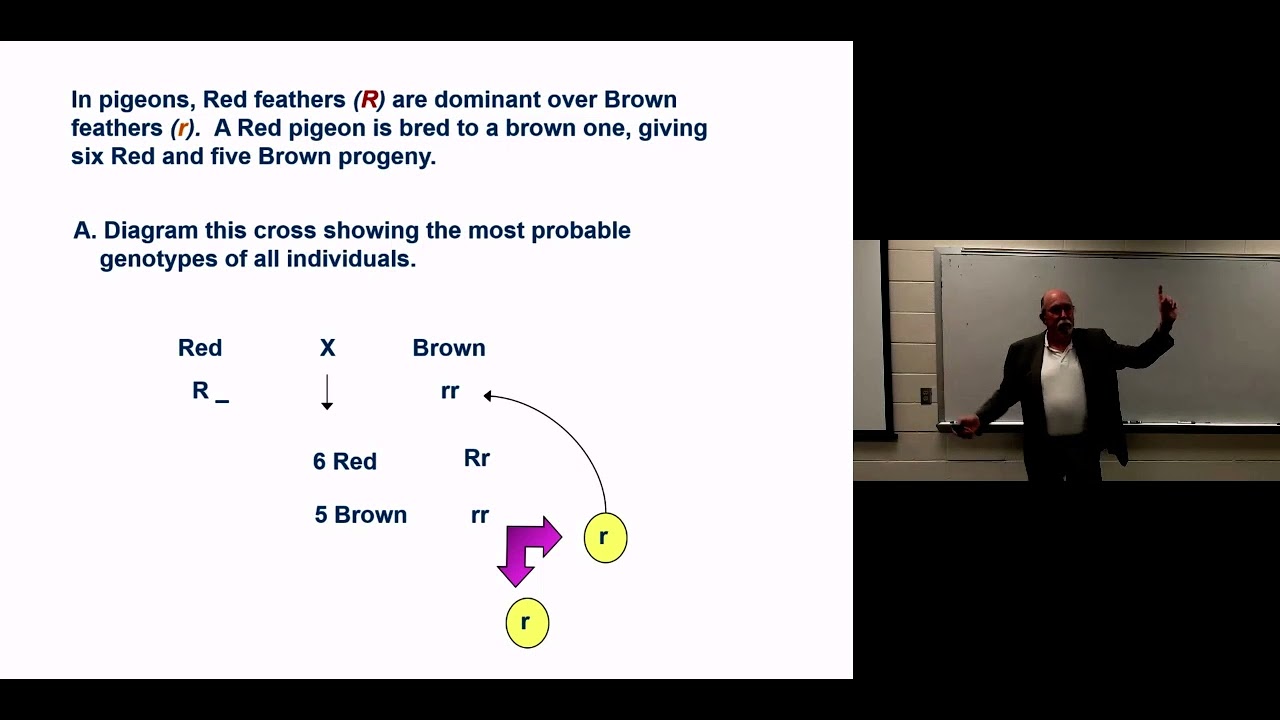
GG Mendelian Monohybrids Part 3
Keywords
Summary
150 words
Critical Evaluation
Value of the Information & Strength of the Argument
The video provides clear and practical value for students learning Mendelian genetics. It offers a step-by-step problem-solving strategy that is logical and easy to follow. The argumentation is sound, as the instructor explains the reasoning behind each step, such as why a 3:1 ratio indicates a heterozygous cross and why the appearance of a recessive phenotype in offspring reveals the parents’ genotypes. The use of multiple examples reinforces the concepts and demonstrates their application. The emphasis on using the ‘Big Six’ sheet as a reference is a practical pedagogical tool. However, the video does not delve into the underlying molecular mechanisms or historical context, which might be a limitation for advanced learners.
Scientific Rigor, Source Quality, Title Accuracy
The scientific rigor is adequate for an introductory tutorial. The content is accurate and aligns with standard genetic principles. However, the video does not cite any external sources or references, relying solely on the instructor’s explanations. The title accurately reflects the content, as it is indeed the third part of a series on Mendelian monohybrids. The video’s approach is consistent with established educational methods for teaching genetics.
194 words
Title / Content Match
The title accurately reflects the content, which is the third part of a series on Mendelian monohybrid crosses.
Quality & Reliability
7/10
The content is a straightforward tutorial on Mendelian genetics, accurately explaining the principles of segregation and Punnett square analysis. The information is correct and aligns with established genetic knowledge, but it lacks citations to primary sources and is presented in a conversational style typical of an educational video.
Key Moments
Markers derived by PSI from the transcript: the creator did not define chapters.
- Introduction and reminder to have the 'Big Six' sheet ready.
- First practice problem: red vs brown feathers in pigeons, emphasizing writing down known information.
- Explanation of using ratios to determine parental genotypes, specifically 1:1 ratio indicating a test cross.
- Second practice problem: albinism in humans, using the appearance of an albino child to deduce carrier parents.
- Discussion of alternative outcomes and the possibility of homozygous dominant parents when no recessive offspring appear.
- Third practice problem: black and white mice, using a 3:1 ratio to infer heterozygous parents.
- Explanation of how to determine dominant and recessive alleles from the ratio.
- Conclusion and preview of future topics involving dihybrid crosses.
Contribution & Novelties
This video provides a practical, step-by-step approach to solving Mendelian monohybrid problems, emphasizing the use of a reference sheet and logical deduction. It is particularly useful for beginners who need a clear methodology. The video does not introduce new scientific concepts but rather reinforces foundational knowledge through examples.
Pour aller plus loin :
- Mendelian inheritance - Wikipedia — Provides a comprehensive overview of Mendel’s laws and their applications.
- Punnett square - Wikipedia — Explains the tool used to predict genotypes and phenotypes in genetic crosses.
- Test cross - Wikipedia — Details the method used to determine an individual’s genotype by crossing with a homozygous recessive.
105 words
Radar Profile
The radar profile shows balanced scores across all dimensions, with slightly higher scores in information quantity and quality, reflecting the video's solid educational content. The technical level is moderate, suitable for introductory genetics students. The overall reliability is good, though the lack of cited sources slightly lowers the score.