GG RNA Processing Part 3
Keywords
Summary
145 words
Critical Evaluation
Value of the Information & Strength of the Argument
The video provides valuable information on alternative splicing, a key mechanism in gene expression. It explains the concept clearly, using concrete examples like calcitonin and tropomyosin to illustrate how different tissues can produce different proteins from the same gene. The argumentation is solid, as it builds on previously discussed concepts (capping, polyadenylation, splicing) and logically progresses to alternative splicing and its implications. The instructor also highlights the importance of co-transcriptional splicing and the role of regulatory elements, which adds depth to the discussion. However, the video lacks citations to specific studies or sources, which weakens its scientific rigor. The informal tone and occasional digressions (e.g., about migraines) may reduce focus but do not undermine the core content.
Scientific Rigor, Source Quality, Title Accuracy
The video demonstrates a good understanding of the subject, but it does not cite specific sources or studies. The description provides no links to references, so the scientific basis relies on the instructor’s expertise. The title accurately reflects the content, which is a continuation of a series on RNA processing. The video is suitable for an audience with some background in molecular biology, as it assumes familiarity with transcription and translation. The lack of citations is a notable weakness, but the information presented is generally accurate and up-to-date. The video does not include any advertising or sponsored content.
230 words
Title / Content Match
The title 'RNA Processing Part 3' accurately reflects the content, which focuses on RNA processing, specifically alternative splicing and its implications.
Quality & Reliability
6/10
The video provides a clear and accurate overview of RNA processing, including alternative splicing, with specific examples (calcitonin/CGRP, tropomyosin) and mentions of therapeutic approaches. However, it lacks citations to primary literature and contains some informal language and minor inaccuracies (e.g., '38,016 splice variants' for Dscam, which is actually 38,016 possible isoforms, but the number is correct). The content is generally reliable for educational purposes.
Key Moments
Markers derived by PSI from the transcript: the creator did not define chapters.
- Introduction to RNA processing and alternative splicing
- Explanation of exon skipping and its role in generating protein diversity
- Example of Dscam gene in Drosophila with 38,016 possible splice variants
- Discussion of co-transcriptional splicing and regulatory elements
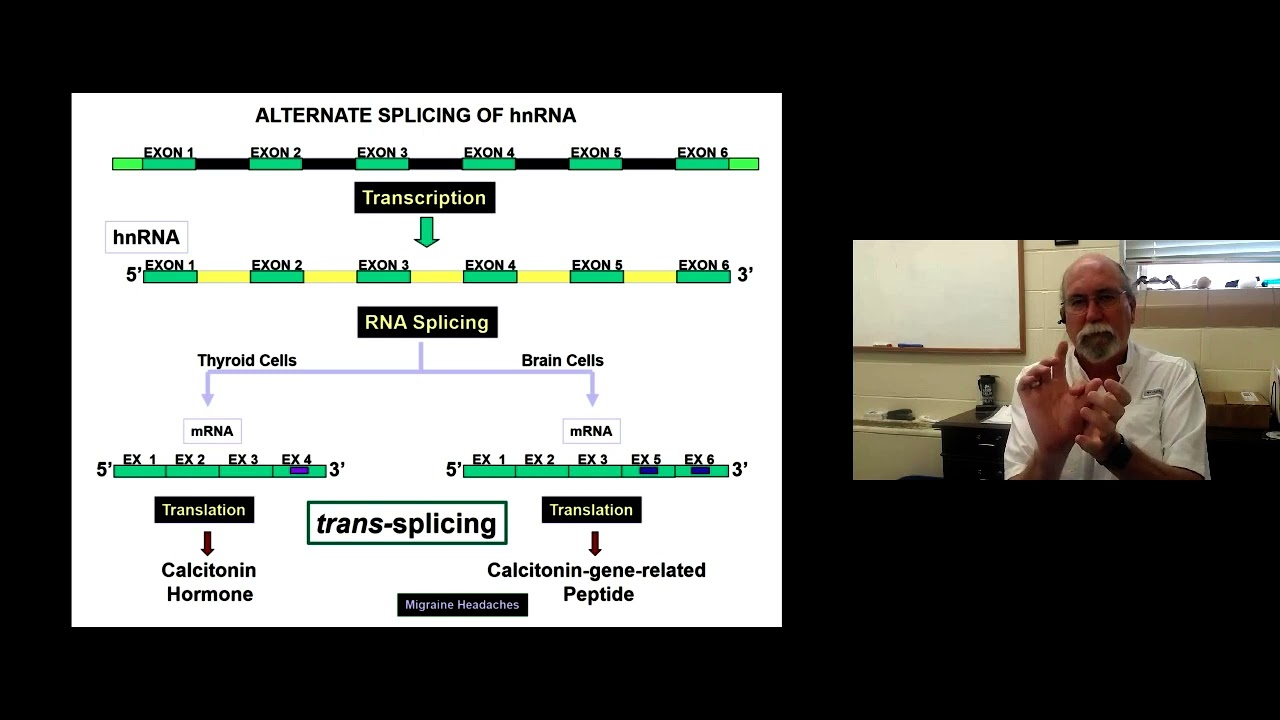
- Example of calcitonin/CGRP gene and its tissue-specific splicing
- Example of tropomyosin gene with different splicing in muscle and brain
- Discussion of splicing defects and their link to diseases like migraine
- Therapeutic approaches using antisense oligonucleotides for splicing correction
- Conclusion: one gene can produce many proteins, challenging the central dogma
Contribution & Novelties
The video provides a clear and accessible explanation of alternative splicing, emphasizing its importance in generating protein diversity and its implications for disease. It highlights the concept of co-transcriptional splicing and the role of regulatory elements, which is a relatively recent area of research. The examples of calcitonin/CGRP and tropomyosin are well-chosen to illustrate tissue-specific splicing. The video also introduces therapeutic strategies like antisense oligonucleotides, which are relevant for treating genetic disorders.
Pour aller plus loin :
- Alternative splicing — Comprehensive overview of the mechanisms and significance of alternative splicing.
- Dscam gene — Details on the Drosophila Dscam gene and its thousands of splice variants.
- Antisense oligonucleotide therapy — Explanation of how antisense oligonucleotides can modulate splicing for therapeutic purposes.
120 words
Radar Profile
The radar profile shows a balanced performance across all dimensions, with slightly higher scores in information quantity and quality, and lower in technical level and reliability. This indicates a solid educational video that is informative but lacks depth in technical detail and rigorous sourcing.