GG Mendelian Monohybrids Part 1
Keywords
Summary
161 words
Critical Evaluation
Value of the Information & Strength of the Argument
The lecture provides a clear and accurate explanation of Mendelian monohybrid crosses, effectively using the historical narrative of Mendel’s experiments to illustrate the logic behind the principles. The argumentation is sound, building from the observation of 3:1 ratios to the inference of a 1:2:1 genotypic ratio and the principle of segregation. The instructor emphasizes the importance of understanding these fundamentals for tackling more complex genetic problems, which adds practical value. However, the lecture is introductory and does not delve into molecular mechanisms or exceptions, limiting its depth.
Scientific Rigor, Source Quality, Title Accuracy
The scientific rigor is adequate for an introductory lecture. The content aligns with standard genetics textbooks, and the historical account of Mendel is accurate. However, no specific sources are cited, and the lecture relies on the instructor’s expertise. The title accurately reflects the content, which is focused on monohybrid crosses. The lecture does not include any commercial or promotional segments.
162 words
Title / Content Match
The title accurately reflects the content, which focuses on Mendelian monohybrid crosses.
Quality & Reliability
7/10
The lecture is based on established Mendelian genetics principles, presented by an experienced educator. The content is accurate and aligns with standard genetics textbooks, though it lacks citations to primary sources and is delivered in a conversational style.
Key Moments
Markers derived by PSI from the transcript: the creator did not define chapters.
- Introduction to the series on Mendelian genetics, emphasizing the importance of understanding monohybrid crosses.
- Overview of topics to be covered: genes, alleles, loci, homozygotes, heterozygotes, phenotype, genotype, and mode of inheritance.
- Transition from molecular genetics to transmission genetics, with an analogy to art history.
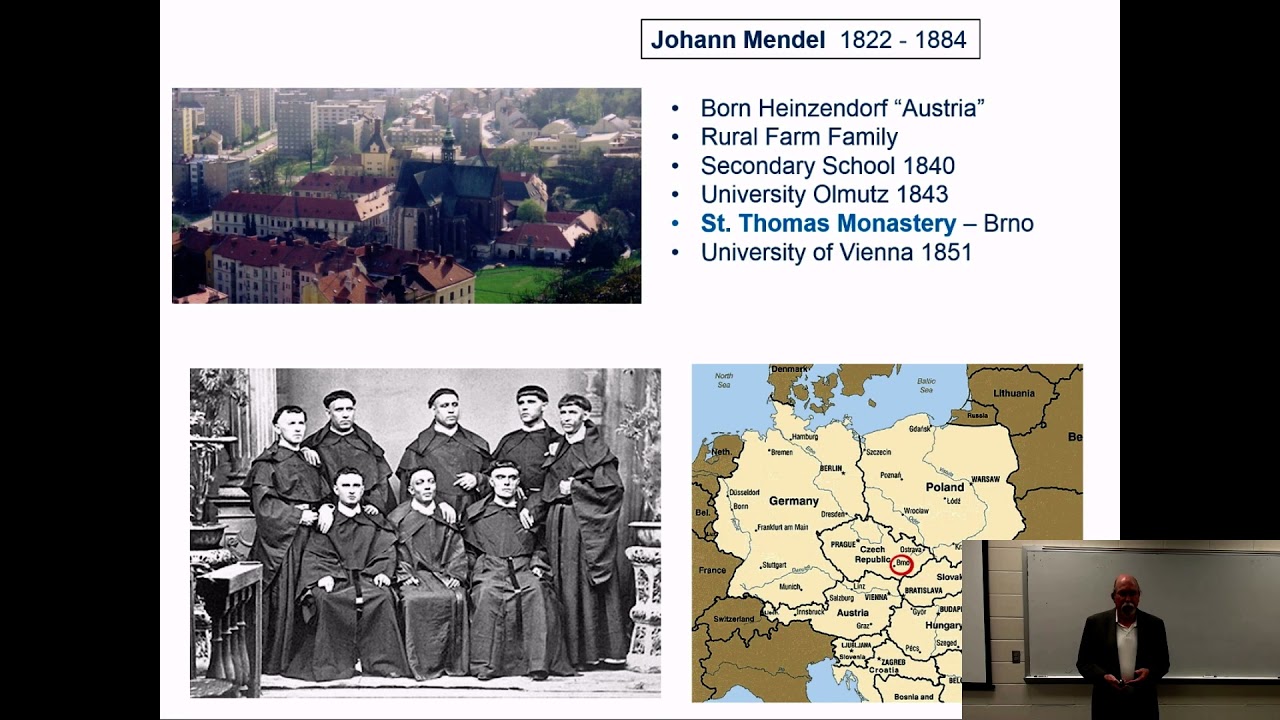
- Biographical background on Gregor Mendel and his work with pea plants.
- Explanation of Mendel's monohybrid cross setup and the F1 generation results, which contradicted blending inheritance.
- Description of the F2 generation and the reappearance of the recessive trait in a 3:1 ratio.
- Mendel's inference of the 1:2:1 genotypic ratio and the concept of mode of inheritance.
Contribution & Novelties
The lecture provides a clear pedagogical introduction to Mendelian monohybrid crosses, using a historical narrative to explain the logic behind the principles. It emphasizes the distinction between genotypic and phenotypic ratios and introduces the concept of mode of inheritance. While the content is not novel, the presentation is effective for beginners.
Pour aller plus loin :
- Mendelian inheritance — Overview of Mendel’s laws and their applications.
- Gregor Mendel — Detailed biography and context of his experiments.
- Punnett square — Tool for predicting genotype and phenotype ratios in crosses.
88 words
Radar Profile
The radar profile shows a balanced performance across all dimensions, with slightly higher scores in quality of information and technical level, indicating a solid educational resource for beginners.