GG DNA Replication Part 1
Keywords
Summary
139 words
Critical Evaluation
Value of the Information & Strength of the Argument
The video provides a solid conceptual foundation for understanding DNA replication, clearly explaining the three models and the experimental evidence supporting semi-conservative replication. The argumentation is logical and builds from the need for replication to the experimental proof. However, the presentation is somewhat informal and lacks depth in explaining the molecular details, which are deferred to later lectures. The value lies in its clarity for beginners, but it does not offer novel insights or advanced analysis.
Scientific Rigor, Source Quality, Title Accuracy
The scientific rigor is acceptable for an introductory lecture. The instructor correctly describes the Taylor-Woods-Hughes experiment and the semi-conservative model, but does not provide specific citations or references. The title accurately reflects the content, which is a basic overview. The lecture is based on established textbook knowledge, but the lack of explicit sources limits its scholarly value.
148 words
Title / Content Match
The title accurately reflects the content, which is an introductory lecture on DNA replication.
Quality & Reliability
7/10
The video provides a clear and accurate overview of DNA replication, correctly explaining the semi-conservative model and citing the classic Taylor-Woods-Hughes experiment. However, it lacks detailed citations and contains minor inaccuracies (e.g., 'meiotic division' instead of 'mitotic division' for skin cells). The content is based on established textbook knowledge.
Key Moments
Markers derived by PSI from the transcript: the creator did not define chapters.
- Introduction to DNA replication and its importance for cell division.
- Discussion on why replication is needed: cell size, tissue replacement, and reproduction.
- Explanation of the timing of replication: S phase, not prophase.
- Introduction of the three models: conservative, dispersive, and semi-conservative.
- Description of the Taylor-Woods-Hughes experiment with radioactive thymidine.
- Explanation of why dispersive model was considered and conclusion on semi-conservative model.
Cited Sources
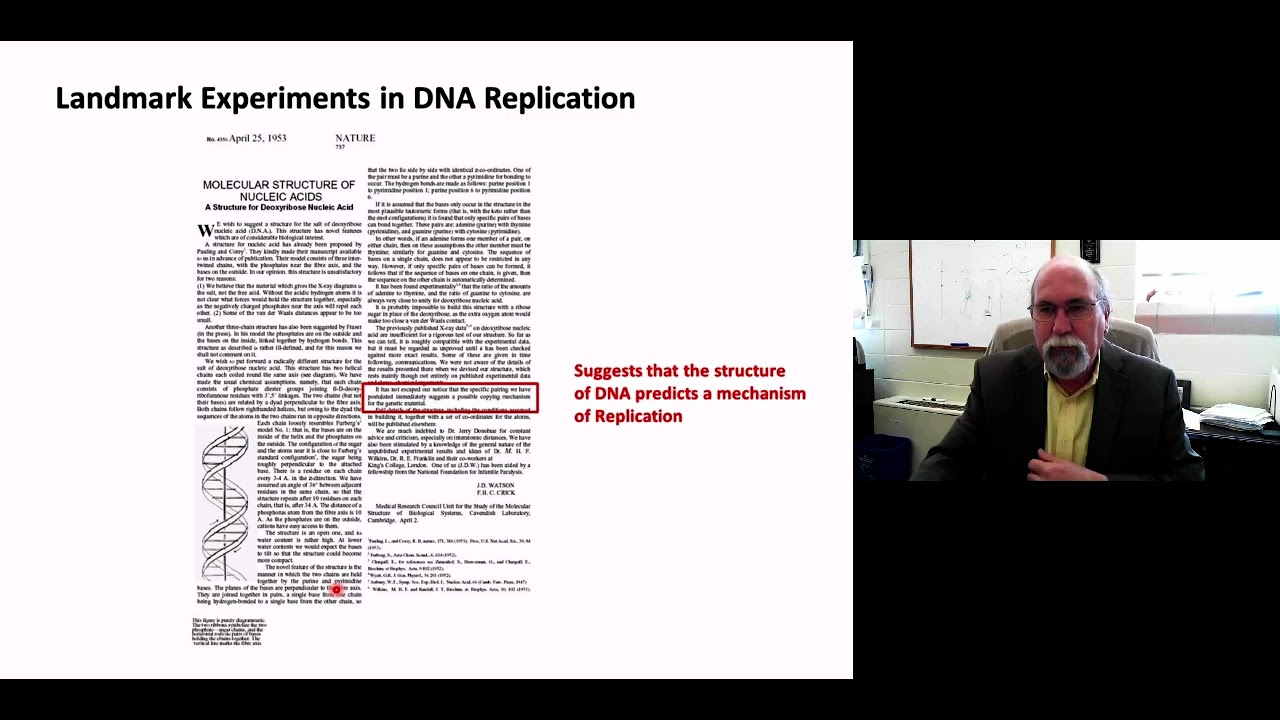
- Watson and Crick's paper on DNA structure — Mentioned as the original proposal of the double helix and semi-conservative replication.
- Taylor, Woods, and Hughes experiment (1957) — Cited as the definitive experiment demonstrating semi-conservative replication in eukaryotes.
Concurring Sources
- Meselson-Stahl experiment — Supports the semi-conservative model with a different experimental approach.
Contribution & Novelties
The video provides a clear and accessible explanation of the semi-conservative model of DNA replication, using the Taylor-Woods-Hughes experiment as evidence. It also clarifies common misconceptions about the timing of replication. However, it does not present new research or novel perspectives.
Pour aller plus loin :
- Meselson-Stahl experiment — The classic experiment that confirmed semi-conservative replication in E. coli.
- DNA replication — Comprehensive overview of the molecular mechanisms.
- Cell cycle — Context for S phase and replication timing.
78 words
Radar Profile
The radar profile shows moderate scores across all dimensions, indicating a balanced but not exceptional video. The highest scores are in quality of information and reliability, reflecting accurate content, while quantity and technical level are lower due to the introductory nature.