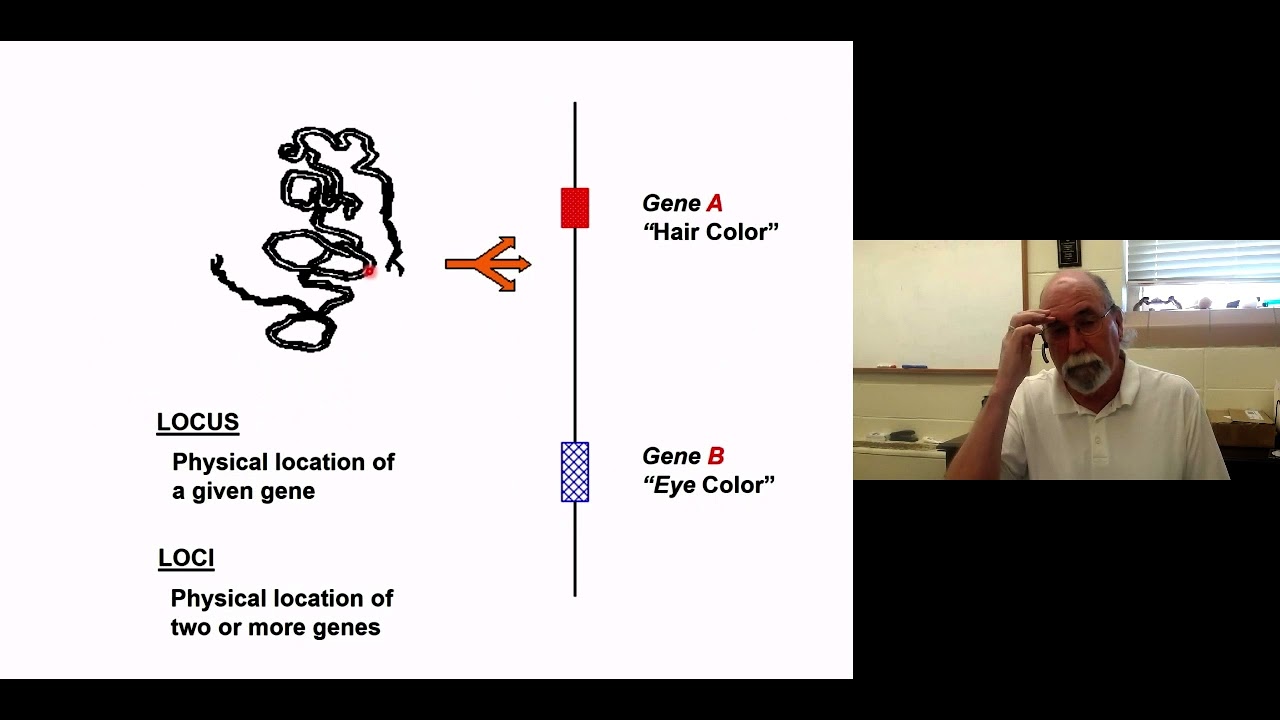
GG Linkage Part 1
Keywords
Summary
165 words
Critical Evaluation
Value of the Information & Strength of the Argument
The lecture provides a solid foundational understanding of genetic linkage, clearly explaining why linkage violates Mendel’s second principle but not the first. The argumentation is logical, starting with a concrete example that demonstrates deviation from Mendelian ratios, then introducing the physical basis (chromosomes) and the mechanisms (crossing over and recombination) that explain the observations. The instructor effectively distinguishes between crossing over and recombination, a common point of confusion, and uses analogies (e.g., cities and countryside) to illustrate gene distribution on chromosomes. The value lies in its pedagogical clarity, making complex concepts accessible without oversimplifying.
Scientific Rigor, Source Quality, Title Accuracy
The scientific rigor is high for an introductory lecture: the content aligns with established genetic principles and the instructor accurately describes the relationship between map units and recombination frequency. He references the National Institutes of Health (NIH) as a resource for chromosome maps, which is a credible source. The title ‘GG Linkage Part 1’ is appropriate and accurately reflects the content. No external sources are cited in the description, but the lecture’s internal consistency and alignment with textbook genetics support its reliability.
191 words
Title / Content Match
The title 'GG Linkage Part 1' is concise and accurately reflects the content, which is the first part of a series on genetic linkage.
Quality & Reliability
8/10
The lecture provides a clear, accurate overview of genetic linkage, correctly distinguishing crossing over from recombination and explaining map units. It is based on established genetic principles and includes references to NIH resources. Minor simplifications (e.g., 'one map unit equals one percent recombination' is a classic approximation) are appropriate for an introductory audience.
Key Moments
Markers derived by PSI from the transcript: the creator did not define chapters.
- Introduction to linkage and its relation to Mendel's principles.
- Definition of linkage and its violation of independent assortment.
- Example of a dihybrid cross showing deviation from 9:3:3:1 ratio.
- Explanation of crossing over and recombination.
- Discussion of linkage groups and linkage maps.
- Introduction of map units and their definition.
- Example of a human chromosome 19 linkage map.
- Comparison of human and mouse chromosomes.
- Applications of linkage mapping in genetics.
- Introduction to two-point and three-point mapping.
Cited Sources
- National Institutes of Health (NIH) - Human Chromosome Markers — Mentioned as a resource for finding human chromosome maps and disease-related genes.
Concurring Sources
- Genetic Linkage - National Human Genome Research Institute — Provides a definition of linkage consistent with the lecture.
Contribution & Novelties
This lecture provides a clear, structured introduction to genetic linkage, emphasizing the distinction between crossing over and recombination, which is often misunderstood. It connects classical Mendelian genetics to chromosomal inheritance, using concrete examples and analogies to aid understanding. The lecture also highlights the practical applications of linkage mapping in understanding gene regulation and chromosomal mutations.
Pour aller plus loin :
- Genetic linkage - Wikipedia — Provides a comprehensive overview of linkage, including historical context and modern applications.
- Crossing over - Wikipedia — Explains the physical process of crossing over during meiosis.
- Recombination - Wikipedia — Details the genetic outcomes of recombination and its role in evolution.
- Linkage map - Wikipedia — Discusses the construction and use of genetic maps.
- Map unit (centimorgan) - Wikipedia — Defines the map unit and its relationship to recombination frequency.
135 words
Radar Profile
The radar profile shows high scores in quality and reliability, with moderate scores in quantity and technical level, indicating a well-structured introductory lecture that is scientifically sound but not extremely detailed or advanced.