GG Epistasis Part 2
Keywords
Summary
166 words
Critical Evaluation
Value of the Information & Strength of the Argument
The video provides a solid educational value by systematically explaining epistasis through classic examples and clear reasoning. The argumentation is logical and builds from basic Mendelian genetics to more complex interactions. The instructor uses analogies (e.g., light switch) to make abstract concepts accessible. However, the presentation is didactic rather than critical, and it does not engage with alternative interpretations or recent research. The focus is on established textbook knowledge, which is appropriate for an introductory genetics course.
Scientific Rigor, Source Quality, Title Accuracy
The scientific rigor is high in terms of accuracy and clarity, but the video does not cite specific sources or references. The content is based on well-established genetics principles, but the lack of citations limits its utility for verification. The title is somewhat informal (‘GG’ likely stands for ‘Genetics’ or ‘Good Game’), but it accurately reflects the content. The video is a tutorial, and the instructor’s expertise is evident, but the absence of external references is a minor weakness.
171 words
Title / Content Match
The title 'GG Epistasis Part 2' is somewhat cryptic but accurately indicates it is the second part of a series on epistasis. The content matches the title, focusing on epistatic modes of inheritance.
Quality & Reliability
8/10
The video provides a clear, structured explanation of epistasis, using classic examples and ratios. The content is scientifically accurate and aligns with standard genetics education. However, it lacks citations to primary sources and is presented as a lecture, which limits its depth for advanced learners.
Key Moments
Markers derived by PSI from the transcript: the creator did not define chapters.
- Introduction to the lecture, recapping the concept of epistasis and outlining the plan for the video.
- Review of the dihybrid cross and the expected genotypic and phenotypic ratios under Mendelian inheritance.
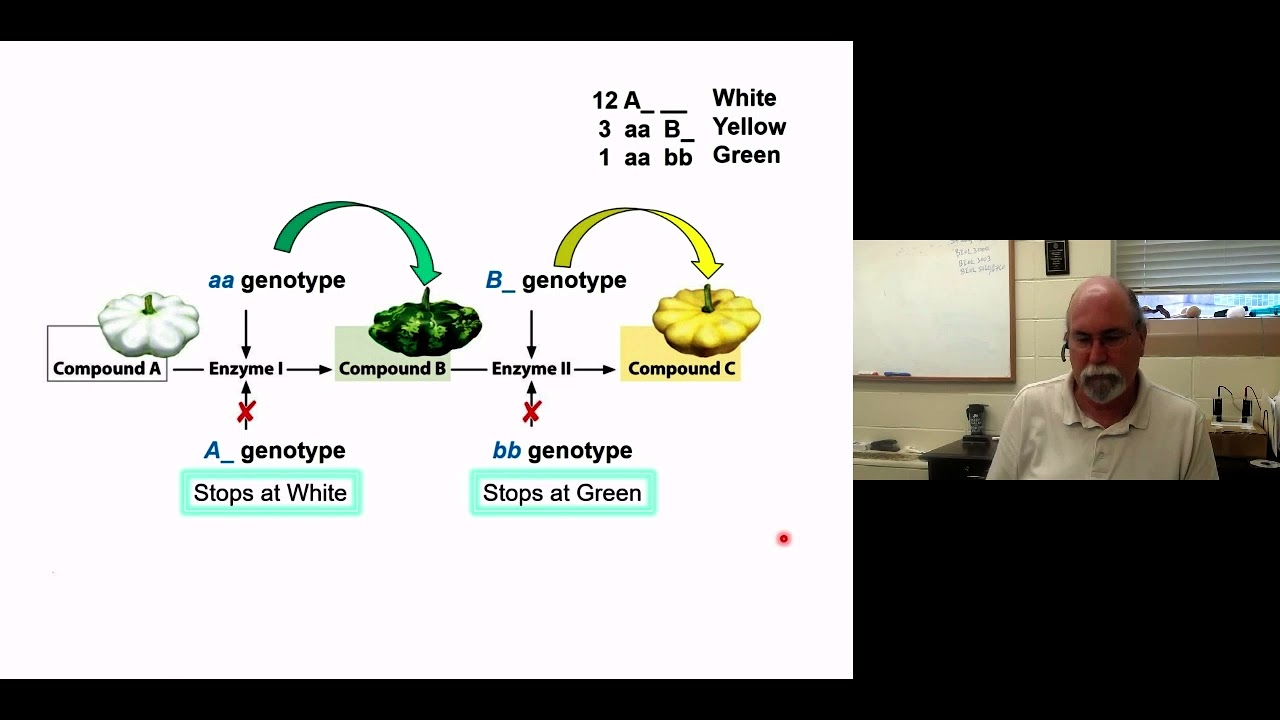
- Explanation of single dominant epistasis with the 12:3:1 ratio, using squash color as an example.
- Discussion of double dominant epistasis with the 15:1 ratio, using shepherd's purse seed shape.
- Introduction to single recessive epistasis with the 9:3:4 ratio, using mouse coat color.
- Explanation of double recessive epistasis with the 9:7 ratio, using pea flower color.
- Summary of additional epistatic ratios and caution about distinguishing Mendelian vs. epistatic 9:3:3:1 ratios.
- Conclusion emphasizing the importance of Mendelian segregation and assortment as the foundation.
Contribution & Novelties
The video offers a clear pedagogical approach to understanding epistasis, breaking down complex ratios into digestible examples. It emphasizes the underlying genotypic ratios and the concept of ’light switch’ regulation, which aids in conceptual understanding. While not novel in content, the presentation is effective for learners.
Pour aller plus loin :
- Epistasis - Wikipedia — Overview of epistasis and its types.
- Gene interaction - Khan Academy — Additional resources on gene interactions.
- Mendelian inheritance - NCBI Bookshelf — Background on Mendelian genetics.
82 words
Radar Profile
The radar profile shows high scores in quantity and quality of information, with a moderate technical level. The video is strong in providing detailed explanations and examples, but the lack of citations and advanced depth keeps the technical level moderate. The overall reliability is high due to the accuracy of the content.