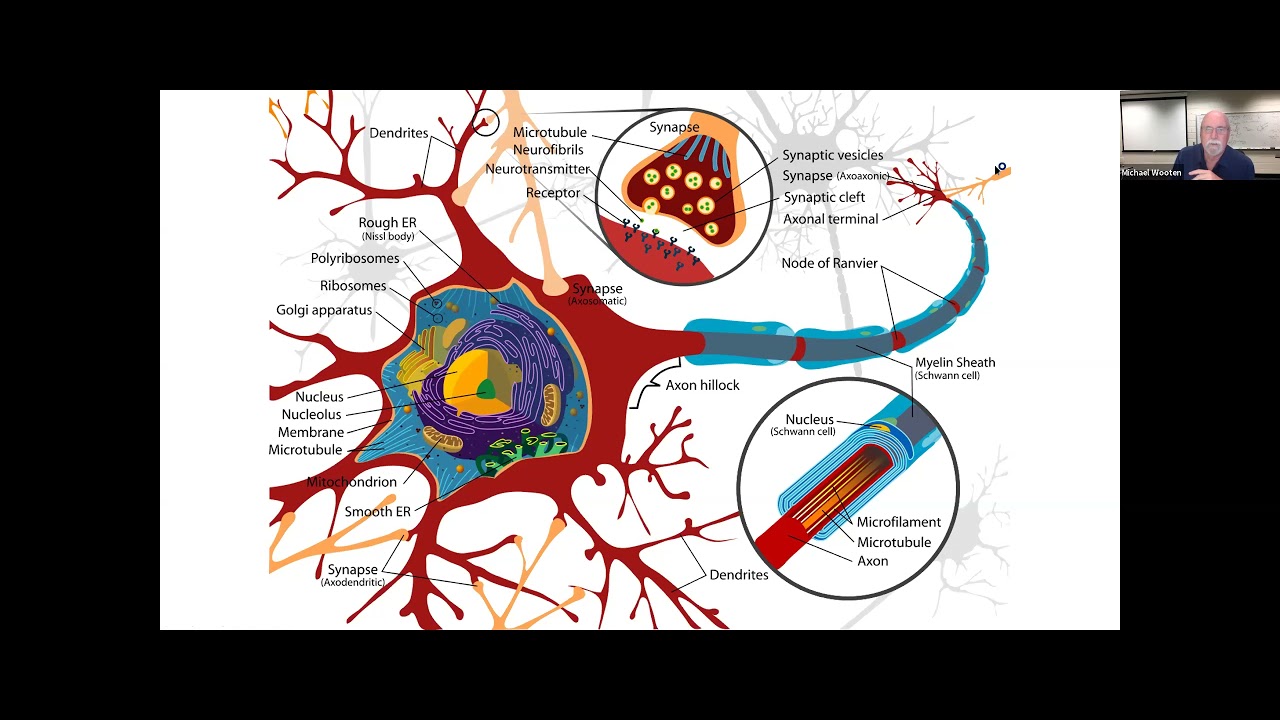
HG Behavior Part 1 Neural Structures
Keywords
Summary
169 words
Critical Evaluation
Value of the Information & Strength of the Argument
The lecture provides a basic but useful overview of neural structures and neurotransmitters, which is valuable for beginners. The argumentation is mostly descriptive, with some connections to genetic disorders, but lacks depth and critical analysis. The instructor does not present a strong argument or thesis, but rather an introductory survey. The information is presented in a conversational manner, which may aid understanding but also leads to some vagueness.
Scientific Rigor, Source Quality, Title Accuracy
The lecture does not cite specific sources, and the description provides no links. The content is based on general knowledge in neuroscience. The title accurately reflects the content, which is a discussion of neural structures. The scientific rigor is moderate: the instructor makes some claims that are oversimplified or imprecise, such as the exact number of neurons and the role of certain neurotransmitters. However, the overall information is consistent with established neuroscience.
155 words
Title / Content Match
The title accurately reflects the content, which focuses on neural structures relevant to behavior.
Quality & Reliability
6/10
The lecture provides a general overview of neural structures and neurotransmitters, but lacks depth and precision in some areas. It mentions some genetic associations but does not provide specific citations or detailed evidence. The content is generally accurate but simplified.
Key Moments
Markers derived by PSI from the transcript: the creator did not define chapters.
- Introduction to the series on genetics and behavior, outlining the plan.
- Overview of brain morphology: weight, convolutions, neurons, and support cells.
- Discussion of neuron structure, including dendrites, axons, and synapses.
- Explanation of synaptic transmission and the role of neurotransmitters.
- Listing of key neurotransmitters: serotonin, dopamine, acetylcholine, etc.
- Discussion of how genetic mutations can affect neurotransmitter systems and behavior.
- Mention of methods like genomic analysis and candidate gene approach, with COMT gene example.
- Conclusion and preview of next lectures on specific genetic disorders.
Contribution & Novelties
The lecture provides a basic introduction to neural structures and their relation to behavior, which is not particularly novel. It serves as a foundation for the series. The instructor mentions the COMT gene as an example, but does not provide detailed information. The lecture is more of a review for students.
Pour aller plus loin :
- Neuroscience — Overview of the field.
- Neurotransmitter — Detailed information on neurotransmitters.
- COMT gene — Information on the COMT gene and its role.
79 words
Radar Profile
The radar profile shows moderate scores across all dimensions, indicating a balanced but not exceptional lecture. The quantity and quality of information are adequate, but the technical level is moderate, and the reliability is acceptable. The lecture is suitable for beginners but lacks depth for advanced learners.