HG Behavior - Schizophrenia 1
Keywords
Summary
146 words
Critical Evaluation
Value of the Information & Strength of the Argument
The lecture provides a valuable introduction to the genetic factors underlying schizophrenia, particularly highlighting the role of the DISC1 gene. The argumentation is generally logical, moving from general behavioral disorder prevalence to specific genetic mechanisms. However, the presentation is somewhat dated and lacks depth in certain areas, such as the discussion of non-random segregation, which is presented as a hypothesis without strong supporting evidence. The instructor does not cite specific studies or sources, which weakens the scientific rigor. The argumentation is clear but could benefit from more recent research findings and a more critical evaluation of the evidence.
Scientific Rigor, Source Quality, Title Accuracy
The lecture lacks explicit citations to scientific literature, which is a significant weakness. The instructor mentions the American Psychiatric Association’s definition of schizophrenia but does not provide a direct reference. The content appears to be based on general knowledge and may not reflect the latest research. The title accurately reflects the content, which is focused on schizophrenia genetics. The lecture is part of a series, so it assumes some prior knowledge, but it is accessible to a general audience. The lack of sources makes it difficult to verify the accuracy of the information presented.
207 words
Title / Content Match
The title accurately reflects the content, which focuses on the genetics of schizophrenia.
Quality & Reliability
6/10
The lecture provides a reasonable overview of genetic aspects of schizophrenia, but lacks citations and relies on dated information. The content is generally accurate but simplified, with some speculative elements (e.g., non-random segregation) presented without strong evidence.
Key Moments
Markers derived by PSI from the transcript: the creator did not define chapters.
- Introduction to the series on genetics and human behavior
- Overview of behavioral disorders prevalence
- Discussion of heritability and twin studies
- Definition of schizophrenia and its symptoms
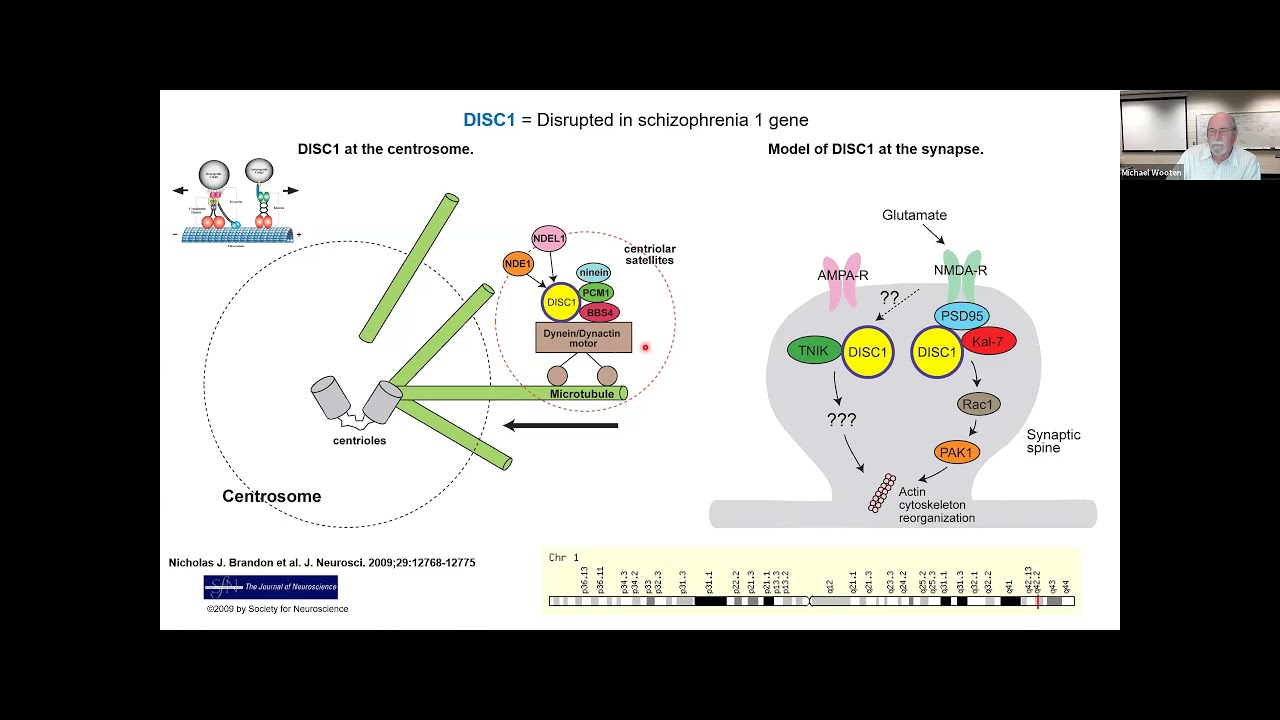
- Introduction to the DISC1 gene and its functions
- DISC1 variants and associated disorders
- Chromosomal translocation in DISC1 and penetrance
- Hypothesis of non-random segregation of DNA strands
- Conclusion and preview of next lecture on pruning
Contribution & Novelties
The lecture provides a basic overview of the genetic basis of schizophrenia, focusing on the DISC1 gene and its role in neuronal function. It introduces the concept of penetrance and a speculative hypothesis about non-random segregation. While not highly novel, it serves as an educational resource for understanding the genetic complexity of psychiatric disorders.
Pour aller plus loin :
- DISC1 gene — Overview of the DISC1 gene and its associations.
- Schizophrenia genetics — NIMH resource on schizophrenia.
- Twin studies in psychiatry — Explanation of twin study methodology.
87 words
Radar Profile
The radar profile shows moderate scores across all dimensions, indicating a balanced but not exceptional lecture. The highest score is in information quantity, while reliability is lower due to lack of citations.