GG Population Genetics Part 6
Keywords
Summary
166 words
Critical Evaluation
Value of the Information & Strength of the Argument
The video provides a solid overview of key population genetics concepts, with clear explanations and relevant examples. The argumentation is logically structured, moving from drift to selection and other factors. However, it lacks depth in quantitative details and does not cite specific studies, which limits its value for advanced learners. The examples are illustrative but sometimes anecdotal.
Scientific Rigor, Source Quality, Title Accuracy
The scientific rigor is moderate: the content is accurate but presented without explicit citations. The title accurately reflects the content. The lecture is part of an educational series, so it is intended for teaching rather than presenting original research. No external sources are mentioned in the description or transcript.
121 words
Title / Content Match
The title is concise and accurately reflects the content, which is the sixth part of a series on population genetics.
Quality & Reliability
7/10
The video is a lecture by a professor, likely with expertise in genetics. It covers established concepts in population genetics, but lacks citations to specific studies or sources. The content is accurate but presented in a simplified manner for educational purposes.
Key Moments
Markers derived by PSI from the transcript: the creator did not define chapters.
- Introduction to mechanisms of gene pool change
- Definition of genetic drift and its dependence on effective population size
- Simulation of drift with different population sizes
- Bottlenecks and founder effects as drift potentiators
- Examples of founder effects in human populations
- Conditions for natural selection
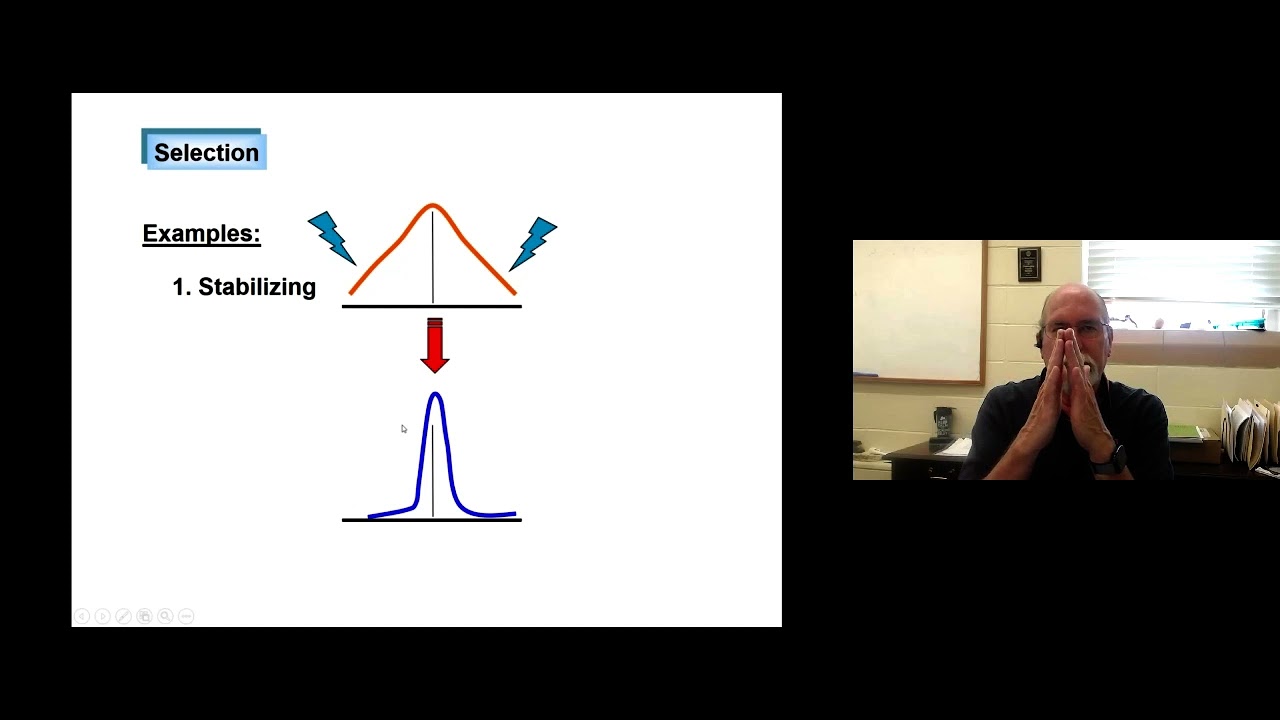
- Stabilizing, directional, and disruptive selection
- Selection against recessive lethals and its slow pace
- Mutation as source of variation and migration's homogenizing effect
- Neutralist-selectionist debate and modern synthesis
Contribution & Novelties
The lecture provides a comprehensive overview of population genetics mechanisms, integrating drift, selection, mutation, and migration. It emphasizes the importance of effective population size and the slow pace of selection, which is often underappreciated. The discussion of the neutralist-selectionist debate adds historical context.
Pour aller plus loin :
- Genetic drift — Overview of genetic drift and its effects.
- Founder effect — Explanation of founder effects with examples.
- Population bottleneck — Details on bottlenecks and their consequences.
- Natural selection — Comprehensive article on natural selection.
- Neutral theory of molecular evolution — Overview of the neutralist perspective.
95 words
Radar Profile
The radar profile shows balanced scores across information quantity, quality, technical level, and reliability, indicating a well-rounded educational resource. The high quantity and quality scores reflect the comprehensive coverage, while the technical level is moderate, suitable for an introductory audience.