GG Mutation Part 5
Keywords
Summary
147 words
Critical Evaluation
Value of the Information & Strength of the Argument
The lecture provides valuable information on somatic mutations and mosaicism, illustrating with well-known syndromes. The argumentation is clear and logical, building from basic concepts to specific examples. The instructor effectively explains the impact of mutation timing and the concept of mosaicism. However, the discussion is somewhat superficial, lacking depth in molecular mechanisms and without citing specific studies or sources.
Scientific Rigor, Source Quality, Title Accuracy
The scientific rigor is moderate. The content is based on established genetic principles, but no sources are cited, and the presentation is informal. The title is not descriptive and does not reflect the specific content. The lecture would benefit from referencing primary literature to support the claims about mutation frequencies and outcomes.
126 words
Title / Content Match
The title 'GG Mutation Part 5' is vague and does not clearly indicate the content, which focuses on somatic mutations and mosaicism.
Quality & Reliability
7/10
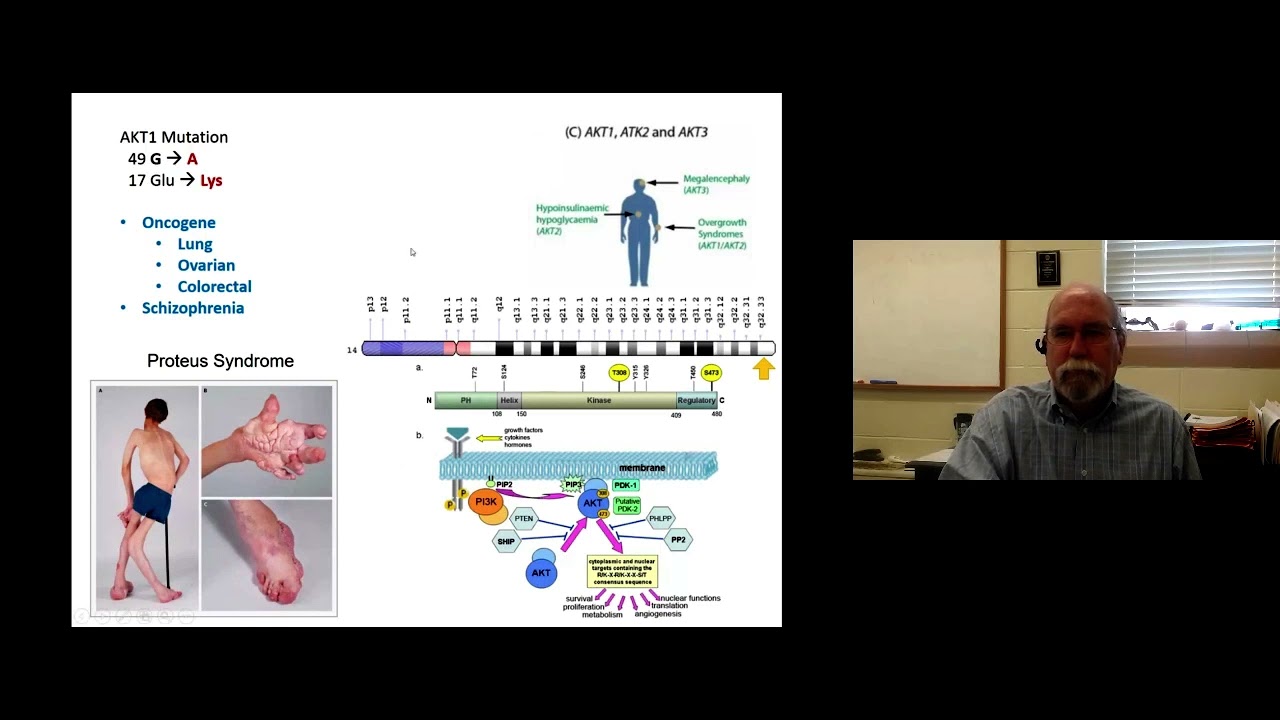
The lecture is based on established genetic concepts and presents specific examples of somatic mutations (Sturge-Weber, McCune-Albright, Proteus syndrome) and chromosomal mosaicism in IVF. The information is generally accurate, but lacks citations to primary literature and contains some oversimplifications.
Key Moments
Markers derived by PSI from the transcript: the creator did not define chapters.
- Introduction to somatic mutations and mosaicism
- Explanation of how mutation timing affects mosaicism
- Sturge-Weber syndrome: GNAQ mutation and its effects
- McCune-Albright syndrome: GNAS mutation and clinical features
- Proteus syndrome: AKT1 mutation and overgrowth
- Chromosomal mosaicism in IVF and aneuploidy
- Studies on mosaic embryos and correction mechanisms
- Conclusion and summary of mutation lecture series
Contribution & Novelties
This lecture provides a concise overview of somatic mutations and mosaicism, using well-known syndromes as examples. It highlights the importance of mutation timing and the concept of cellular competition. The discussion on chromosomal mosaicism in IVF is particularly relevant, as it addresses a common clinical issue. The lecture serves as a good introduction for students, but does not offer novel insights for experts.
Pour aller plus loin :
- Somatic mosaicism — Overview of mosaicism and its implications.
- Sturge-Weber syndrome — Detailed information on this condition.
- McCune-Albright syndrome — Clinical features and genetics.
- Proteus syndrome — Information on this overgrowth syndrome.
100 words
Radar Profile
The radar profile shows balanced scores across all dimensions, with slightly lower technical depth and source rigor. This indicates a lecture that is informative but not highly detailed or well-referenced.