GG DNA Physical Structure Part 5
Keywords
Summary
181 words
Critical Evaluation
Value of the Information & Strength of the Argument
The video provides valuable practice problems that reinforce understanding of DNA structure. The argumentation is logical and step-by-step, making it easy to follow. The instructor emphasizes the importance of thinking through problems rather than memorizing facts, which is pedagogically sound. The examples are classic and cover key concepts such as base pairing, Chargaff’s rules, and hydrogen bonding. The explanations are clear and accurate, with appropriate caveats (e.g., the 10.5 bases per turn nuance). The video effectively demonstrates how to apply theoretical knowledge to solve quantitative problems.
Scientific Rigor, Source Quality, Title Accuracy
The scientific content is rigorous and aligns with established molecular biology. However, the video does not cite specific sources or references; it relies on general knowledge and textbook problems. The title accurately reflects the content, which is a continuation of a series on DNA physical structure. The video is well-structured and focused on problem-solving, which is appropriate for a tutorial. No external sources are mentioned, so the quality of sources cannot be assessed beyond the accuracy of the content itself.
181 words
Title / Content Match
The title accurately reflects the content, which focuses on DNA physical structure and problem-solving.
Quality & Reliability
7/10
The content is scientifically accurate and aligns with established molecular biology principles (Chargaff's rules, DNA structure, base pairing). The presentation is clear and educational, though it lacks citations or references to primary literature. The video is a tutorial aimed at reinforcing concepts, and the information is reliable for its intended purpose.
Key Moments
Markers derived by PSI from the transcript: the creator did not define chapters.
- Introduction and review of key concepts: complementarity, hydrogen bonds, anti-parallel, polarity.
- Problem 1: Molecule with 5000 base pairs - calculating nucleotides, sugars, turns, and length.
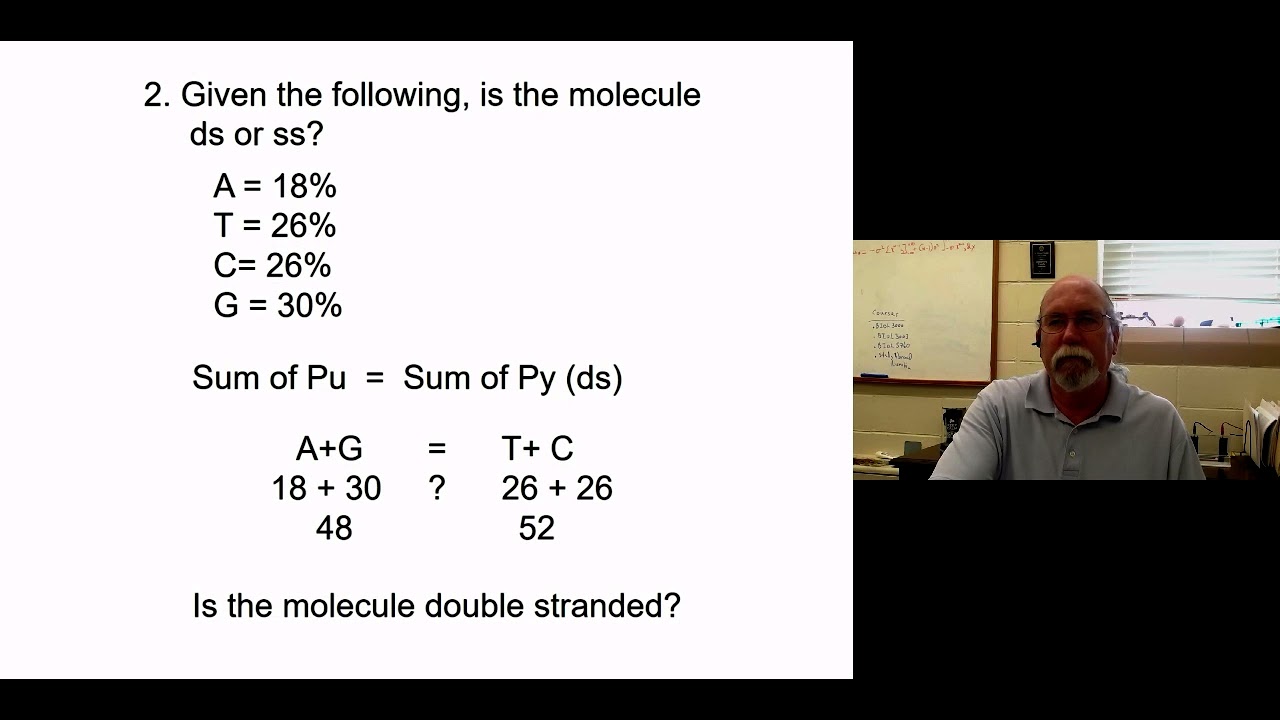
- Problem 2: Using Chargaff's rules to determine base percentages.
- Problem 3: Calculating total hydrogen bonds in a double-stranded region.
- Problem 4: Determining single vs double stranded DNA from base composition.
- Discussion on thermal stability and GC content, with example of ordering DNA fragments.
- Comparison of DNA and RNA: structure, function, and key differences.
Contribution & Novelties
The video provides a practical application of DNA structure concepts through worked examples, which is valuable for students. It reinforces understanding of Chargaff’s rules, hydrogen bonding, and base pair calculations. The approach of solving problems step-by-step is effective for learning. The video does not present new research but serves as an educational tool.
Pour aller plus loin :
- Chargaff’s rules — Background on the empirical rules used in the video.
- DNA structure — General overview of DNA physical structure.
- Base pair — Details on base pairing and hydrogen bonds.
89 words
Radar Profile
The radar profile shows a balanced performance across all dimensions, with slightly higher scores in quality of information and reliability, indicating a solid educational resource. The lower score in technical level suggests it is accessible to a broad audience, while the quantity of information is adequate for a tutorial.