GG Population Genetics Part 1
Keywords
Summary
176 words
Critical Evaluation
Value of the Information & Strength of the Argument
The video offers valuable introductory content on population genetics, effectively explaining key concepts and historical context. The presenter’s argumentation is coherent, building from Darwin’s ideas to the modern synthesis and applications. He uses clear examples to illustrate the importance of allele frequencies and genetic processes. However, the argumentation is largely narrative and lacks rigorous scientific evidence for some claims, such as the origin of leprosy in the Americas. The personal anecdotes add credibility but are not substantiated with specific data or references. Overall, the value lies in its educational clarity and the presenter’s expertise, but it could benefit from more concrete examples and citations.
Scientific Rigor, Source Quality, Title Accuracy
The scientific rigor is moderate. The presenter correctly attributes major contributions to Darwin, Fisher, Haldane, and Wright, and mentions the Nature definition of population genetics. However, he does not provide specific citations or references to the studies he mentions, such as the leprosy DNA analysis or the giraffe species classification. The title accurately reflects the content, which is an introductory overview. The video is suitable for a general audience, but for a scientific audience, more rigorous sourcing would be expected. The presenter’s expertise is evident, but the lack of explicit references reduces the overall scientific rigor.
215 words
Title / Content Match
The title accurately reflects the content, which introduces the field of population genetics, its history, and applications.
Quality & Reliability
7/10
The video provides a solid historical overview of population genetics, correctly attributing key concepts to Darwin, Fisher, Haldane, and Wright. The presenter demonstrates expertise, but the content is largely introductory and lacks detailed citations or references to specific studies. The mention of leprosy origins in the Americas is presented without supporting evidence, and the discussion of giraffe species is simplified. Overall, the information is reliable for a general audience but not exhaustive.
Key Moments
Markers derived by PSI from the transcript: the creator did not define chapters.
- Introduction to population genetics as the fourth major area of genetics.
- Definition of population genetics from Nature, focusing on genetic composition of populations.
- Discussion of Darwin's contributions, including natural selection and random changes (genetic drift).
- Darwin's pangenesis and the absence of the word 'evolution' in Origin of Species.
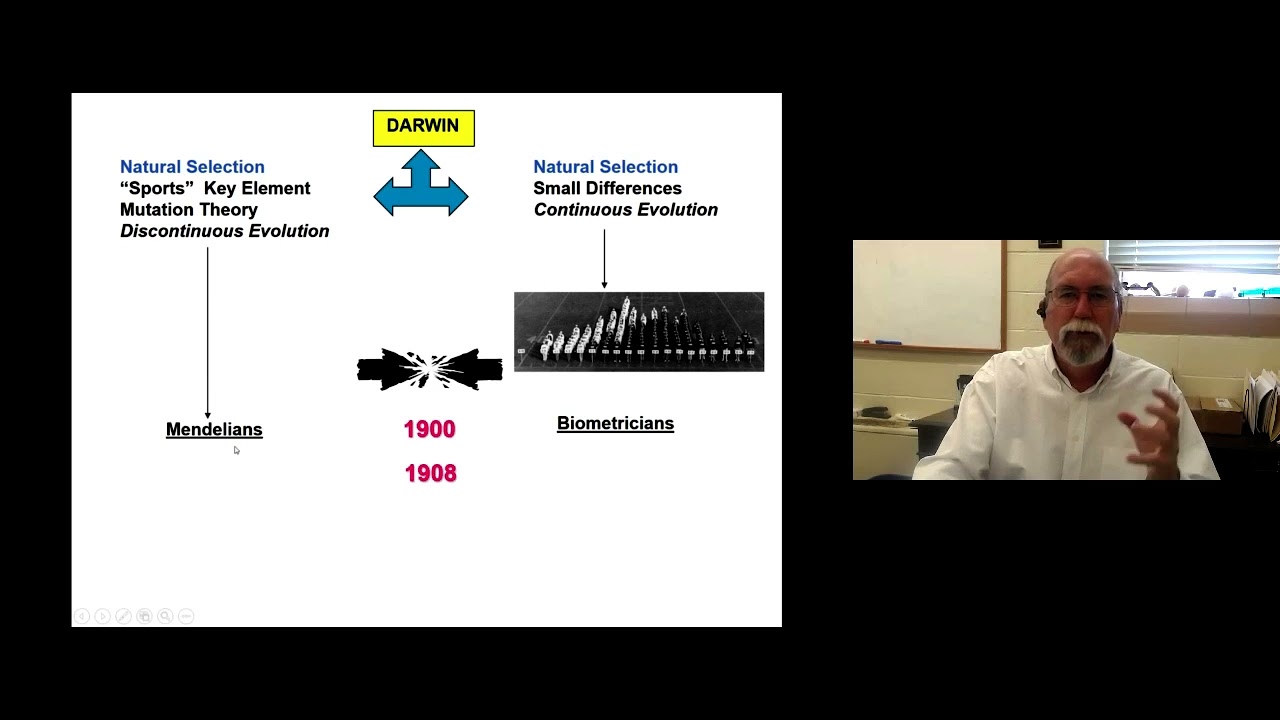
- Debate between biometricians and Mendelians, leading to Fisher's 1918 synthesis.
- Introduction of Fisher, Haldane, and Wright as founders of population genetics.
- Modern applications: genetic counseling, forensic genetics, ecological genetics, evolutionary genetics.
- Example of human origins and migration, using allele frequencies and head lice variation.
- Leprosy origins traced to the Americas, with DNA from medieval bones.
- Conservation genetics: giraffes as four distinct species, and personal research on river blindness worms.
Cited Sources
- Nature definition of population genetics — The presenter quotes a definition from the journal Nature, but no specific article is mentioned.
Concurring Sources
- Population genetics - Wikipedia — General reference for the field.
Contribution & Novelties
The video provides a clear and engaging introduction to population genetics, emphasizing the historical development and practical applications. It uniquely highlights the often-overlooked role of genetic drift in Darwin’s work and the resolution of the biometrician-Mendelian debate. The presenter’s personal research anecdotes add a practical perspective. However, the content is largely introductory and does not present new scientific findings.
Pour aller plus loin :
- Population genetics - Wikipedia — Comprehensive overview of the field.
- Hardy–Weinberg principle - Wikipedia — Fundamental concept in population genetics.
- Ronald Fisher - Wikipedia — Key figure in the modern synthesis.
- Sewall Wright - Wikipedia — Contributions to genetic drift and adaptive landscapes.
107 words
Radar Profile
The radar profile shows moderate scores across all dimensions, with slightly higher scores in quantity and quality of information, reflecting a well-structured introductory lecture. The lower technical level indicates accessibility to a broad audience.