GG History Part 2
Keywords
Summary
148 words
Critical Evaluation
Value of the Information & Strength of the Argument
The video provides a clear narrative of historical theories, connecting them to broader scientific developments. It explains the logic behind each theory and why they were eventually disproved. However, the argumentation is mostly descriptive rather than critical, and it lacks depth in discussing the scientific evidence. The presenter uses anecdotes and analogies to make the content accessible, but this sometimes oversimplifies complex ideas.
Scientific Rigor, Source Quality, Title Accuracy
The video does not cite specific sources, and the description only mentions that it is a simple lecture. The title is vague but consistent with the series. The content is generally accurate, but there are minor inaccuracies, such as the claim that Pasteur’s experiments occurred ’late in the 1800s’ (they were in the 1860s). The video also simplifies Weismann’s experiment, which actually involved cutting off tails of mice for many generations, but the conclusion is correct. Overall, the scientific rigor is moderate, but the lack of citations reduces its reliability.
168 words
Title / Content Match
The title 'GG History Part 2' is vague but the content matches the series on genetics history.
Quality & Reliability
6/10
The video provides a historical overview of early theories of heredity, but lacks citations and contains some inaccuracies (e.g., Pasteur's experiments are late 1800s, but the video says 'late in the 1800s' which is correct; however, the description of Weismann's experiment is oversimplified). The content is generally accurate but not rigorously sourced.
Key Moments
Markers derived by PSI from the transcript: the creator did not define chapters.
- Introduction and recap of domestication
- Discussion of spontaneous generation and its historical context
- Pasteur's experiments refuting spontaneous generation
- Greek theories of form and function, male and female roles
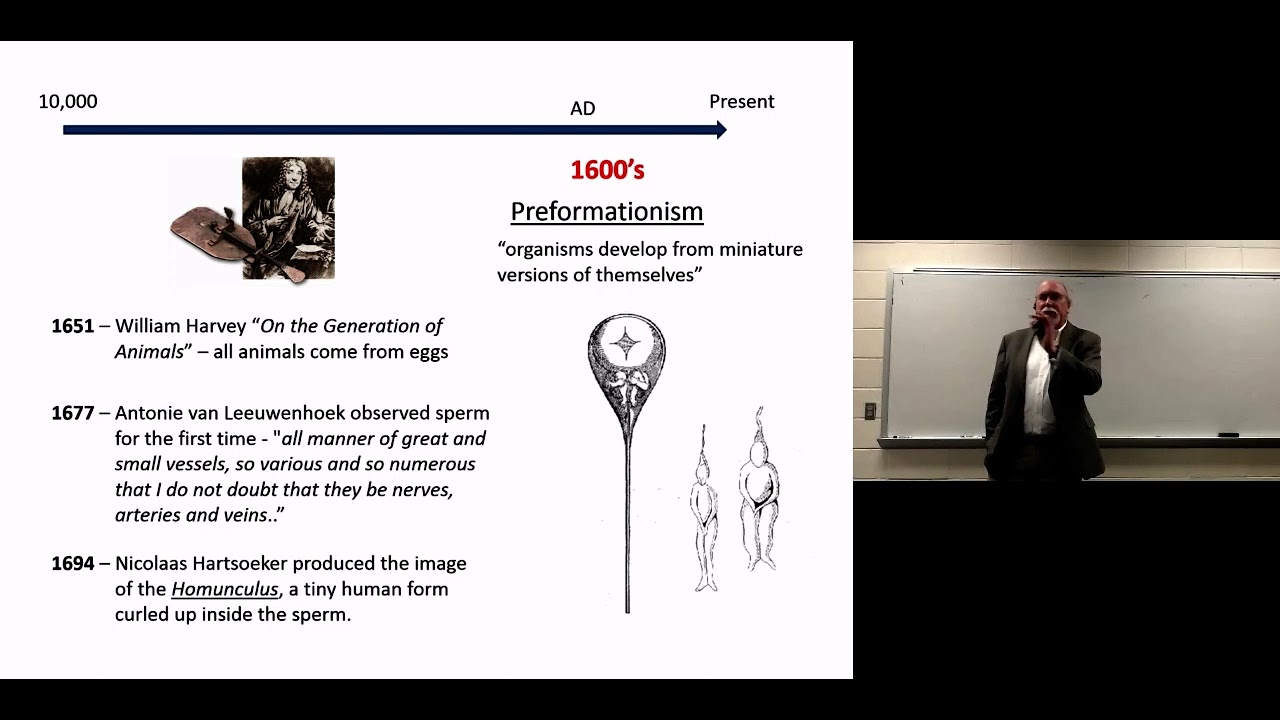
- Preformationism and the discovery of sperm and eggs
- Darwin's pangenesis and blending inheritance
- Lamarckian inheritance and the giraffe example
- Weismann's experiments refuting Lamarckism
- Summary and transition to part three
Contribution & Novelties
The video offers a concise historical overview of early heredity theories, making connections between them and later developments. It is useful for beginners but does not present new information. For further exploration, consider the following:
- Spontaneous generation - Wikipedia — Provides a detailed history and scientific refutation.
- Preformationism - Wikipedia — Explains the theory and its historical context.
- Pangenesis - Wikipedia — Discusses Darwin’s theory and its implications.
- Lamarckism - Wikipedia — Overview of Lamarck’s ideas and their reception.
- August Weismann - Wikipedia — Details on Weismann’s experiments and contributions.
90 words
Radar Profile
The radar profile shows moderate scores across all dimensions, with a slightly higher score in quantity of information and lower in technical level. This suggests a balanced but introductory-level educational content.