GG Translation Part 1
Keywords
Summary
209 words
Critical Evaluation
Value of the Information & Strength of the Argument
The video provides a solid foundational explanation of the genetic code and translation, valuable for students new to molecular genetics. The instructor uses clear examples and analogies, such as comparing codons to words in a language. The argumentation is logical, building from transcription to translation and explaining the features of the genetic code systematically. The explanation of wobble and the mathematical reasoning for triplet codons is particularly effective. However, the video does not delve into experimental evidence or historical context, which might be expected for a more rigorous scientific treatment.
Scientific Rigor, Source Quality, Title Accuracy
The scientific content is accurate and consistent with standard textbooks. However, the video does not cite specific sources or references, which limits its scientific rigor. The title ‘GG Translation Part 1’ is somewhat cryptic but accurately indicates the topic and series. The adequacy between title and content is acceptable, though a more descriptive title would be clearer.
162 words
Title / Content Match
The title 'GG Translation Part 1' is somewhat vague but accurately indicates the topic (translation) and that it is part of a series.
Quality & Reliability
7/10
The content is scientifically accurate and aligns with established molecular biology concepts. The instructor explains the genetic code, codon features, and the translation process with clarity. However, the video lacks citations to primary sources and is presented as a lecture, which limits its depth for advanced learners.
Key Moments
Markers derived by PSI from the transcript: the creator did not define chapters.
- Introduction: recap of transcription and post-transcriptional modifications.
- Overview of translation: location (cytoplasm), ribosomes, and timing (G1 phase).
- Explanation of codons: triplets of nucleotides, read in a non-overlapping manner.
- Features of the genetic code: unambiguous, degenerate, non-overlapping, universal.
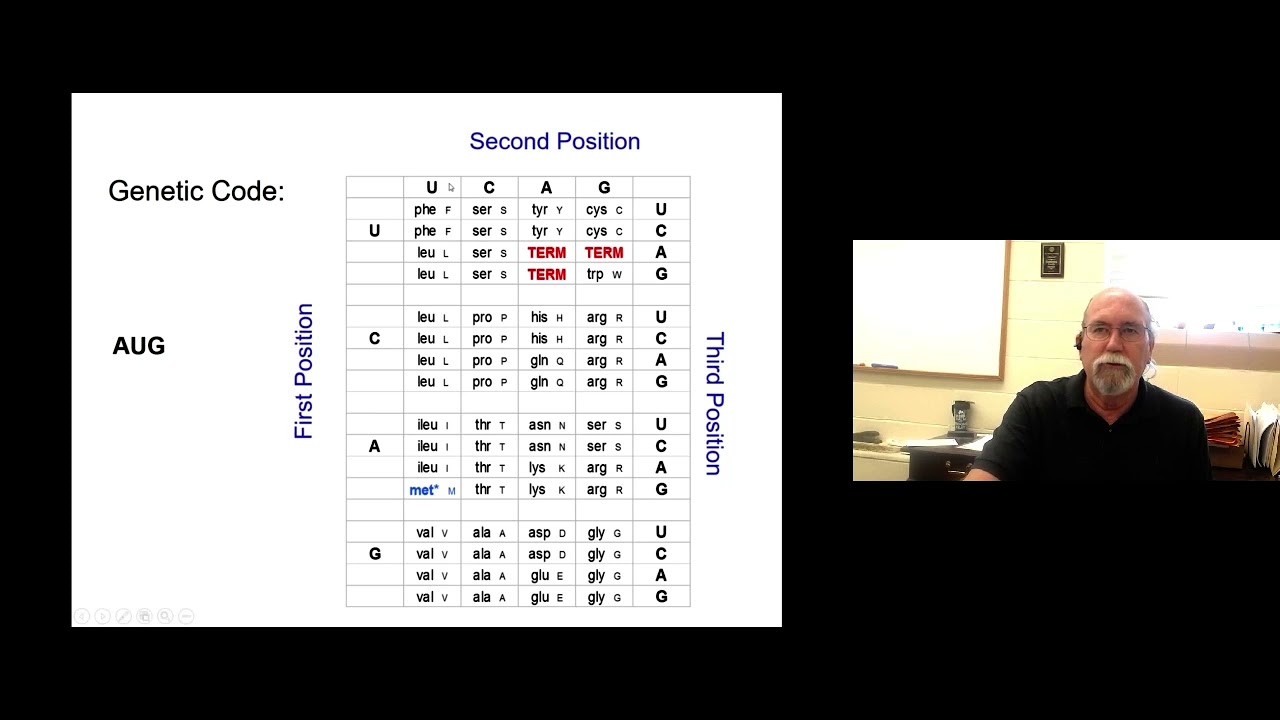
- Start codon (AUG) and stop codons (UAA, UGA, UAG).
- Reading a codon table: example with AUG coding for methionine.
- Wobble hypothesis: third position changes often do not alter amino acid.
- Why codons are triplets: mathematical reasoning (4^3 = 64).
- Conclusion: preview of next video on tRNA and ribosomes.
Contribution & Novelties
This video offers a clear and accessible introduction to translation, particularly the genetic code, for beginners. It effectively explains the features of the code and the wobble phenomenon with simple examples. The mathematical justification for triplet codons is a nice addition.
Pour aller plus loin :
- Genetic code - Wikipedia — Comprehensive overview of the genetic code, including its history and variations.
- Wobble hypothesis - Wikipedia — Detailed explanation of the wobble hypothesis and its implications.
- Translation (biology) - Wikipedia — Overview of the translation process, including initiation, elongation, and termination.
91 words
Radar Profile
The radar profile shows a balanced performance across all dimensions, with slightly higher scores in quality of information and reliability, reflecting the accurate but basic content. The lower score in technical level indicates that the video is introductory, while the moderate quantity of information suggests a focused but not exhaustive treatment.