GG DNA Replication Part 2
Keywords
Summary
198 words
Critical Evaluation
Value of the Information & Strength of the Argument
The video provides a solid foundational explanation of DNA replication, breaking down complex processes into understandable steps. It effectively uses analogies (e.g., movie, rope) to illustrate concepts like supercoiling and the trombone loop. The argumentation is logical and builds on previous knowledge, but it lacks depth in some areas, such as the detailed regulation of replication and the specific differences between prokaryotic and eukaryotic systems. The instructor clearly states that the content is simplified and encourages further study, which is appropriate for an introductory audience.
Scientific Rigor, Source Quality, Title Accuracy
The video does not cite specific sources, but the content aligns with standard molecular biology textbooks. The instructor mentions Arthur Kornberg and his Nobel Prize, which adds credibility. The title accurately reflects the content, as it is a continuation of a series on DNA replication. The presentation is clear and well-structured, though it could benefit from visual aids or animations to enhance understanding. The lack of citations to primary literature is a limitation for viewers seeking deeper verification.
178 words
Title / Content Match
The title accurately reflects the content, which is a continuation of a series on DNA replication, focusing on the molecular mechanisms.
Quality & Reliability
7/10
The video provides a clear and accurate overview of DNA replication mechanisms, based on established textbook knowledge. It correctly distinguishes between prokaryotic and eukaryotic systems and mentions key proteins and processes. However, it lacks citations to primary sources and includes some simplifications that may omit nuances.
Key Moments
Markers derived by PSI from the transcript: the creator did not define chapters.
- Introduction and overview of the four steps of DNA replication.
- Discussion of origins of replication and initiator proteins.
- Explanation of replication bubbles and bidirectional replication.
- Introduction of licensing factors and origin recognition complex.
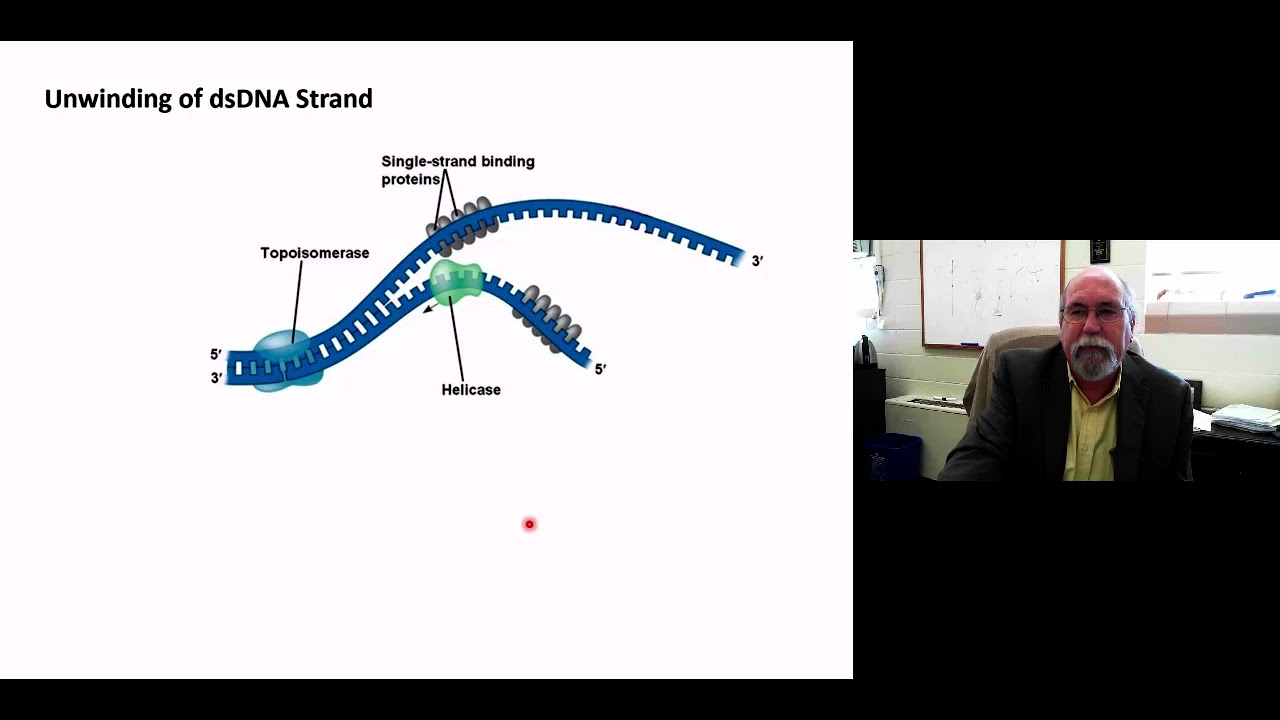
- Unwinding process: helicase, single-stranded binding proteins, and gyrase.
- Primase and RNA primer synthesis.
- Elongation by DNA polymerase and directionality.
- Leading and lagging strands, Okazaki fragments.
- Proofreading and DNA ligase function.
- Trombone loop model and coordination of synthesis.
Cited Sources
- Arthur Kornberg - Nobel Prize — Mentioned as a key figure in understanding DNA replication.
Concurring Sources
- DNA Replication - NCBI Bookshelf — Provides detailed molecular biology background consistent with the video.
Contribution & Novelties
This video provides a clear and accessible introduction to the molecular mechanisms of DNA replication, suitable for students. It effectively explains the roles of key enzymes and the coordination of leading and lagging strand synthesis. The inclusion of the trombone loop model adds depth. For further exploration, consider the following:
- DNA replication - Wikipedia — Comprehensive overview of the process.
- Okazaki fragments - Wikipedia — Detailed explanation of discontinuous synthesis.
- DNA polymerase - Wikipedia — Information on the various types and functions.
82 words
Radar Profile
The radar profile shows high scores in information quantity and quality, with moderate technical level and reliability. This indicates a well-balanced educational video that is informative but not overly technical, making it suitable for a general audience.
💬 No comments were provided for analysis.