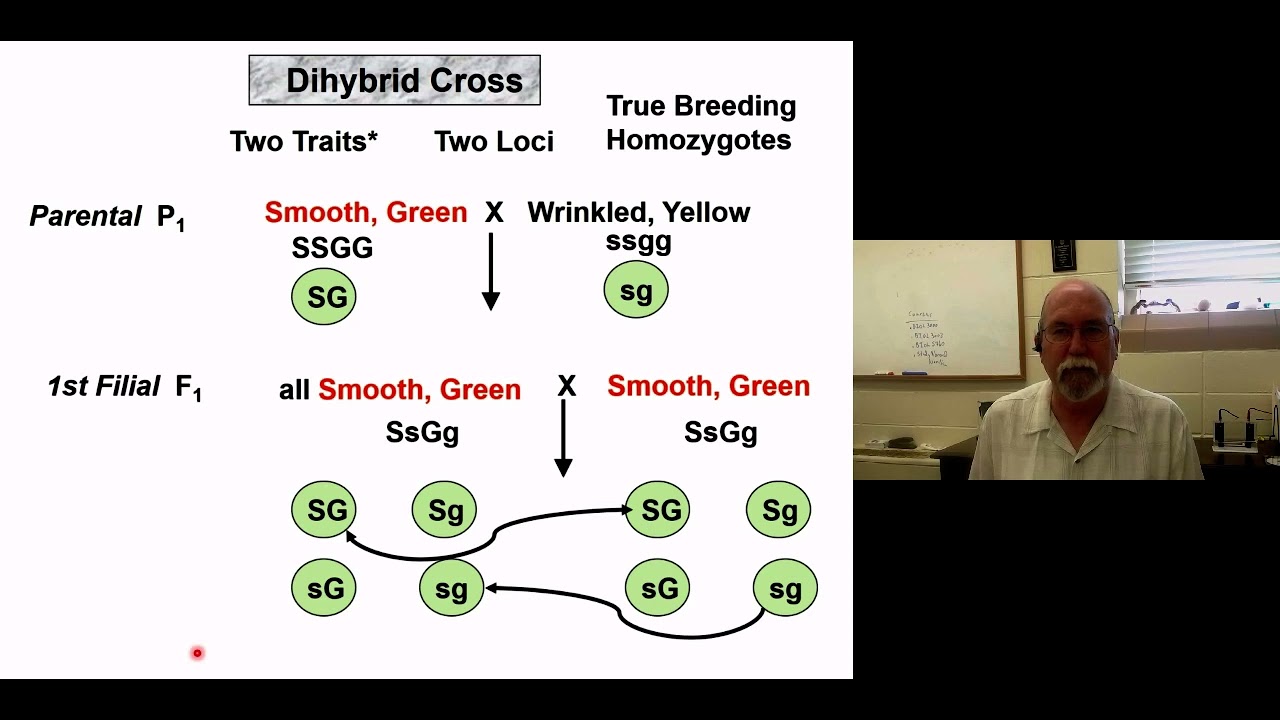
GG Mendelian Dihybrid Part 1
Keywords
Summary
176 words
Critical Evaluation
Value of the Information & Strength of the Argument
The video provides a solid introduction to dihybrid crosses and the principle of independent assortment. The argumentation is clear and logical, building from basic concepts to more complex applications. The use of a concrete example (seed shape and color) helps illustrate the principles. The instructor effectively explains both the Punnett square method and the product rule, highlighting the efficiency of the latter. The explanation of how segregation underlies independent assortment is particularly valuable, as it connects the two principles. However, the video lacks depth in discussing exceptions or complexities, such as linked genes, which could be a limitation for advanced students.
Scientific Rigor, Source Quality, Title Accuracy
The scientific content is accurate and aligns with established Mendelian genetics. The instructor does not cite external sources, but the information is standard textbook material. The title accurately reflects the content, which is a focused lecture on dihybrid crosses. The video is well-structured, with clear explanations and visual aids (though not visible in the transcript). No comments were provided, so no analysis of public reception is possible.
183 words
Title / Content Match
The title accurately reflects the content, which is an introductory lecture on Mendelian dihybrid crosses.
Quality & Reliability
7/10
The content is scientifically accurate, presenting Mendelian genetics principles clearly. The explanation is thorough, but the video is a basic tutorial with no citations or references to primary literature, limiting its depth for advanced learners.
Key Moments
Markers derived by PSI from the transcript: the creator did not define chapters.
- Introduction to the lecture, review of monohybrid crosses and Mendel's first principle.
- Definition of dihybrid cross and introduction to the example traits (seed shape and color).
- Setting up the parental cross with true-breeding plants and determining gametes.
- F1 generation and self-cross to produce F2, listing possible gametes.
- Using a Punnett square to solve the dihybrid cross and obtain the 9:3:3:1 ratio.
- Introduction to the product rule as an alternative method, explaining independent assortment.
- Applying the product rule to derive the phenotypic ratio without a Punnett square.
- Conclusion and preview of the next lecture.
Contribution & Novelties
The video offers a clear pedagogical approach to teaching dihybrid crosses, emphasizing the conceptual link between segregation and independent assortment. It provides a step-by-step demonstration of both the Punnett square and the product rule, which is valuable for students. The explanation of how to multiply segregation ratios to obtain assortment ratios is particularly instructive.
Pour aller plus loin :
- Mendelian inheritance — Overview of Mendel’s laws.
- Independent assortment — Detailed explanation of the principle.
- Punnett square — Visual tool for genetic crosses.
- Product rule (probability) — Mathematical basis for multiplying probabilities.
91 words
Radar Profile
The radar profile shows high scores in quality of information and reliability, with moderate scores in quantity and technical level. This indicates a well-explained but basic tutorial, suitable for beginners in genetics.