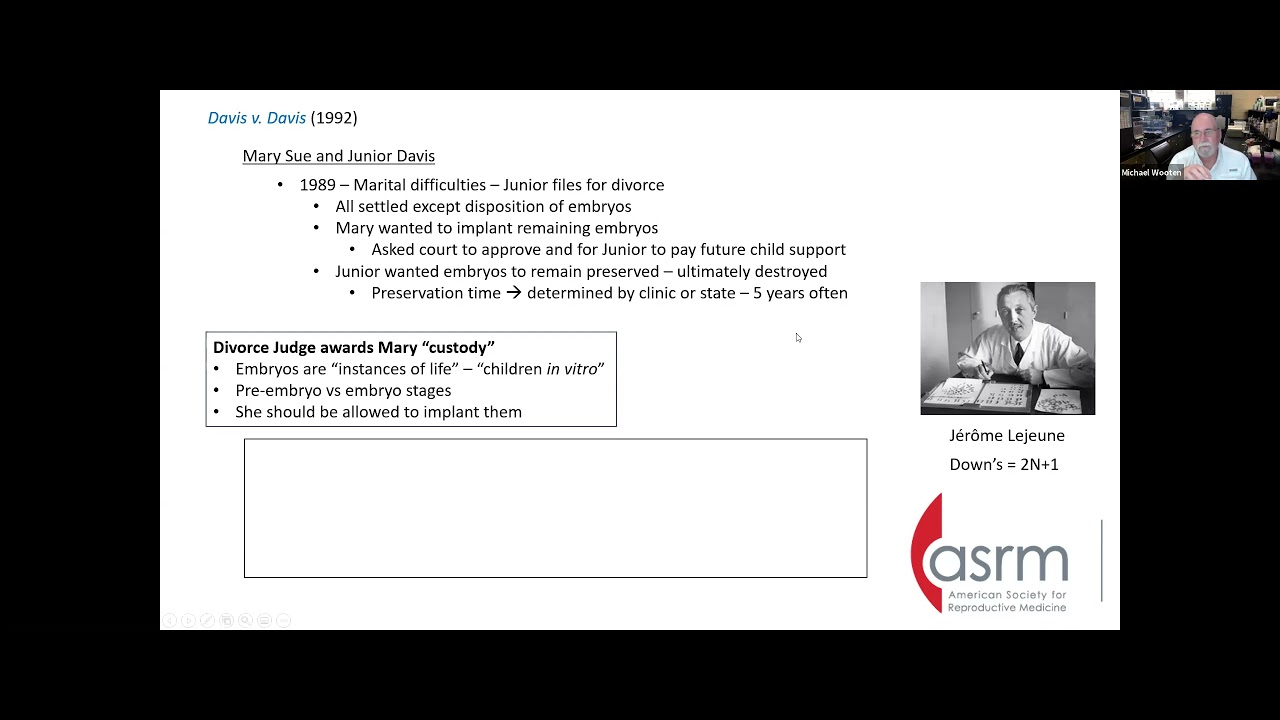
HG Legal - Davis v Davis Legal Issues
Keywords
Summary
134 words
Critical Evaluation
Value of the Information & Strength of the Argument
The video provides a valuable overview of the legal and ethical complexities surrounding embryo disposition, using a well-documented case to illustrate key principles. The argumentation is coherent, tracing the case through the court system and explaining the legal reasoning behind each decision. The speaker effectively connects the case to broader concepts like personhood and reproductive rights, highlighting the ongoing relevance of these issues. However, the presentation is one-sided, reflecting the speaker’s personal views on the matter, and does not thoroughly explore counterarguments or alternative perspectives.
Scientific Rigor, Source Quality, Title Accuracy
The video demonstrates a reasonable level of scientific and legal rigor, accurately referencing the Davis v. Davis case and related legal precedents such as Griswold v. Connecticut and Roe v. Wade. The speaker also mentions the Born-Alive Infants Protection Act and the American Society for Reproductive Medicine’s stance on embryo definition. However, the video lacks formal citations and relies on the speaker’s interpretation of legal documents. The title accurately reflects the content, which is focused on the legal issues of the case. The speaker’s expertise in genetics adds credibility, but the presentation is more of an expert opinion than a comprehensive legal analysis.
203 words
Title / Content Match
The title accurately reflects the content, which focuses on the legal issues of the Davis v. Davis case.
Quality & Reliability
6/10
The video provides a detailed and accurate account of the Davis v. Davis case, citing key legal precedents and statutes. However, it is presented from a single expert's perspective without formal citations or peer review, and some statements lack nuance.
Key Moments
Markers derived by PSI from the transcript: the creator did not define chapters.
- Introduction to the topic and the Davis v. Davis case
- Background of the couple and their fertility struggles
- Details of the IVF procedures and the creation of embryos
- The divorce and the dispute over the embryos
- The trial court's decision and the concept of embryos as children
- The appellate court's reversal and the right not to be a parent
- The Tennessee Supreme Court's ruling on personhood
- Discussion of the Born-Alive Infants Protection Act
- Explanation of fetal rights and personhood laws
- Potential consequences of personhood laws
- Broader implications for medicine and law
- Conclusion and advice for professionals
Cited Sources
- Davis v. Davis — The case is the central topic of the video.
- Griswold v. Connecticut — Cited as a precedent for the right to privacy in reproductive matters.
- Roe v. Wade — Mentioned in relation to abortion rights and the legal status of embryos.
- Born-Alive Infants Protection Act — Discussed in the context of defining personhood.
Concurring Sources
- Davis v. Davis (Wikipedia) — Provides a detailed account of the case, consistent with the video's narrative.
Dissenting Sources
- American Society for Reproductive Medicine — The ASRM's definition of pre-embryo differs from the speaker's interpretation, as mentioned in the video.
Contribution & Novelties
The video provides a clear and accessible explanation of the Davis v. Davis case and its significance in establishing legal precedents for embryo disposition. It highlights the distinction between embryos and pre-embryos and the concept of personhood, which are crucial for understanding current debates on reproductive rights. The speaker’s perspective as a geneticist adds a scientific dimension to the legal discussion.
Pour aller plus loin :
- Davis v. Davis (Wikipedia) — Overview of the case and its legal significance.
- Personhood (Wikipedia) — Discussion of the concept of personhood in law and ethics.
- In vitro fertilisation (Wikipedia) — Background on IVF and associated legal issues.
104 words
Radar Profile
The radar profile shows a balanced distribution across information quantity, quality, technical level, and reliability, with a slight emphasis on quality and technicality. This suggests a moderately informative and reliable presentation, though not highly technical or exhaustive.
💬 No comments were provided for analysis.