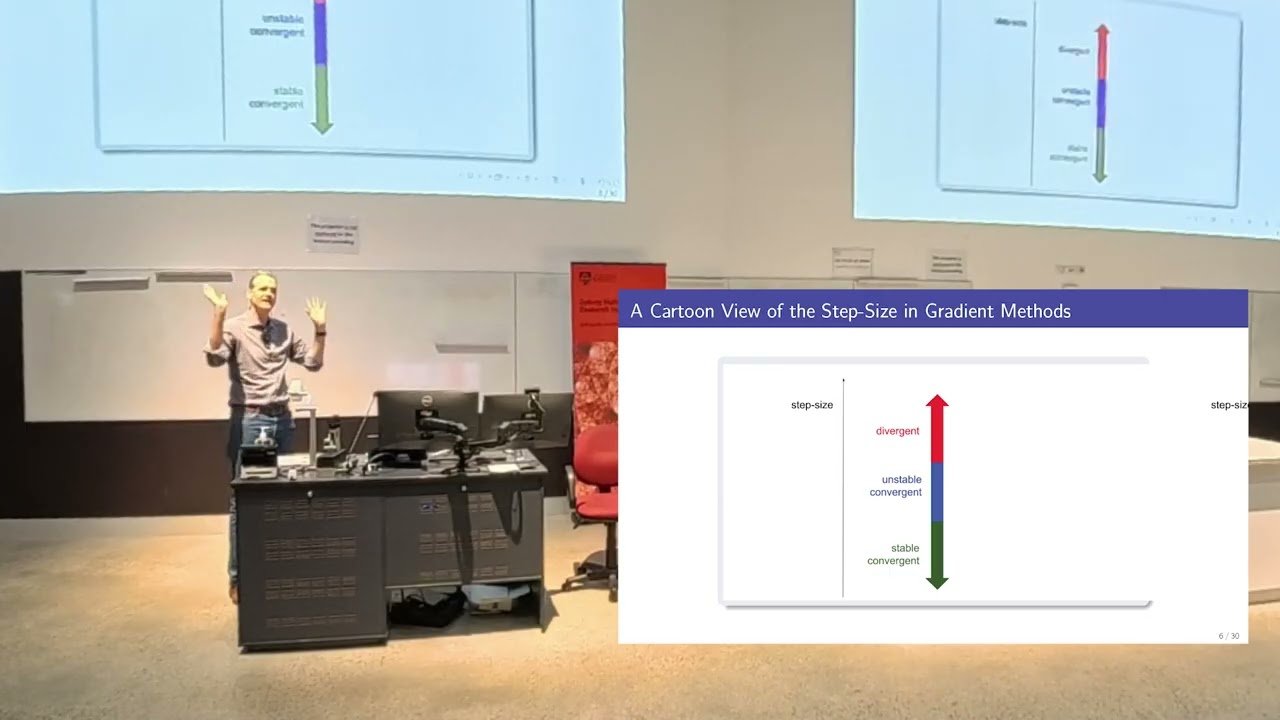
Gradient optimization methods: the benefits of instability
Keywords
Summary
156 words
Critical Evaluation
Value of the Information & Strength of the Argument
The talk provides valuable insights into the theoretical underpinnings of gradient descent in deep learning, challenging classical optimization theory. The argumentation is solid, based on mathematical proofs and recent research. The speaker clearly explains the motivation, the setting, and the results, making a compelling case for the benefits of instability. The presentation is well-structured, moving from simple linear cases to more complex neural network settings, and includes empirical illustrations. The value lies in offering a theoretical explanation for a phenomenon observed in practice, which could guide algorithm design.
Scientific Rigor, Source Quality, Title Accuracy
The talk is scientifically rigorous, with clear assumptions and results. The speaker cites joint work with Pierre Marion, Matus Telgarsky, Jingfeng Wu, and Bin Yu, indicating a strong research foundation. The title accurately reflects the content, focusing on gradient optimization methods and the benefits of instability. The presentation is based on the speaker’s expertise and recent research, but as a seminar talk, it does not provide full proofs or detailed references. The description includes the speaker’s credentials, enhancing credibility. No comments were provided for analysis.
188 words
Title / Content Match
The title accurately reflects the content, focusing on gradient optimization methods and the benefits of instability (edge of stability) in deep learning.
Quality & Reliability
9/10
The talk is given by a leading expert in the field (Peter Bartlett, UC Berkeley and Google DeepMind), based on joint work with other recognized researchers. The content is theoretical and mathematical, with clear assumptions and results. The presentation is rigorous, but as a seminar talk, it does not provide full proofs or peer-reviewed details, hence a slight deduction.
Key Moments
Markers derived by PSI from the transcript: the creator did not define chapters.
- Introduction by the host and speaker introduction.
- Motivation: deep learning progress and the need for theoretical understanding.
- Classical approach: approximation, optimization, and statistical questions.
- Contrast with deep learning: over-parameterization, instability, and benign overfitting.
- Gradient flow vs gradient descent, sufficient condition for monotone decrease.
- Empirical illustration: three-layer neural net with logistic loss showing oscillations and better performance with larger step size.
- Linear classification setting: logistic loss, assumptions, and main results on convergence for any step size.
- Edge of stability phase and stable phase, trade-off in step size choice, and acceleration to 1/t^2 rate.
- Necessity of non-monotonicity for faster rates.
- Extensions to neural networks: NTK regime and conditions for similar behavior.
Cited Sources
- Joint work with Pierre Marion, Matus Telgarsky, Jingfeng Wu, and Bin Yu — The talk is based on joint work with these researchers, mentioned at the beginning.
Concurring Sources
- Edge of stability (Wikipedia) — The concept of edge of stability is central to the talk.
- Neural tangent kernel (Wikipedia) — The NTK regime is mentioned as a setting where the results extend.
Contribution & Novelties
The talk presents recent theoretical results on gradient descent with logistic loss, showing that large step sizes leading to instability can yield faster convergence rates (1/t^2) compared to classical 1/t rates. This provides a theoretical explanation for the empirical benefits of using large step sizes in deep learning. The results extend to neural networks in the NTK regime, offering insights into the role of instability in optimization.
Pour aller plus loin :
- Edge of stability — Wikipedia article on the phenomenon.
- Neural tangent kernel — Wikipedia article on NTK, relevant to the extension to neural networks.
- Gradient descent — Wikipedia article on gradient descent, providing background.
106 words
Radar Profile
The radar profile shows high scores in quality, technical level, and reliability, with a slightly lower score in quantity of information due to the seminar format. This indicates a highly technical and reliable presentation with a moderate amount of content.