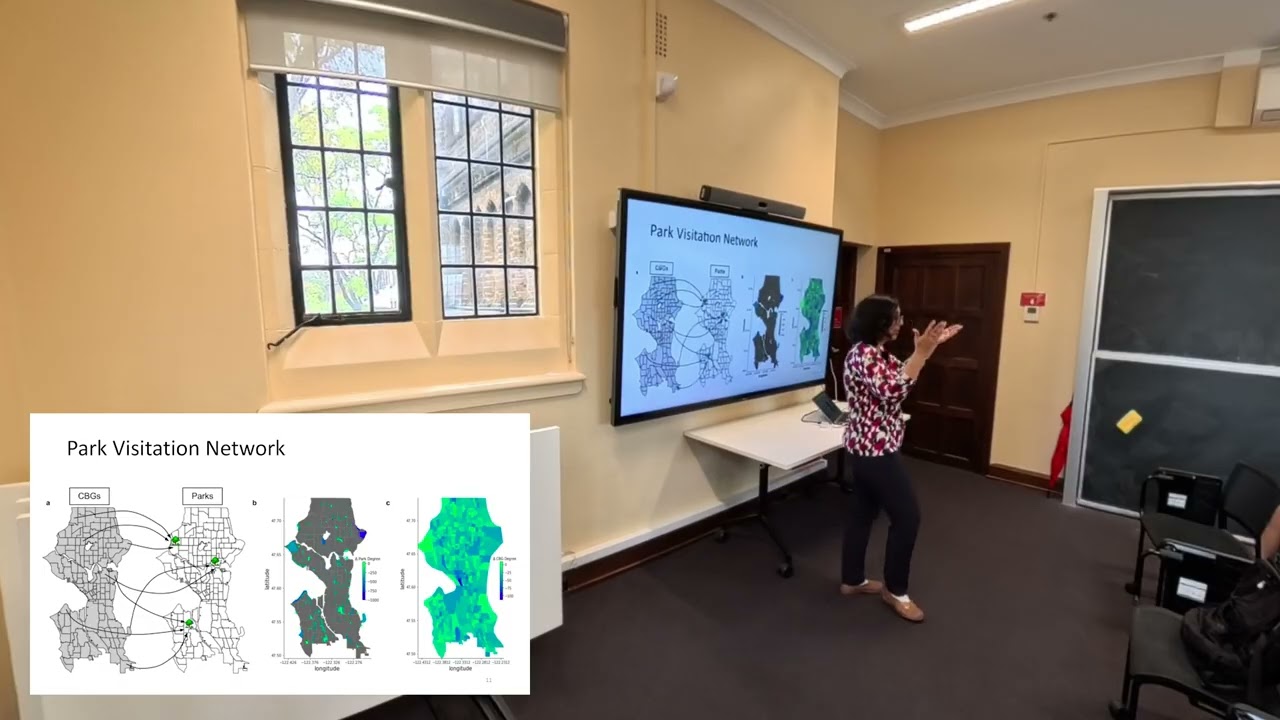
Mobility vs Epidemics
Keywords
Summary
129 words
Critical Evaluation
Value of the Information & Strength of the Argument
The talk provides valuable insights into the bidirectional relationship between mobility and epidemics. The first study demonstrates the robustness of the gravity model in predicting park visitation, even during a pandemic, and reveals socioeconomic disparities in mobility changes. The argumentation is solid, backed by empirical data and statistical analysis. The second study offers a novel framework for identifying epidemic origins, which is a significant contribution to epidemiological modeling. The speaker clearly explains the methodology and acknowledges limitations, such as data granularity and the need for validation. The argumentation is logical and well-structured, making complex concepts accessible.
Scientific Rigor, Source Quality, Title Accuracy
The talk is scientifically rigorous, referencing two peer-reviewed publications. The speaker is a researcher at a university, and the methods are based on established models (gravity model, SIR). The sources are credible and directly relevant. The title accurately reflects the content, which focuses on the interaction between mobility and epidemics. The talk does not include any promotional content. The speaker acknowledges limitations and discusses potential biases, demonstrating scientific integrity.
180 words
Title / Content Match
The title accurately reflects the content, which explores the bidirectional relationship between human mobility and epidemic spread.
Quality & Reliability
8/10
The talk presents original research with rigorous mathematical modeling and validation against empirical data (COVID-19, H1N1). The speaker is an academic researcher, and the studies are published in peer-reviewed journals. Limitations are acknowledged, such as data granularity and model assumptions.
Key Moments
Markers derived by PSI from the transcript: the creator did not define chapters.
- Introduction and overview of the talk's two parts.
- Introduction to the gravity model and its application to park visitation data.
- Analysis of how the pandemic changed mobility patterns, with focus on socioeconomic differences.
- Transition to the second part: how mobility impacts epidemic spread.
- Introduction of the effective distance concept and its role in predicting epidemic spread.
- Presentation of the metapopulation framework and the 'Big Bang' concept.
- Validation of the framework with COVID-19 and H1N1 data.
- Conclusion and implications for public health policy.
Cited Sources
- Recreational mobility prior and during the COVID-19 pandemic — Study on park visitation patterns in Washington State, using gravity model.
- The Big Bang of an epidemic: a metapopulation approach to identify the spatiotemporal origin of contagious diseases and their universal spreading pattern — Framework for identifying epidemic origins using effective distance.
Concurring Sources
- The hidden geometry of complex, network-driven contagion phenomena — This paper introduced the effective distance concept, which is foundational to the speaker's framework.
Contribution & Novelties
The talk presents two original studies that contribute to the understanding of mobility-epidemic interactions. The first study applies the gravity model to park visitation data, revealing socioeconomic disparities in mobility changes during the pandemic. The second study introduces a novel metapopulation framework that uses effective distance to identify epidemic origins, validated with real-world data. This framework offers a practical tool for public health planning.
Pour aller plus loin :
- Gravity model — The gravity model is widely used in spatial interaction modeling, including trade and mobility.
- Effective distance — A concept used to measure connectivity in networks, relevant to epidemic spread.
- Metapopulation — A population model that considers spatially separated subpopulations, applicable to epidemiology.
114 words
Radar Profile
The radar profile shows high scores in information quality, technical level, and reliability, with a slightly lower score in information quantity due to the focused scope of the talk. This indicates a technically deep and reliable presentation, though it may not cover a broad range of topics.
💬 Sur les 0 commentaires analysés, aucune tendance n'est disponible.