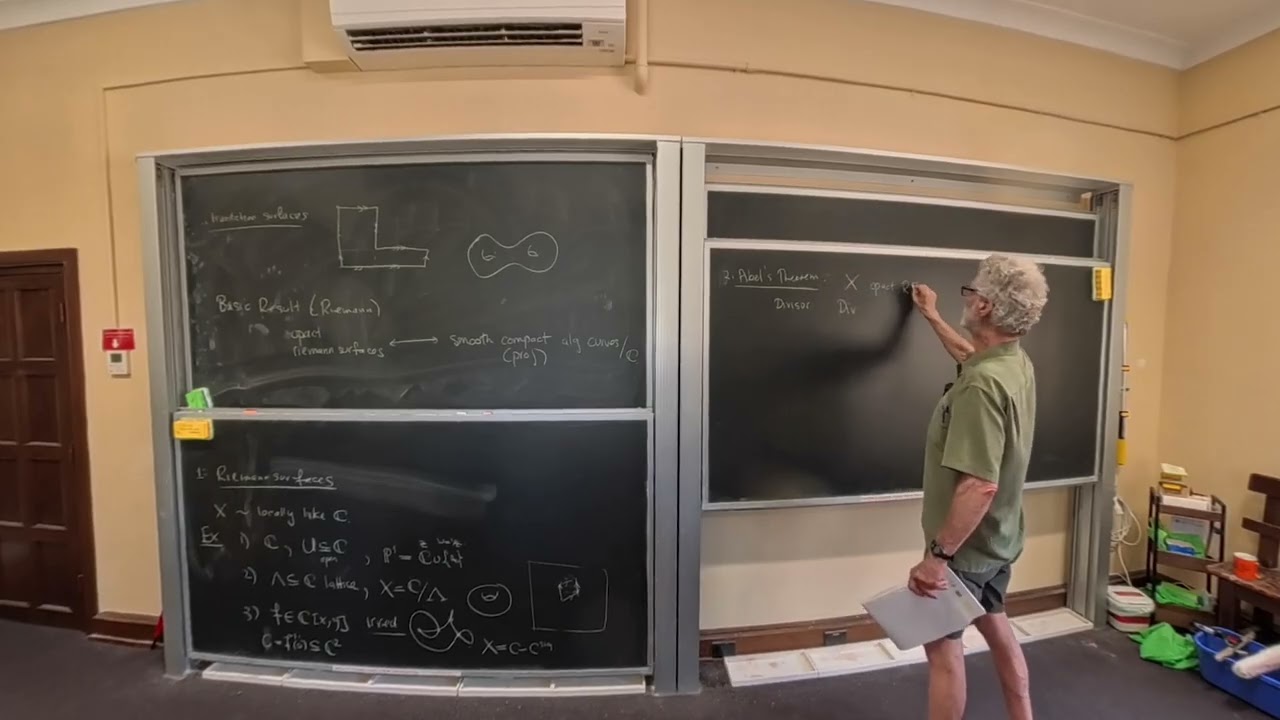
Mapping class groups and algebraic cycles
Keywords
Summary
191 words
Critical Evaluation
Value of the Information & Strength of the Argument
The lecture provides substantial value by synthesizing classical results (Abel-Jacobi theory, Chow groups) with modern research directions, particularly the connection to mapping class groups. The argumentation is rigorous, with clear logical progression from foundational concepts to advanced conjectures. Hain carefully motivates each step, explaining why certain cycles are homologically trivial and how Griffiths’ intermediate Jacobians serve as tools for detecting non-triviality. He also addresses the field-dependence of Chow groups, contrasting behavior over C and number fields, which is a subtle and important point. The presentation is well-structured and accessible to a mathematically mature audience, though it assumes familiarity with algebraic geometry and topology.
Scientific Rigor, Source Quality, Title Accuracy
The talk demonstrates high scientific rigor, with precise definitions and theorems stated accurately. Hain references classical work by Abel, Riemann, Mumford, Griffiths, and others, and mentions specific constructions like the Ceresa cycle and Gross-Schoen cycles. The title accurately reflects the content, as the talk indeed focuses on the interplay between mapping class groups and algebraic cycles. No external sources are cited in the description, but the talk itself is a reliable source of information given the speaker’s expertise. The content is consistent with established mathematical literature, and the new cycle mentioned is presented as recent research, which is appropriate for a seminar talk.
221 words
Title / Content Match
The title accurately reflects the content: the talk focuses on the relationship between mapping class groups and algebraic cycles, with detailed exposition of both topics.
Quality & Reliability
8/10
The talk is given by a leading expert (Richard Hain, Duke University) and presents well-established mathematical concepts (Riemann surfaces, Abel-Jacobi theory, Chow groups) alongside recent research results. The content is rigorous and technically accurate, though it is a lecture overview rather than a peer-reviewed publication.
Key Moments
Markers derived by PSI from the transcript: the creator did not define chapters.
- Introduction and overview of the talk's goals
- Definition and examples of Riemann surfaces
- Abel's theorem and the Jacobian variety
- Introduction to algebraic cycles and Chow groups
- Mumford's theorem on infinite dimensionality of Chow groups
- Definition of the Ceresa cycle and its properties
- Griffiths' intermediate Jacobians as detection tools
- Connection to mapping class groups and Torelli subgroups
- Discussion of cycles defined for all curves
- New higher algebraic cycle for hyperelliptic curves
Contribution & Novelties
The lecture provides a comprehensive overview of the relationship between algebraic cycles and mapping class groups, synthesizing classical results with recent developments. It highlights the Ceresa cycle as a key example and explains how Griffiths’ intermediate Jacobians can be used to study its non-triviality. The talk also introduces a new higher algebraic cycle for hyperelliptic curves, constructed with Wanlin Li, which represents an original contribution. This cycle is defined for all hyperelliptic curves and is expected to have interesting properties related to the Torelli group.
Pour aller plus loin :
- Ceresa cycle — Provides background on the Ceresa cycle and its significance in algebraic geometry.
- Griffiths intermediate Jacobian — Explains the concept of intermediate Jacobians and their role in studying algebraic cycles.
- Mapping class group — Offers an introduction to mapping class groups and their applications.
- Chow group — Defines Chow groups and rational equivalence, fundamental to the talk.
- Torelli group — Discusses the Torelli subgroup of the mapping class group, relevant to the talk’s themes.
166 words
Radar Profile
The radar profile shows high scores in quality of information and technical level, reflecting the advanced mathematical content and expert presentation. The quantity of information is also high, but the global reliability score is slightly lower due to the lack of external citations and the nature of a seminar talk. The overall profile indicates a technically dense and reliable lecture suitable for a specialized audience.