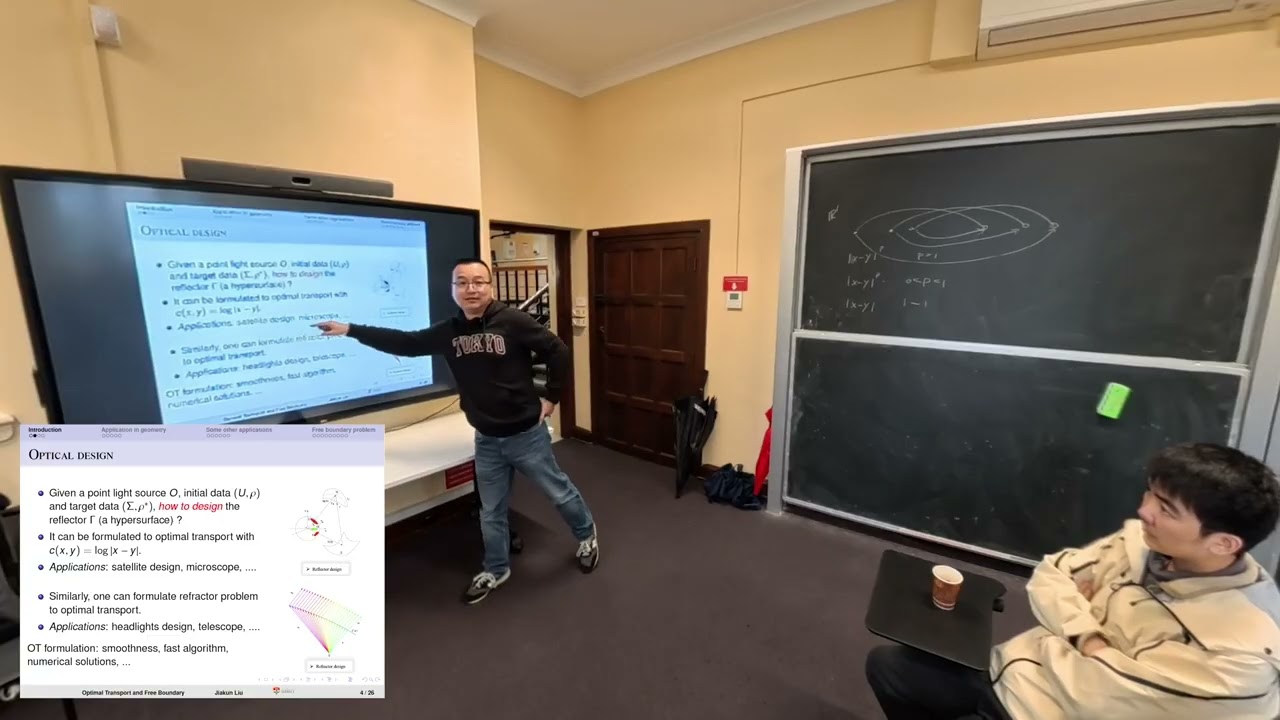
Introduction to Optimal Transport and Free Boundary Problems
Keywords
Summary
123 words
Critical Evaluation
Value of the Information & Strength of the Argument
The talk provides a valuable overview of optimal transport and its applications, with clear explanations and illustrative examples. The speaker’s argumentation is solid, building from basic definitions to advanced results. He effectively demonstrates the power of optimal transport in proving classical inequalities and its relevance in diverse fields. The presentation of recent research on free boundary regularity is particularly valuable, as it addresses open problems and highlights the speaker’s contributions. The logical flow is clear, and the speaker takes care to explain the intuition behind each step.
Scientific Rigor, Source Quality, Title Accuracy
The talk demonstrates scientific rigor, with references to classical results (e.g., Monge, Brenier, Caffarelli) and recent work. The speaker mentions specific theorems and authors, providing a clear lineage of ideas. The title accurately reflects the content, covering both an introduction and a focus on free boundary problems. The talk is well-structured and the mathematical arguments are presented carefully. The speaker does not overstate results and acknowledges limitations, such as the counterexamples for non-convex domains.
176 words
Title / Content Match
The title accurately reflects the content, covering both an introduction to optimal transport and a discussion of free boundary problems.
Quality & Reliability
8/10
The talk is given by a researcher at the University of Sydney, presenting established results and recent research. The content is mathematically rigorous, with references to classical theorems and recent papers. The presentation is clear and well-structured, though it is a lecture rather than a peer-reviewed publication.
Key Moments
Markers derived by PSI from the transcript: the creator did not define chapters.
- Introduction and overview of the talk's four parts.
- Definition of optimal transport: measure-preserving maps and cost functions.
- Example of discrete optimal transport with different cost functions, showing non-uniqueness for linear cost.
- Applications: reflector problem, refractor problem, and satellite design.
- Introduction of the Monge-Ampère equation for quadratic cost and its role in PDEs.
- Interior regularity results for the Monge-Ampère equation (Caffarelli).
- Global regularity results and the question of smoothness up to the boundary.
- Application to isoperimetric inequality: proof using optimal transport.
- Application to Brunn-Minkowski inequality and its relation to isoperimetric inequality.
- Application to image recognition: transport between hypercubes and comparison with conformal mapping.
- Application to cosmology: modeling universe evolution with optimal transport.
- Recent research on free boundary regularity in optimal transport, relaxing uniform convexity.
Cited Sources
- Optimal Transport: Old and New — Reference for optimal transport theory, including Monge's problem and Wasserstein distances.
- The Monge-Ampère equation — The PDE central to optimal transport with quadratic cost.
- Isoperimetric inequality — Classical geometric inequality proven via optimal transport in the talk.
- Brunn-Minkowski theorem — Geometric inequality also proven via optimal transport.
- Caffarelli's regularity theory — Foundational results on regularity of solutions to Monge-Ampère equations.
Concurring Sources
- Optimal Transport: Old and New — Standard reference for optimal transport theory.
- The Monge-Ampère equation — Provides background on the PDE.
Contribution & Novelties
The talk provides a clear and comprehensive introduction to optimal transport, highlighting its versatility across geometry, image processing, and cosmology. The speaker’s recent work on free boundary regularity relaxes the uniform convexity condition, extending classical results to a critical case. This is a significant contribution as it applies to convex envelopes, which are not uniformly convex.
Pour aller plus loin :
- Optimal transport — Overview of the field.
- Monge-Ampère equation — The PDE central to the talk.
- Wasserstein metric — Distance between probability measures arising from optimal transport.
- Caffarelli’s regularity theory — Key results on regularity.
- Free boundary problem — General concept relevant to the research discussed.
107 words
Radar Profile
The radar profile shows high scores in information quality, technical level, and reliability, with a slightly lower score in information quantity due to the talk's introductory nature. This indicates a technically rigorous and reliable presentation, though it may not cover all aspects of the field in depth.
💬 No comments were provided for analysis.