Physical measures, intermittent dynamics and random walks
Keywords
Summary
161 words
Critical Evaluation
Value of the Information & Strength of the Argument
The talk provides valuable insights into the behavior of empirical measures in systems without physical measures. The argumentation is rigorous, with clear statements of results and sketches of proofs. The progression from simple random walks to more complex star-shaped graphs and then to dynamical systems is logical and well-motivated. The results are novel and contribute to the understanding of non-ergodic behavior. The speaker engages with audience questions, clarifying technical points, which strengthens the presentation.
Scientific Rigor, Source Quality, Title Accuracy
The talk is scientifically rigorous, with precise mathematical statements and proofs. The speaker cites joint work with Douglas Coates and Amin Talebi, but no external sources are explicitly mentioned. The title accurately reflects the content, covering physical measures, intermittent dynamics, and random walks. The presentation is technical and assumes a high level of mathematical background, but the reasoning is sound. No comments were provided for analysis.
155 words
Title / Content Match
The title accurately reflects the content, which connects physical measures in dynamical systems to random walks and intermittent dynamics.
Quality & Reliability
8/10
The talk presents rigorous mathematical results, with proofs sketched and references to joint work. The speaker is a recognized expert. The presentation is technical and assumes advanced knowledge, but the reasoning is clear and the results appear novel.
Key Moments
Markers derived by PSI from the transcript: the creator did not define chapters.
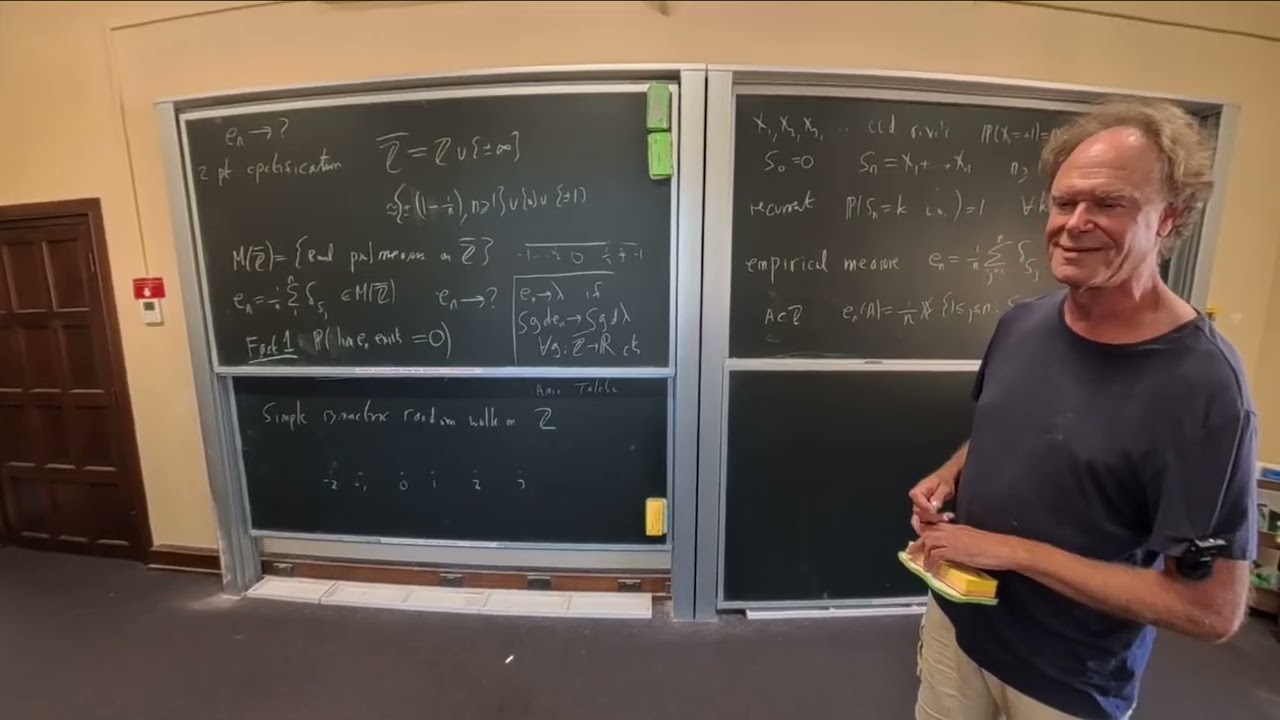
- Introduction and setup: simple symmetric random walk on integers, empirical measures.
- Definition of empirical measures and compactification of integers with two infinities.
- Statement of facts: almost sure non-convergence and characterization of subsequential limits.
- Convergence in distribution to arcsine law for simple symmetric random walk.
- Generalization to star-shaped graphs with multiple rays and generalized multi-ray arcsine law.
- Discussion of recurrent random walks with bounded jumps and extension of results.
- Transition to dynamical systems: Birkhoff ergodic theorem and physical measures.
- Definition of physical measures and connection to empirical measures.
- Examples of systems without physical measures and characterization of limits.
- Conclusion and summary of joint work.
Cited Sources
- Physical measures, intermittent dynamics and random walks (talk description) — The talk itself, which includes the abstract and joint work mention.
Concurring Sources
- Ergodic theory — Provides background on ergodic theorems and invariant measures.
- Arcsine distribution — The distribution that appears in the limit for simple symmetric random walk.
- Physical measure — Definition and relevance in dynamical systems.
Contribution & Novelties
The talk presents new results on the distributional limits of empirical measures for random walks on star-shaped graphs and for dynamical systems without physical measures. The characterization of subsequential limits as the entire simplex of convex combinations of delta measures at infinities is novel. The connection to intermittent dynamics provides a new perspective on physical measures.
Pour aller plus loin :
- Ergodic theory — Foundational concepts for the talk.
- Arcsine law — The distribution appearing in the simple random walk case.
- Physical measure — Definition and context in dynamical systems.
90 words
Radar Profile
The radar profile shows high scores in technical level and information quality, with slightly lower but still strong scores in quantity and reliability. This indicates a highly technical, rigorous talk with substantial content, though the presentation is dense and may not be accessible to a general audience.