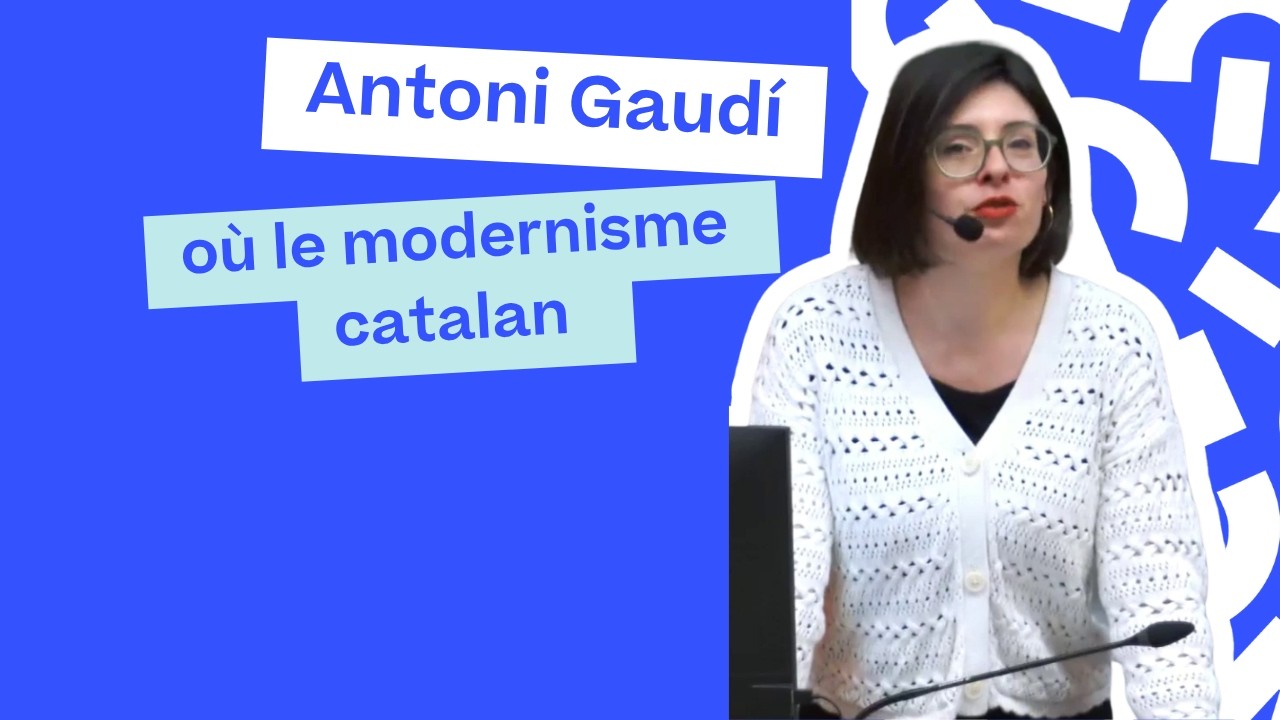
Antoni Gaudí, ou le modernisme catalan
Keywords
Summary
181 words
Critical Evaluation
The lecture by Pauline Retailleau offers a comprehensive and well-structured introduction to Antoni Gaudí’s work and the Catalan modernisme movement. As a trained art historian and licensed guide, Retailleau demonstrates a strong command of the subject, providing detailed historical context and referencing specific sources. The presentation is logically organized, moving chronologically through Gaudí’s career and highlighting key projects such as the Casa Vicens, Casa Calvet, and the Sagrada Família. One of the strengths of the lecture is its emphasis on the technical and artisanal aspects of Gaudí’s work, which is often overshadowed by his more flamboyant designs. Retailleau’s discussion of Gaudí’s background as a metalworker’s son and his use of local materials adds depth to the understanding of his architectural innovations. The lecture also effectively situates Gaudí within the broader Art Nouveau movement, explaining how Catalan modernisme was a regional variation that incorporated local cultural references. The speaker’s use of primary sources, such as Gaudí’s own writings, lends credibility to the presentation. However, the lecture is primarily descriptive rather than analytical, and it does not engage deeply with critical debates or controversies surrounding Gaudí’s work. Additionally, the presentation is aimed at a general audience, so it lacks the technical detail that might be expected in a more specialized academic setting. The title accurately reflects the content, and the lecture fulfills its promise to explore Gaudí’s contribution to Catalan modernisme. Overall, the lecture is informative and engaging, making it a valuable resource for those interested in art history and architecture.
249 words
Title / Content Match
The title accurately reflects the content, which focuses on Gaudí's work and the Catalan modernisme movement.
Quality & Reliability
8/10
The speaker is a trained art historian and licensed guide, providing detailed historical context and citing specific sources. The content is well-structured and based on established scholarship, though it is a lecture rather than peer-reviewed research.
Key Moments
Markers derived by PSI from the transcript: the creator did not define chapters.
- Introduction to the lecture and Gaudí's significance.
- Discussion of Gaudí's background and training.
- Overview of Catalan modernisme and its relation to Art Nouveau.
- Analysis of Casa Vicens, Gaudí's first private commission.
- Discussion of Casa Calvet and its recognition.
- Exploration of Gaudí's use of natural motifs and materials.
- Introduction to the Sagrada Família and its importance.
- Discussion of Gaudí's later works and legacy.
- Conclusion and summary of Gaudí's impact.
Cited Sources
- Nantes Université LinkedIn — Official university page for further information.
- Nantes Université YouTube Channel — Channel for more lectures and content.
Concurring Sources
- UNESCO World Heritage Centre — Official listing of Gaudí's works as World Heritage.
Contribution & Novelties
The lecture provides a comprehensive overview of Gaudí’s work, emphasizing the technical and artisanal aspects of his architecture. It offers a chronological exploration of his projects, from early commissions to the Sagrada Família, and situates his work within the broader context of Catalan modernisme. The speaker’s expertise as an art historian adds depth to the discussion, making it accessible to a general audience while still providing valuable insights.
Pour aller plus loin :
- Antoni Gaudí - Wikipedia — Comprehensive biography and list of works.
- Catalan modernism - Wikipedia — Overview of the movement.
- Sagrada Família - Wikipedia — Detailed information on Gaudí’s masterpiece.
103 words
Radar Profile
The radar profile shows high scores in information quantity, quality, and reliability, with a moderate score in technical level, reflecting the lecture's balance between accessibility and depth.