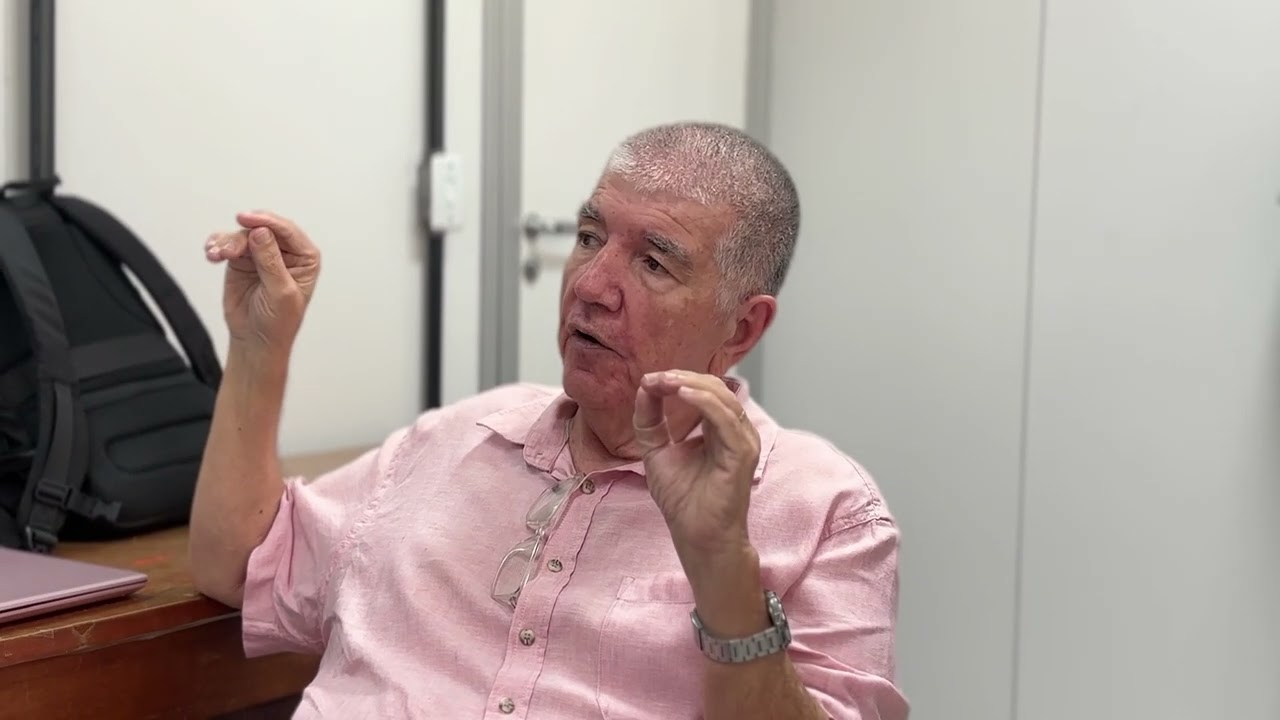
Entrevista com Prof. Raul Manhães sobre o Departamento de Nutrição (03/06/2026)
Keywords
Summary
166 words
Critical Evaluation
Value of the Information & Strength of the Argument
The value of the information lies in its firsthand perspective on the history of a significant academic department, offering personal anecdotes and insights not found in official records. The argumentation is based on personal experience and memory, which gives it authenticity but also limits its objectivity. The interviewee’s narrative is coherent and passionate, but it lacks systematic evidence or references to support specific claims, making it more of a testimonial than a rigorous historical analysis.
Scientific Rigor, Source Quality, Title Accuracy
The scientific rigor is moderate: the interview provides a personal account without citing specific documents or publications. The quality of sources is limited to the interviewee’s memory and mentions of individuals and events, without external verification. The title accurately describes the content, which is an interview about the department’s history. No comments were provided for analysis.
146 words
Title / Content Match
The title accurately reflects the content, which is an interview with Prof. Raul Manhães about the department's history.
Quality & Reliability
6/10
The interview is a first-person account of the history of the Nutrition Department at UFPE, based on personal memories and anecdotes. While the interviewee is a credible academic, the content is subjective and lacks verifiable citations or documentary evidence. The historical claims are plausible but not systematically cross-checked.
Key Moments
Markers derived by PSI from the transcript: the creator did not define chapters.
- Introduction and request for self-presentation.
- Prof. Manhães introduces himself, mentioning his birth, family ties to Josué de Castro, and his medical education.
- He describes the department when he arrived, mentioning key figures and the physical environment.
- He discusses the importance of the department for nutrition in Brazil and the lack of historical appreciation.
- He recounts his most memorable moment: his meeting with Dr. Nelson Chaves.
- He talks about his achievements as coordinator of the graduate program and his initiative to create a veterans' group.
- He expresses pride in his students and mentions several by name, including those abroad.
- He reflects on how he wishes to be remembered, quoting Ecclesiastes and emphasizing the importance of the department's history.
- He gives a message to future generations, urging them to cultivate history and culture, and to be citizens.
- He discusses the importance of understanding Brazil's history and mentions Josué de Castro's book 'Geografia da Fome'.
Cited Sources
- Josué de Castro — Mentioned as a relative and inspiration for studying medicine.
- Nelson Chaves — Founding figure of the Nutrition Department, mentioned as a mentor.
- Anaí de Teodósio — Researcher and mentor, mentioned as a key figure.
Concurring Sources
- Josué de Castro — His work on hunger and nutrition aligns with the department's mission.
Contribution & Novelties
The interview provides a unique personal testimony about the history of the Nutrition Department at UFPE, offering insights into its founding figures and evolution. It highlights the importance of preserving institutional memory and the role of mentorship in shaping scientific careers.
Pour aller plus loin :
- Josué de Castro — Key figure in Brazilian nutrition and author of ‘Geografia da Fome’.
- History of nutrition science — Provides context on the development of nutrition as a discipline.
- Federal University of Pernambuco — Official page for the university where the department is located.
91 words
Radar Profile
The radar profile shows moderate scores across all dimensions, with slightly higher in quantity of information and lower in technical level. This reflects an interview that is rich in personal anecdotes but not deeply technical or rigorously sourced.