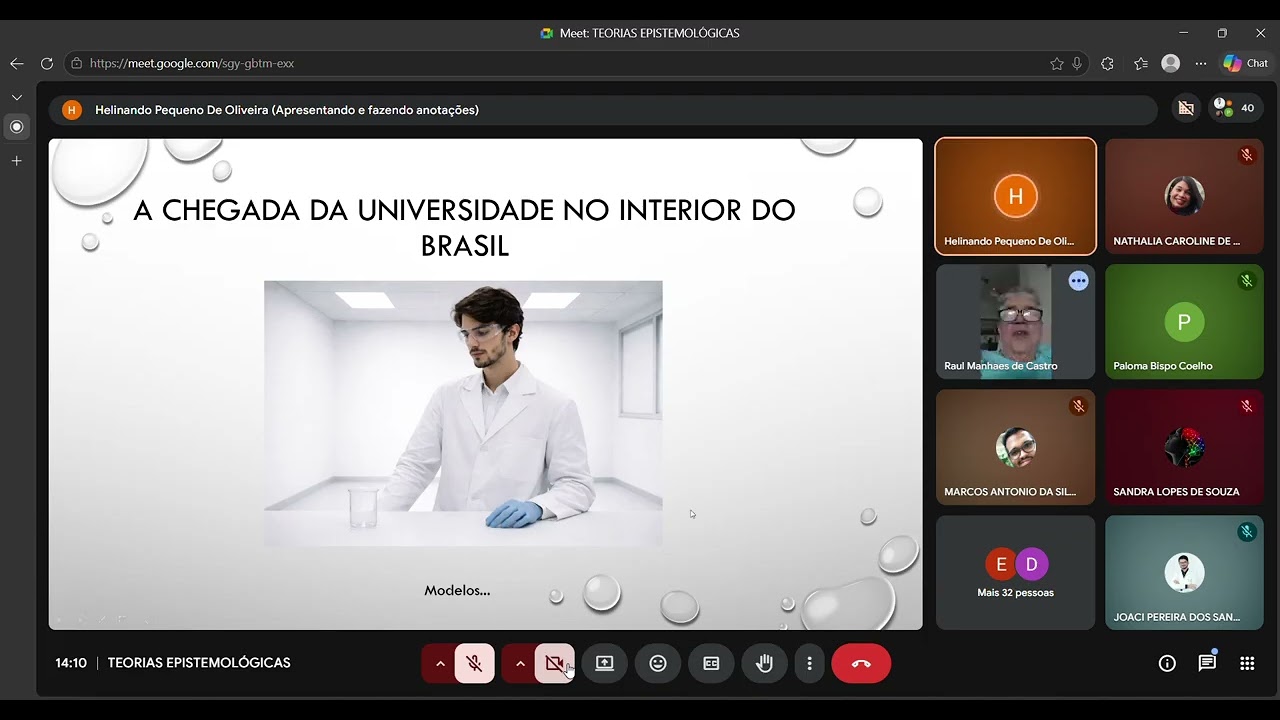
TEORIAS EPISTEMOLÓGICAS: Aula - Elementos sertanejos para pesquisa em nanotecnologia
Keywords
Summary
164 words
Critical Evaluation
Value of the Information & Strength of the Argument
The lecture provides valuable insights into the practical challenges and opportunities of conducting research in a resource-limited setting. The argumentation is based on the speaker’s personal journey, which lends authenticity but also limits generalizability. He effectively argues for the integration of research with teaching and extension, and for the adoption of a circular economy model. However, the scientific details are sparse, and the talk is more motivational and reflective than technically detailed. The use of local materials is presented as a creative solution, but quantitative data on their performance is not provided.
Scientific Rigor, Source Quality, Title Accuracy
The scientific rigor is moderate: the speaker is a credible researcher, but the talk is largely anecdotal. He mentions the use of AI for generating images and references his own work, but no specific publications are cited. The title accurately reflects the content, which is a lecture on epistemological theories applied to nanotechnology research in the sertão. The talk does not delve into formal epistemological frameworks but rather uses the term loosely to discuss the philosophy of research in a regional context. The description provides some background on the speaker’s credentials, which supports his authority.
202 words
Title / Content Match
The title accurately reflects the content: the lecture discusses epistemological theories in the context of using 'sertanejo' (backcountry) elements for nanotechnology research.
Quality & Reliability
7/10
The lecture is given by a professor with a solid academic background (PhD in Physics, postdoc at MIT, CNPq productivity fellow) and presents a personal narrative of building a research institute in a semi-arid region. The information is based on his direct experience and is plausible, but it is largely anecdotal and lacks detailed scientific data or references. The scientific content is presented in a general manner, focusing on the application of nanotechnology to local resources (tilapia skin, goat leather) within a circular economy framework.
Key Moments
Markers derived by PSI from the transcript: the creator did not define chapters.
- Introduction and speaker presentation by the moderator.
- Speaker begins, thanks for invitation, and mentions the topic.
- Discussion of the 'colonizing' model of university expansion and his arrival at UNIVASF.
- Description of the initial lack of infrastructure, only a beaker and a destiller.
- Mention of the expansion of federal universities in Brazil, with maps showing growth.
- Discussion on the challenges of keeping researchers in the interior and the need for a specific profile.
- Introduction of the circular economy concept and its application in the lab.
- Examples of using tilapia skin and goat leather for nanotechnology applications.
- Description of the current research institute with 14 laboratories.
- Reflections on the role of research as a means to extension and serving the community.
Cited Sources
- UNIVASF - Universidade Federal do Vale do São Francisco — The speaker is a professor at this university and discusses its establishment and development.
- Academia Pernambucana de Ciências — The speaker is vice-president of this academy, mentioned in the introduction.
- CNPq - Conselho Nacional de Desenvolvimento Científico e Tecnológico — The speaker is a CNPq productivity fellow, mentioned in the introduction.
Concurring Sources
- UNIVASF - Universidade Federal do Vale do São Francisco — The speaker's institution, confirming its existence and role in the region.
Contribution & Novelties
The lecture offers a unique perspective on conducting nanotechnology research in a semi-arid region, emphasizing the use of local biological resources (tilapia skin, goat leather) within a circular economy framework. It highlights the importance of integrating research with teaching and extension, and the challenges of building a research culture from scratch. The speaker’s personal narrative provides practical insights for researchers considering positions in emerging universities.
Pour aller plus loin :
- Circular economy — Relevant to the core concept of the lecture.
- Triboelectric nanogenerator — Directly related to the use of goat leather for energy generation.
- Tilapia skin as a biological template — Example of using tilapia skin in biomedical applications.
110 words
Radar Profile
The radar profile shows a balanced but moderate performance across all dimensions, with slightly higher scores in information quality and reliability, reflecting the speaker's credibility and the practical relevance of the content, but lower scores in technical depth and information quantity due to the anecdotal nature of the talk.
💬 No comments were provided for analysis.