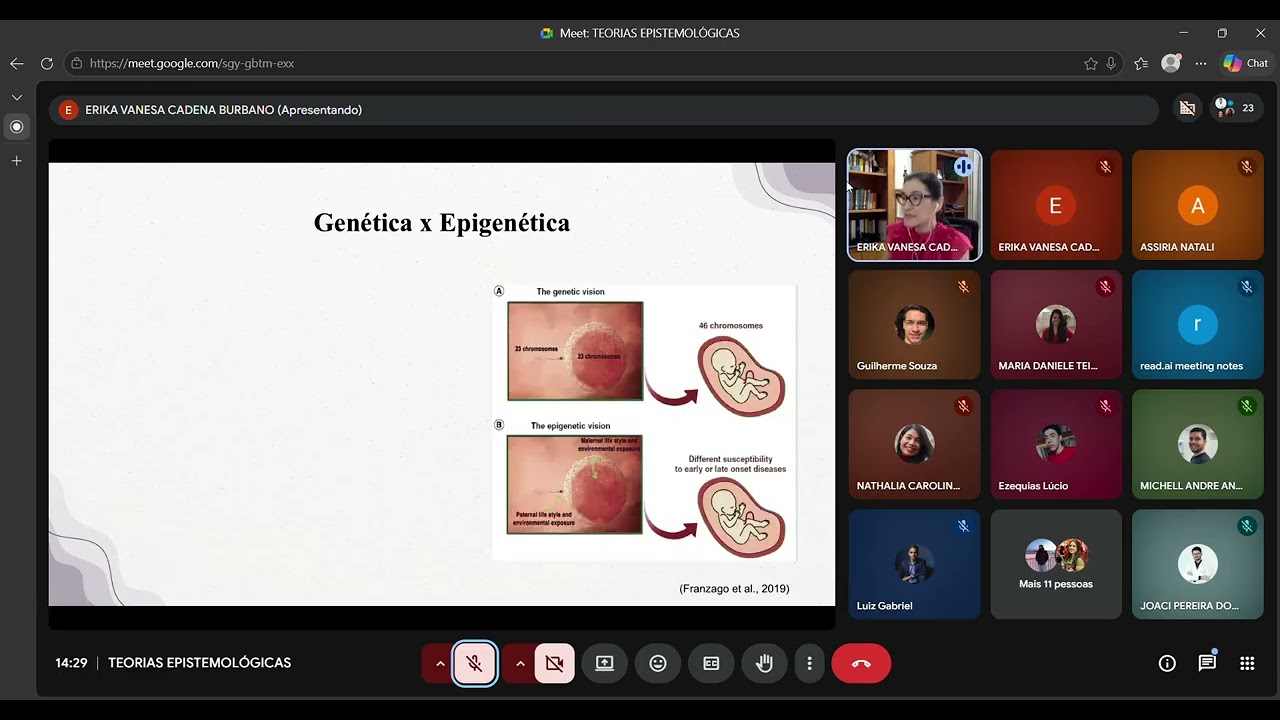
TEORIAS EPISTEMOLÓGICAS: aula - O DOHAD e os avanços epistemológicos nas ciências da saúde
Keywords
Summary
160 words
Critical Evaluation
Value of the Information & Strength of the Argument
The lecture provides a valuable synthesis of the DOHaD framework, integrating historical models and contemporary hypotheses. It effectively argues that health and disease are shaped by complex interactions between genes and environment, particularly during sensitive developmental periods. The argumentation is coherent, building from basic models to more nuanced epigenetic and programming concepts. However, it relies heavily on established theories without critically examining alternative viewpoints or potential limitations, and some causal links are presented as more definitive than current evidence might warrant.
Scientific Rigor, Source Quality, Title Accuracy
The lecture demonstrates scientific rigor by grounding its content in well-known studies and hypotheses, such as those by Neel, Barker, and Lucas. However, it does not provide explicit citations or references during the talk, which limits the ability to verify specific claims. The title accurately reflects the content, focusing on epistemological theories and DOHaD. The presentation is clear and structured, but the lack of critical discussion and potential oversimplification of complex topics slightly reduce its scientific depth.
173 words
Title / Content Match
The title accurately reflects the content, which focuses on epistemological theories and DOHaD in health sciences.
Quality & Reliability
7/10
The lecture provides a comprehensive overview of DOHaD, tracing its historical development and key hypotheses. It is based on established scientific literature and presented by a qualified professional. However, it lacks explicit citations and critical evaluation of the evidence, and some concepts are simplified.
Key Moments
Markers derived by PSI from the transcript: the creator did not define chapters.
- Introduction to DOHaD and its historical origins
- Explanation of unicausal and multicausal models of disease
- Discussion of social determinants of health model
- Introduction to genetics and epigenetics in reproduction
- Explanation of phenotypic plasticity and critical developmental periods
- Overview of the thrifty genotype hypothesis and Dutch Hunger Winter study
- Barker's fetal origins hypothesis and its implications
- Thrifty phenotype hypothesis and mechanisms of metabolic programming
- Lucas's concept of fetal programming and critical windows
- Expansion of DOHaD to include preconception and later life stages
Cited Sources
- DOHaD concept — Central theme of the lecture
- Thrifty genotype hypothesis (Neel, 1962) — Discussed in the context of diabetes susceptibility
- Dutch Hunger Winter study (1976) — Cited as evidence for early-life nutritional effects on obesity
- Barker's fetal origins hypothesis (1993) — Discussed in relation to cardiovascular disease and low birth weight
- Thrifty phenotype hypothesis (Hales & Barker, 2001) — Explained as a mechanism linking fetal malnutrition to metabolic syndrome
- Fetal programming (Lucas, 1994) — Introduced as a concept for long-term effects of early-life stimuli
Concurring Sources
- DOHaD Society — International society dedicated to DOHaD research
- WHO: Social determinants of health — Relevant to the social determinants model discussed
Dissenting Sources
- Critiques of the thrifty phenotype hypothesis — Some researchers argue that the hypothesis oversimplifies the complex interactions and may not fully explain the observed associations.
Contribution & Novelties
The lecture offers a comprehensive and accessible synthesis of the DOHaD framework, tracing its evolution from early models of disease causation to contemporary epigenetic perspectives. It uniquely integrates multiple hypotheses and highlights the importance of critical developmental periods, providing a holistic view of health and disease across the lifespan. The emphasis on preconception health and the role of epigenetic marks in gametes adds a modern dimension to the discussion.
Pour aller plus loin :
- Developmental Origins of Health and Disease (DOHaD) — Overview of the concept and its history.
- Epigenetics — Mechanisms of epigenetic regulation.
- Thrifty phenotype hypothesis — Detailed explanation of the hypothesis.
- Barker hypothesis — Fetal origins of adult disease.
- Dutch famine of 1944–1945 — Historical context and studies.
121 words
Radar Profile
The radar profile shows high scores in information quantity and quality, reflecting the comprehensive coverage of DOHaD. The technical level is moderate, indicating accessibility to a broad audience. Overall reliability is good, but the lack of explicit citations and critical analysis slightly lowers the score.
💬 No comments were provided for analysis.