TEORIAS EPISTEMOLÓGICAS: Aula - Josué de Castro DOHAD e o Pensamento Complexo
Keywords
Summary
186 words
Critical Evaluation
Value of the Information & Strength of the Argument
The lecture provides valuable insights by connecting historical and contemporary scientific frameworks. It effectively argues that Josué de Castro’s work anticipated key concepts in DOHaD and complex thinking, offering a coherent narrative that bridges disciplines. The argumentation is solid, supported by references to Castro’s books and DOHaD literature, though it relies heavily on the speaker’s interpretation and may oversimplify some complex scientific concepts.
Scientific Rigor, Source Quality, Title Accuracy
The scientific rigor is moderate; the lecture is based on established literature and the speaker’s expertise, but it lacks direct citations or peer-reviewed sources. The title accurately reflects the content, and the presentation is well-structured. No comments were provided for analysis.
119 words
Title / Content Match
The title accurately reflects the content, which covers epistemological theories, Josué de Castro, DOHaD, and complex thinking.
Quality & Reliability
7/10
The lecture is presented by a nutritionist with academic credentials, and it draws on established scientific concepts (DOHaD, phenotypic plasticity) and historical works. However, it is a single presentation without peer review or external verification, and some claims are simplified.
Key Moments
Markers derived by PSI from the transcript: the creator did not define chapters.
- Introduction of the speaker and topic.
- Biographical overview of Josué de Castro.
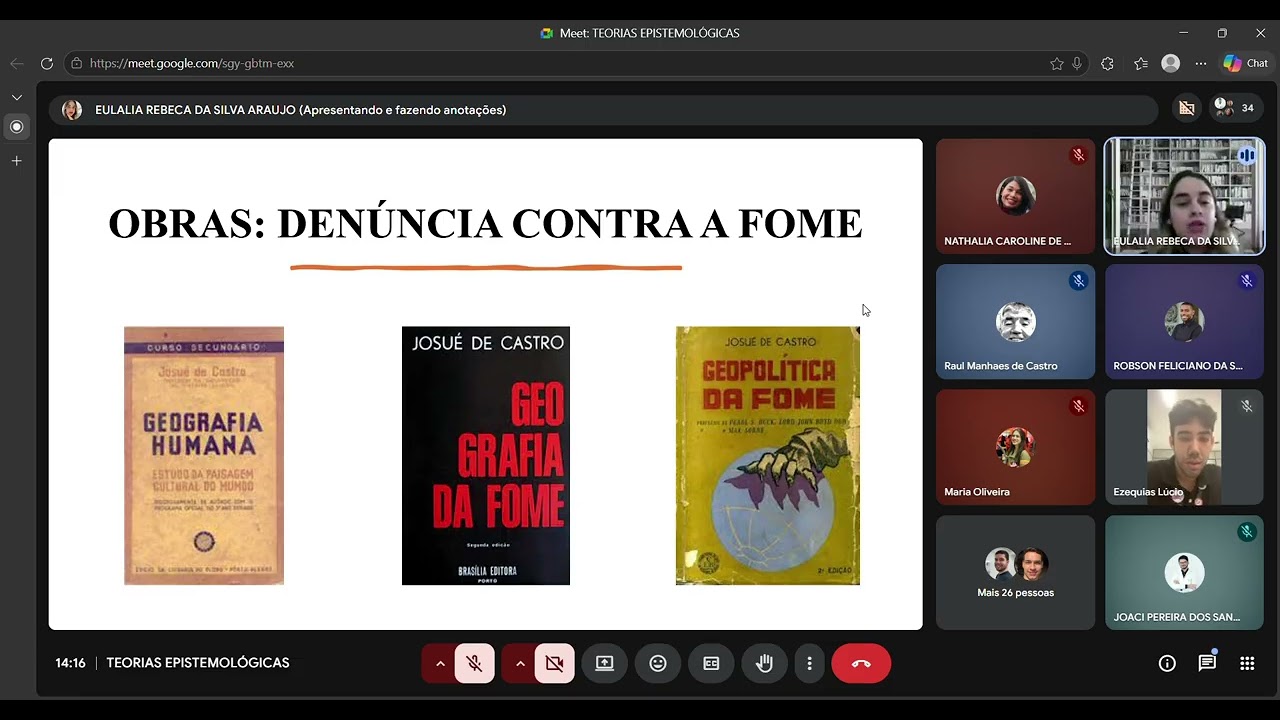
- Discussion of Castro's major works and his transdisciplinary approach.
- Explanation of the map of hunger in Brazil and dietary proposals.
- Connection between Castro's ideas and phenotypic plasticity.
- Introduction to DOHaD and its relevance to Castro's work.
- Discussion of Edgar Morin's complex thinking and transdisciplinarity.
- Synthesis of how Castro, DOHaD, and complex thinking interrelate.
- Conclusion and final remarks on social responsibility.
Cited Sources
- Geografia da Fome — Mentioned as a major work by Josué de Castro.
- Geopolítica da Fome — Mentioned as a major work by Josué de Castro.
- A Alimentação Brasileira à Luz da Geografia Humana — Mentioned as an early work by Josué de Castro.
- O Livro Negro da Fome — Mentioned as a work by Josué de Castro.
- Os Sete Saberes Necessários à Educação do Futuro — Mentioned as a key book by Edgar Morin.
Concurring Sources
- DOHaD concept — Supports the lecture's explanation of DOHaD.
- Phenotypic plasticity — Supports the lecture's discussion of phenotypic plasticity.
Dissenting Sources
- No discordant sources found — No sources contradicting the lecture's content were identified.
Contribution & Novelties
The lecture offers a novel synthesis by linking Josué de Castro’s historical work to the modern DOHaD framework and Edgar Morin’s complex thinking, highlighting the transdisciplinary nature of these approaches. It provides a unique perspective on how early 20th-century ideas anticipated contemporary scientific paradigms.
Pour aller plus loin :
- Developmental Origins of Health and Disease (DOHaD) — Provides an overview of the DOHaD concept.
- Phenotypic plasticity — Explains the concept of phenotypic plasticity, central to DOHaD.
- Edgar Morin — Biography and overview of Morin’s work on complex thinking.
- Josué de Castro — Biography and contributions of Josué de Castro.
99 words
Radar Profile
The radar profile shows high scores in quantity of information and fiabilité, with moderate scores in quality and technical level, indicating a well-informed but not highly technical presentation.