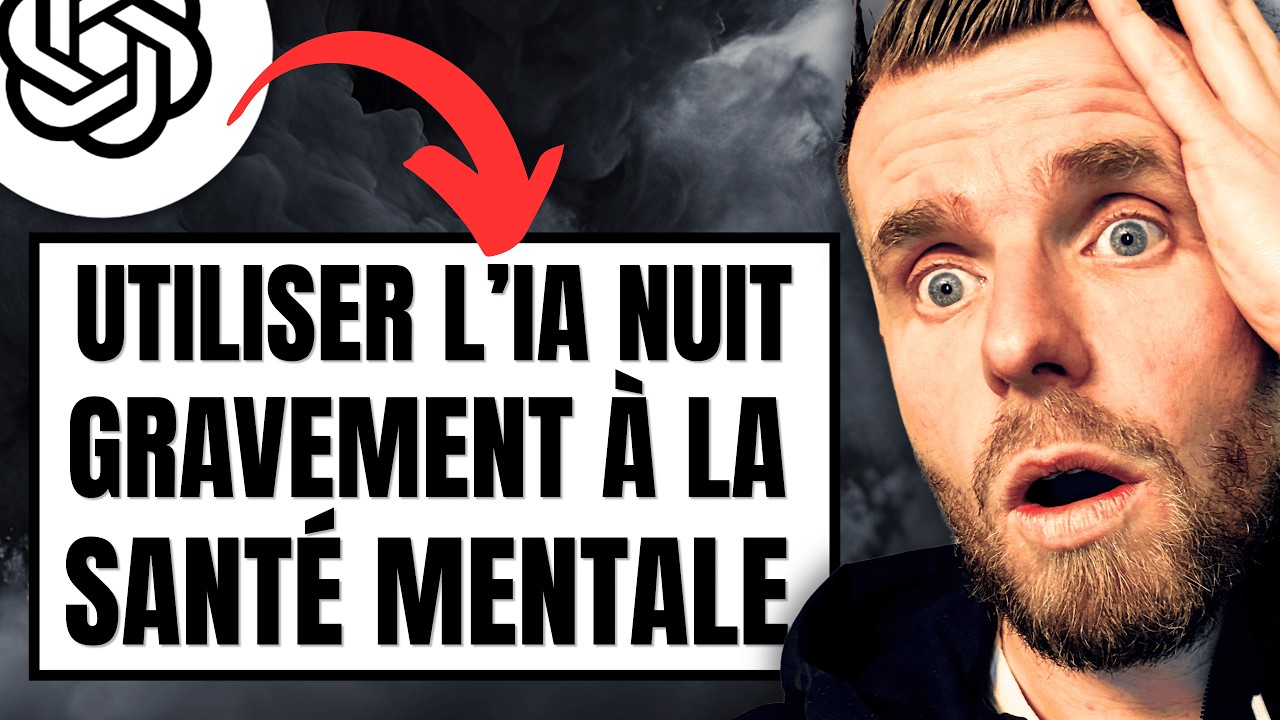
Comment l'IA bousille la Santé Mentale (et personne en parle)
Keywords
Summary
147 words
Critical Evaluation
The video presents a personal and emotional testimony about the potential negative effects of AI on mental health. The creator, Ludo Salenne, shares his own struggles with motivation, confidence, and isolation, attributing them to his extensive use of AI tools like ChatGPT. While the video is honest and relatable, it lacks scientific rigor. The arguments are based on anecdotal evidence and personal observations rather than empirical research. The creator references psychological concepts like the three pillars of motivation (autonomy, competence, connection) and the IKEA effect, but does not provide citations or studies to support his claims. The video is more of an opinion piece than a scientific analysis. The creator’s extreme usage of AI (7-10 hours per day) may not be representative of the general population, and his conclusions may be biased by his personal experience. However, the video raises important questions about the societal impact of AI on mental health, which are worth exploring further. The lack of sources and the subjective nature of the content limit its reliability as a scientific resource. The title accurately reflects the content, and the video is well-structured with clear chapters. Overall, the video is thought-provoking but should be viewed as a personal perspective rather than evidence-based information.
205 words
Title / Content Match
The title accurately reflects the content, which focuses on the negative impacts of AI on mental health.
Quality & Reliability
5/10
The video is a personal testimony and opinion piece, not a scientific study. It lacks citations to peer-reviewed research, relying on anecdotal evidence and general psychological concepts. The creator's extreme usage of AI (7-10 hours/day) may bias his perspective. However, the video is honest and raises important concerns, but the lack of verifiable sources and the subjective nature limit its reliability.
Chapters
- Le problème qu'on a pas vu venir
- L'IA flingue la motivation
- Le déclic pour moi
- La perte de contrôle
- ChatGPT et l'IA isolent...
- Ça, on le fait tous (et ça craint)
- Ce que je ne dis pas !
- Le syndrome ChatGPT
- L'IA détruit la confiance en soi
- ChatGPT rend accroc
- Le piège invisible
- Le burn-out IA
- On est tous touchés... !
- ChatGPT bousille les sentiments
- Comment on se fait avoir ?
- Le défi pour l'avenir
Cited Sources
- Comment ChatGPT vous bousille le cerveau — Previous video by the same creator, referenced as the basis for this one, discussing impacts of AI on the brain.
Concurring Sources
- Comment ChatGPT vous bousille le cerveau — The creator's previous video, which this one builds upon, presenting similar concerns about AI's impact on cognitive abilities.
Contribution & Novelties
The video provides a personal and honest account of the potential negative effects of AI on mental health, particularly focusing on motivation, confidence, and social connection. It highlights the ‘IKEA effect’ and the ‘ChatGPT syndrome’ as mechanisms through which AI may reduce satisfaction and increase avoidance of effort. While not scientifically rigorous, it offers a unique perspective from a heavy AI user.
Pour aller plus loin :
- Self-Determination Theory — Relevant to the three pillars of motivation (autonomy, competence, relatedness) discussed in the video.
- IKEA effect — The cognitive bias mentioned in the video, explaining why we value things we put effort into.
- Digital addiction — Related to the potential addictive nature of AI and its impact on mental health.
120 words
Radar Profile
The radar profile shows moderate scores in information quantity and technical level, but lower scores in information quality and reliability, reflecting the subjective and non-scientific nature of the content.
💬 Très positif. Sur les 30 commentaires analysés, la grande majorité exprime un soutien chaleureux et une gratitude pour la transparence et l'honnêteté de l'auteur, partageant souvent des expériences personnelles similaires.