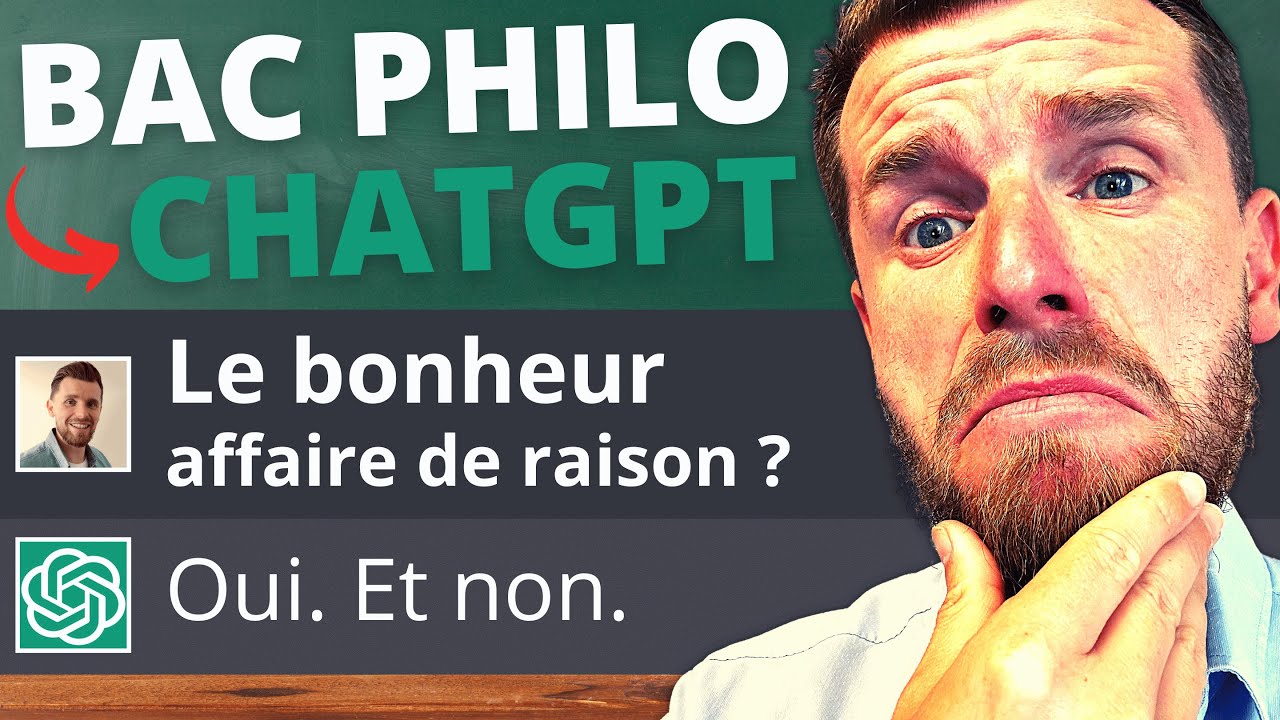
Je passe le BAC PHILO avec CHATGPT (on vise le 20 !)
Keywords
Summary
227 words
Critical Evaluation
Value of the Information & Strength of the Argument
The video provides a practical, step-by-step demonstration of using ChatGPT for exam preparation, which is valuable for students and educators interested in AI applications. The argumentation is based on the creator’s personal experience and the AI’s responses, which are presented as illustrative examples rather than definitive advice. The creator does not critically evaluate the quality of the AI-generated content, but he does note that the AI’s suggestions are conventional and that a real exam would require more depth. The video’s value lies in its demonstration of prompt engineering and the potential of AI as a study aid, but it lacks a rigorous analysis of the philosophical concepts or the reliability of the AI’s output.
Scientific Rigor, Source Quality, Title Accuracy
The video does not cite any scientific or academic sources. The only sources mentioned are the creator’s own videos and a link to his training course, which are promotional. The title accurately describes the content, which is a casual experiment rather than a rigorous study. The video’s scientific rigor is low, as it relies on anecdotal evidence and AI-generated content without verification. The creator does not provide any critical analysis of the AI’s suggestions or the philosophical validity of the generated essays. The video is best viewed as an entertainment or tutorial piece, not as a reliable educational resource.
228 words
Title / Content Match
The title accurately reflects the content: the creator takes the 2023 French philosophy baccalaureate exam with the help of ChatGPT.
Quality & Reliability
5/10
The video is a practical demonstration of using ChatGPT for philosophy exam preparation. It is not a scientific source, and the information is anecdotal and based on personal experience. The AI-generated content is not verified for accuracy, and the video includes promotional elements for the creator's own training course.
Chapters
Cited Sources
- Formation ChatGPT (Ludo Salenne) — Promotional link to the creator's own training course on ChatGPT.
- Playlist des cours ChatGPT — Playlist of the creator's ChatGPT tutorials.
- Comment bien utiliser ChatGPT — Creator's video on how to use ChatGPT effectively.
- Comment créer le prompt parfait - Tuto Complet — Creator's tutorial on creating the perfect prompt.
- La meilleure méthode pour ChatGPT — Creator's video on the best method for using ChatGPT.
- La connexion Web Browsing sur ChatGPT — Creator's video on web browsing with ChatGPT.
- Les plugins ChatGPT — Creator's video on ChatGPT plugins.
Concurring Sources
- ChatGPT in Education — Discusses the use of ChatGPT in educational settings, including its benefits and challenges.
Dissenting Sources
- AI-generated content and academic integrity — The video's approach of using AI to generate essays could be seen as conflicting with academic integrity principles, which emphasize original work and proper citation.
Contribution & Novelties
The video offers a practical, real-time demonstration of using ChatGPT for a specific academic task (philosophy exam preparation). It showcases prompt engineering techniques, such as assigning a role and asking for structured plans and quotes. The novelty lies in the application of AI to a traditional educational exercise, highlighting both its potential and limitations. However, the video does not provide a deep analysis of the philosophical content or the AI’s reliability.
Pour aller plus loin :
- ChatGPT — Overview of the AI model and its capabilities.
- Prompt engineering — Techniques for designing effective prompts for AI models.
- Philosophy of education — Theoretical foundations for using AI in education.
108 words
Radar Profile
The radar profile shows moderate scores across all dimensions, with slightly higher scores for information quantity and technical level, reflecting the video's practical tutorial nature. The low reliability score indicates that the content is not scientifically rigorous and should be viewed as an informal demonstration.
💬 No comments were provided for analysis.