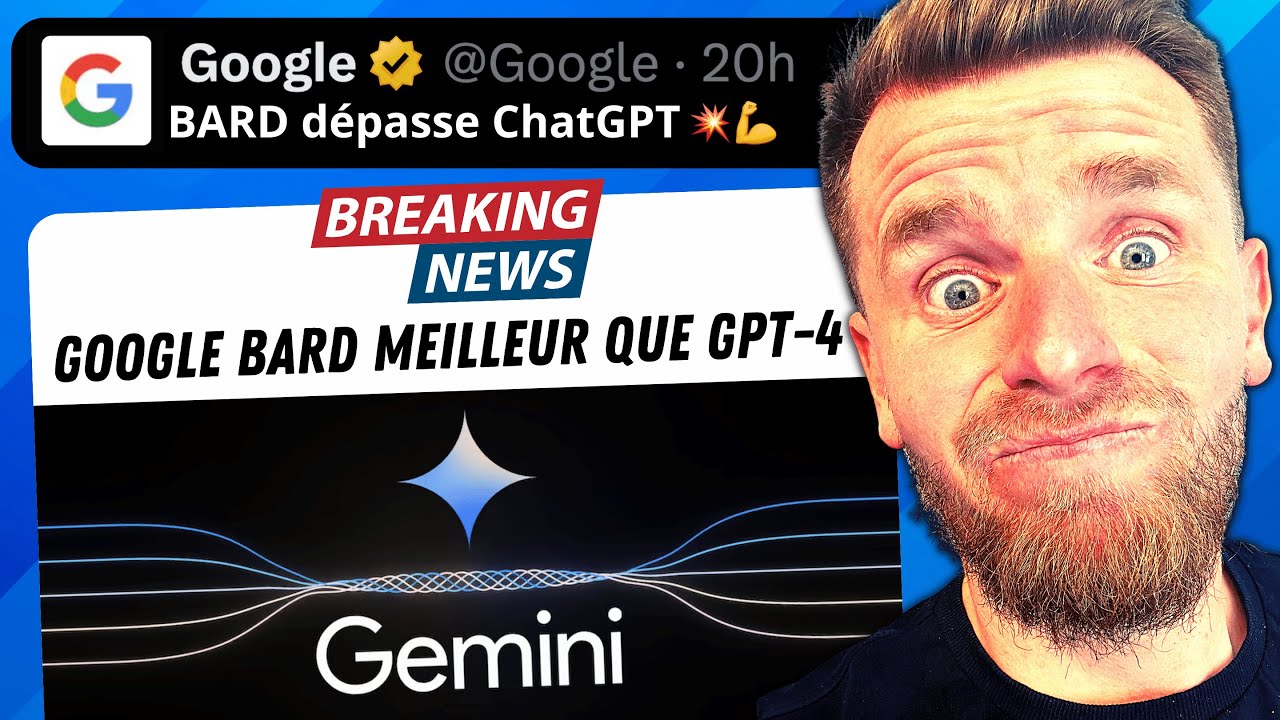
Google BARD meilleur que ChatGPT-4 ? (Pas en France en tout cas…!)
Keywords
Summary
148 words
Critical Evaluation
Value of the Information & Strength of the Argument
The video provides a hands-on, practical comparison of two AI tools, which is valuable for users considering their options. The argumentation is based on direct observations and demonstrations, making it relatable and easy to follow. However, the methodology is not systematic: tests are not repeated, and the sample size is small. The creator acknowledges the limitations and provides transparent reasoning, but the conclusions are subjective and may not generalize. The inclusion of the LMSYS leaderboard adds some external validation, but the interpretation is simplified.
Scientific Rigor, Source Quality, Title Accuracy
The video cites the LMSYS Chatbot Arena leaderboard and Google’s official blog about Gemini, which are relevant and credible sources. However, the analysis of these sources is superficial, and the creator does not delve into the methodology behind the leaderboard. The title accurately reflects the content, and the video stays on topic. The creator’s own tests are not scientifically rigorous, but they are presented as anecdotal evidence, which is appropriate for a YouTube video. The promotional segments are clearly marked and do not undermine the core content.
186 words
Title / Content Match
The title accurately reflects the content: a comparison between Google Bard and ChatGPT-4, with a focus on the French context. The video delivers on this promise.
Quality & Reliability
6/10
The video is a hands-on comparative test of Google Bard and ChatGPT-4, based on personal experience and practical demonstrations. It includes references to the LMSYS Chatbot Arena leaderboard and Google's official blog, but the methodology is informal and not scientifically rigorous. The creator acknowledges limitations and provides transparent observations, but the conclusions are subjective and based on a limited set of tests.
Chapters
Cited Sources
- Google Bard chat — The tool being tested.
- LMSYS Chatbot Arena Leaderboard — Referenced to show the ranking of AI models.
- Google Blog: Discover Gemini — Official Google announcement about Gemini.
- Word Counter (Ouest-France) — Used to count words in generated texts.
Concurring Sources
- LMSYS Chatbot Arena Leaderboard — The ranking source cited in the video.
External References
Contribution & Novelties
The video offers a practical, user-oriented comparison of Google Bard and ChatGPT-4, highlighting real-world performance differences, especially in the French context. It demonstrates that while Bard may be faster and sometimes more structured, it suffers from significant hallucination issues in web content analysis, making it less reliable for professional use. The creator’s tests with advanced prompts reveal ChatGPT-4’s superior ability to follow complex instructions.
Pour aller plus loin :
- LMSYS Chatbot Arena — The leaderboard referenced in the video for model rankings.
- Gemini (language model) — Wikipedia article on Google’s Gemini model.
- Hallucination (artificial intelligence) — Concept of AI generating false information, central to the video’s findings.
107 words
Radar Profile
The radar profile shows a balanced but moderate performance across all dimensions. The video scores highest on quantity of information, reflecting the multiple tests conducted, but lower on technical depth and reliability, indicating a lack of rigorous methodology and reliance on anecdotal evidence.