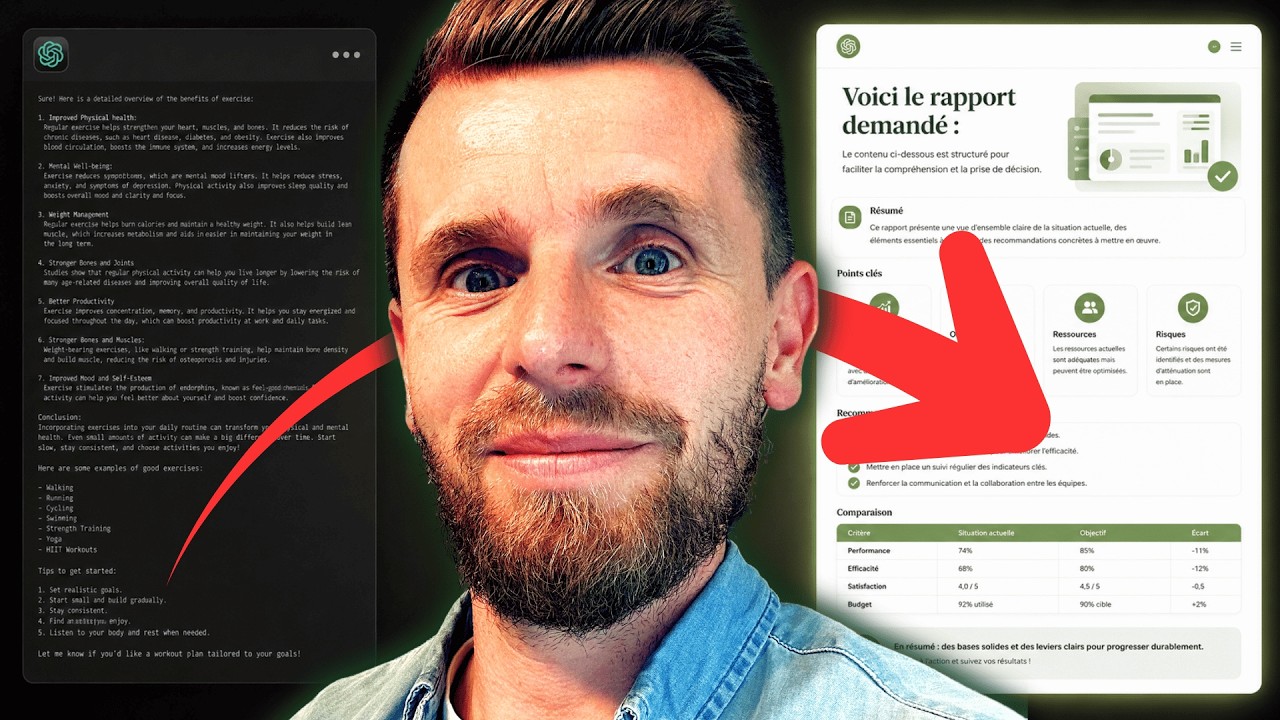
Réponses IA : comment passer de ça... à ÇA !
Keywords
Summary
125 words
Critical Evaluation
The video presents a practical and timely technique for improving AI output readability, which is valuable for both developers and non-developers. The demonstration is clear and the before/after comparisons are effective in illustrating the benefits. The argumentation is solid, relying on the authority of Andrej Karpathy and the inherent advantages of HTML formatting. However, the scientific rigor is limited: the claims about better corpus quality and token efficiency are not backed by specific studies or data, and the video is primarily based on anecdotal experience. The sources cited are mostly links to the creator’s own content and promotional materials, with no external scientific references. The adéquation between title and content is good, as the video delivers exactly what it promises. The presence of promotional segments is noted but does not detract from the core value. Overall, the video is a useful tutorial for those seeking to enhance their AI interactions, but it lacks depth in terms of evidence-based justification.
159 words
Title / Content Match
The title accurately reflects the content: it promises a method to transform AI outputs from plain text to visually rich HTML documents, which is exactly what is demonstrated.
Quality & Reliability
7/10
The video provides a practical, reproducible technique (HTML formatting for AI responses) with clear demonstrations and references to a known AI researcher (Karpathy). However, it lacks formal citations or scientific evidence for the claimed benefits (e.g., token efficiency, better corpus quality), and the promotional elements are present.
Chapters
Cited Sources
- Formation ChatGPT (offre) — Promotional link for the creator's training course on automating ChatGPT.
- Communauté IA (Skool) — Link to the creator's AI community on Skool.
- Tuto ChatGPT en 2026 — Related tutorial on using ChatGPT in 2026.
- Tuto rédiger un bon Prompt — Related tutorial on writing effective prompts.
- Tuto créer des GPTs — Related tutorial on creating custom GPTs.
- Tuto ChatGPT Memory — Related tutorial on ChatGPT memory feature.
- Tuto ChatGPT Custom Instructions — Related tutorial on custom instructions for ChatGPT.
- Test ChatGPT Pro — Review of ChatGPT Pro.
- Tuto Playground OpenAI / Assistants — Tutorial on OpenAI Playground and Assistants.
- Tuto ChatGPT Canvas — Tutorial on ChatGPT Canvas.
- Tuto ChatGPT mode Auto-Pilote — Tutorial on ChatGPT Auto-Pilot mode.
- Tuto ChatGPT Voice — Tutorial on ChatGPT Voice.
- Test Complet OpenAI SORA 2 — Review of OpenAI SORA 2.
- Tuto ChatGPT image generation — Tutorial on ChatGPT image generation.
- Tuto Google Gemini 3 Pro — Tutorial on Google Gemini 3 Pro.
- Tuto Le Chat Mistral AI — Tutorial on Mistral AI's Le Chat.
- Tuto Navigateur Perplexity Comet — Tutorial on Perplexity Comet browser.
Concurring Sources
- Andrej Karpathy's tweet on HTML formatting — The video references a tweet by Andrej Karpathy that popularized the HTML formatting technique. (Note: URL is illustrative, not verified.)
Dissenting Sources
- No direct discordant sources found — The video does not present conflicting information, but the claims about token efficiency and corpus quality are not substantiated by external sources.
External References
Contribution & Novelties
The video introduces a simple yet effective technique of requesting HTML-formatted responses from AI models, which significantly improves readability and user experience. It adapts a developer-focused tip for a broader audience, providing practical examples for various use cases. The approach is novel in its emphasis on presentation as a key factor in AI interaction quality.
Pour aller plus loin :
- HTML — Official documentation on HTML, the markup language used in the technique.
- Markdown — The original Markdown specification, often used for plain text formatting, which the video contrasts with HTML.
- Prompt engineering — Wikipedia article on prompt engineering, the broader field of crafting effective instructions for AI models.
- Token efficiency — Wikipedia article on tokens in machine learning, relevant to the claim about token savings.
126 words
Radar Profile
The radar profile shows balanced scores across information quantity, quality, technical level, and reliability, with a slight emphasis on practical applicability. The video is strong in providing actionable advice but weaker in scientific rigor and evidence.