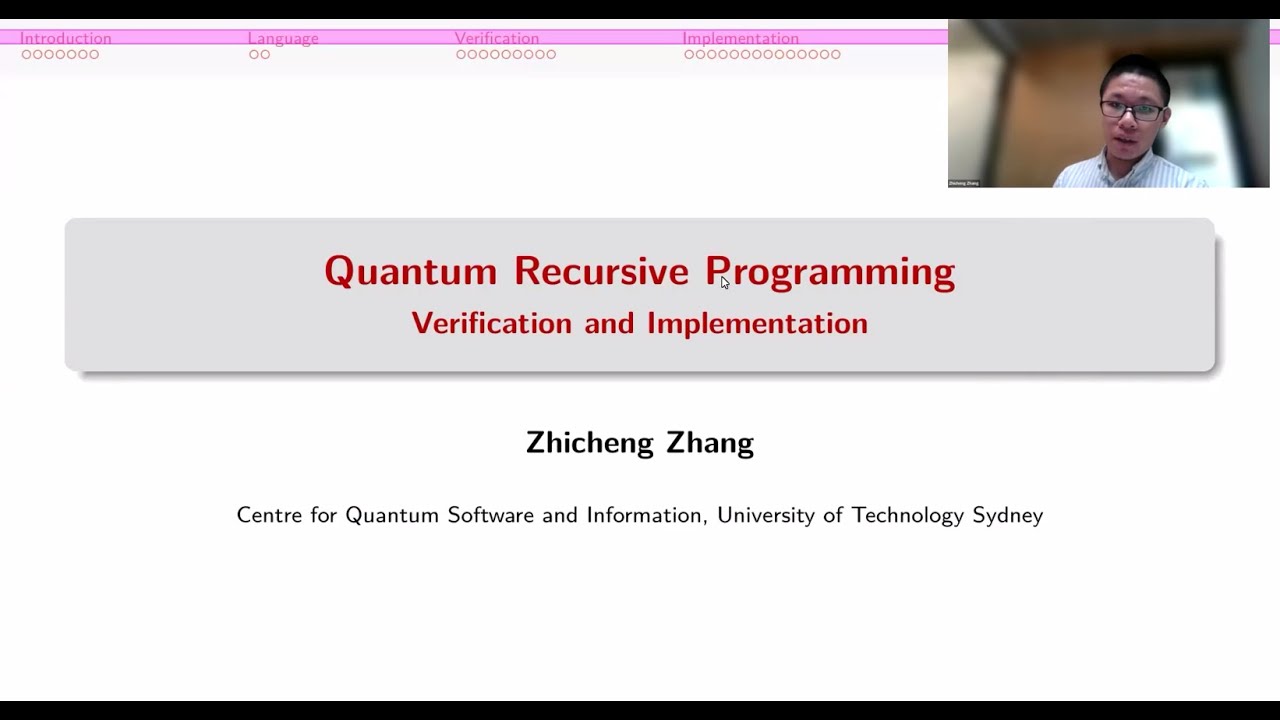
QuCS Lecture67: Prof. Zhicheng Zhang (UTS), Quantum Recursive Programming: Verification and Implementation
Keywords
Summary
95 words
Critical Evaluation
Value of the Information & Strength of the Argument
The lecture provides a solid introduction to formal verification of quantum recursive programs. The speaker clearly motivates the need for high-level quantum programming and verification. He presents a rigorous proof system with soundness and completeness results, which is a strong contribution. The argumentation is well-structured, building from syntax to semantics to proof rules, and includes a concrete example. The implementation part is briefly mentioned but not detailed in the transcript, so the value is mainly in the verification aspect.
Scientific Rigor, Source Quality, Title Accuracy
The lecture is based on two joint works, presumably peer-reviewed, but no specific references are given in the transcript. The speaker is a PhD student at the Centre for Quantum Software and Information, which adds credibility. The title accurately describes the content. The description provides links to the lecture series and organizers, but no direct sources. The rigor is high due to formal methods and theorems, but the lack of explicit citations in the transcript limits the ability to verify sources.
175 words
Title / Content Match
The title accurately reflects the content: the lecture covers both verification (Hoare logic, proof rules) and implementation (synchronization of quantum branches) of quantum recursive programming.
Quality & Reliability
8/10
The lecture is given by a PhD student at a recognized research center, presenting formal methods (Hoare logic, proof systems) for quantum recursive programs. The content is rigorous, based on two joint works, and includes soundness and completeness theorems. The presentation is clear and well-structured, with a motivating example (QFT) and a detailed example (multi-controlled U gate).
Key Moments
Markers derived by PSI from the transcript: the creator did not define chapters.
- Introduction: why quantum programming, goals, and overview of the talk.
- Motivating example: quantum Fourier transform as a recursive program.
- Introduction to RQ C++ syntax and BNF grammar.
- Operational semantics: configurations and transition rules.
- Verification: Hoare triples and correctness specification.
- Proof rules: unitary, sequential, quantum if, block, instantiation, and recursion.
- Soundness and relative completeness theorems.
- Example: proving correctness of multi-controlled U gate.
- Implementation part: synchronization of quantum branches.
Cited Sources
- Lecture series signup — Signup for future weekly Zoom lectures.
- QuCS website — Lecture website for the Quantum Computer Systems series.
- Discord Channel — Discord channel for discussions.
- Zhiding Liang's homepage — Organizer's personal page.
- Hanrui Wang's homepage — Organizer's personal page.
Concurring Sources
- Quantum Hoare logic — The verification method is based on Hoare logic extended to quantum programs.
- Quantum control flow — The concept of quantum if statements and superposition of executions is central.
Contribution & Novelties
The lecture presents a formal framework for quantum recursive programming, including a new language RQ C++ and a proof system for verification. The main novelty is the combination of recursion and quantum control flow, and the soundness and relative completeness results. This provides a foundation for reasoning about quantum algorithms expressed recursively.
Pour aller plus loin :
- Quantum Hoare logic — Relevant to the verification approach.
- Quantum control flow — Discusses the concept of superposition of program executions.
- Quantum Fourier transform — The motivating example.
85 words
Radar Profile
The radar profile shows high scores in information quantity, quality, technical level, and reliability, indicating a dense and rigorous lecture. The low view count and likes suggest a niche audience, but the content is substantial for researchers in quantum programming.