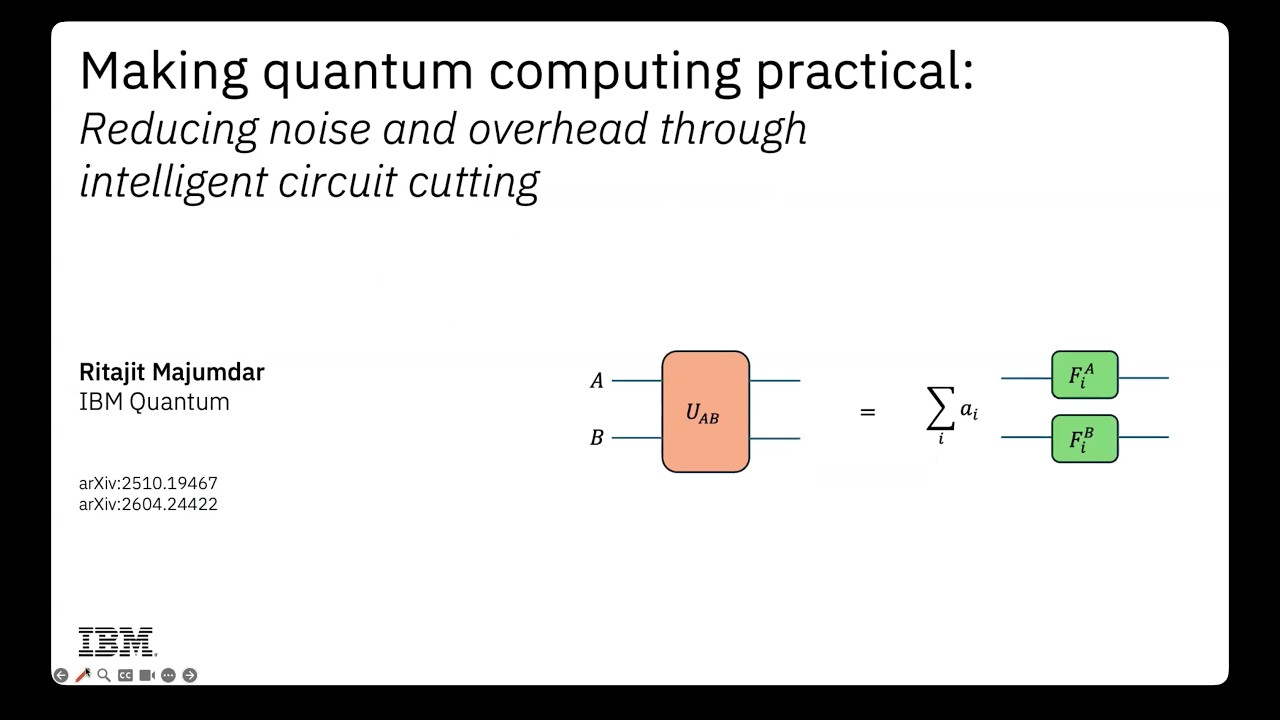
QuCS Lecture77: Dr. Ritajit Majumdar(IBM India), Making quantum computing practical
Keywords
Summary
182 words
Critical Evaluation
Value of the Information & Strength of the Argument
The talk provides valuable insights into circuit cutting, a niche but important topic in quantum computing. The speaker clearly explains the concepts, motivations, and challenges, using concrete examples and demonstrations. The argumentation is solid, backed by practical results from IBM Quantum systems. The presentation is well-structured, progressing from basic definitions to advanced techniques, and effectively communicates the potential and limitations of circuit cutting.
Scientific Rigor, Source Quality, Title Accuracy
The speaker references his own research and IBM Quantum’s work, but does not cite specific papers or external sources during the talk. The description provides links to the QuCS lecture series and Discord, but no direct references. The title accurately reflects the content. The talk is scientifically rigorous, with clear explanations and demonstrations, though it lacks formal citations.
136 words
Title / Content Match
The title accurately reflects the content, focusing on making quantum computing practical through circuit cutting techniques.
Quality & Reliability
8/10
The speaker is a research scientist at IBM Quantum with a PhD, and the talk is based on peer-reviewed research and practical demonstrations. The content is technically accurate and well-structured, though it is a presentation rather than a formal publication.
Key Moments
Markers derived by PSI from the transcript: the creator did not define chapters.
- Introduction and speaker background
- Explanation of classical circuit cutting
- Introduction to quantum circuit cutting and its challenges
- Gate cutting decomposition and quasi-probability
- Wire cutting and its generalized form
- Motivation for circuit cutting as error mitigation
- Example of 109-qubit Ising model and VQE
- Exponential overhead of circuit cutting
- Operator back-propagation technique
- Cut location selection and conclusion
Cited Sources
- QuCS Lecture Series — The lecture series website where the talk is hosted.
- QuCS Discord Channel — Community discussion channel for the lecture series.
Concurring Sources
- QuCS Lecture Series — The lecture series provides a platform for quantum computing talks.
External References
Contribution & Novelties
The talk presents two novel techniques to reduce the overhead of circuit cutting: operator back-propagation to reduce circuit depth, and improved cut location selection. These methods aim to make circuit cutting more practical for error mitigation on noisy quantum devices. The speaker demonstrates their effectiveness on real IBM Quantum hardware, showing significant improvements in accuracy.
Pour aller plus loin :
- Quantum circuit cutting — Overview of circuit cutting techniques.
- Error mitigation for quantum computing — General error mitigation methods.
- IBM Quantum — IBM’s quantum computing platform and resources.
88 words
Radar Profile
The radar profile shows high scores in all dimensions, indicating a well-rounded and reliable presentation. The talk is technically deep, provides substantial information, and is based on credible research, making it a valuable resource for quantum computing enthusiasts.
💬 No comments were provided for analysis.